
Introduction
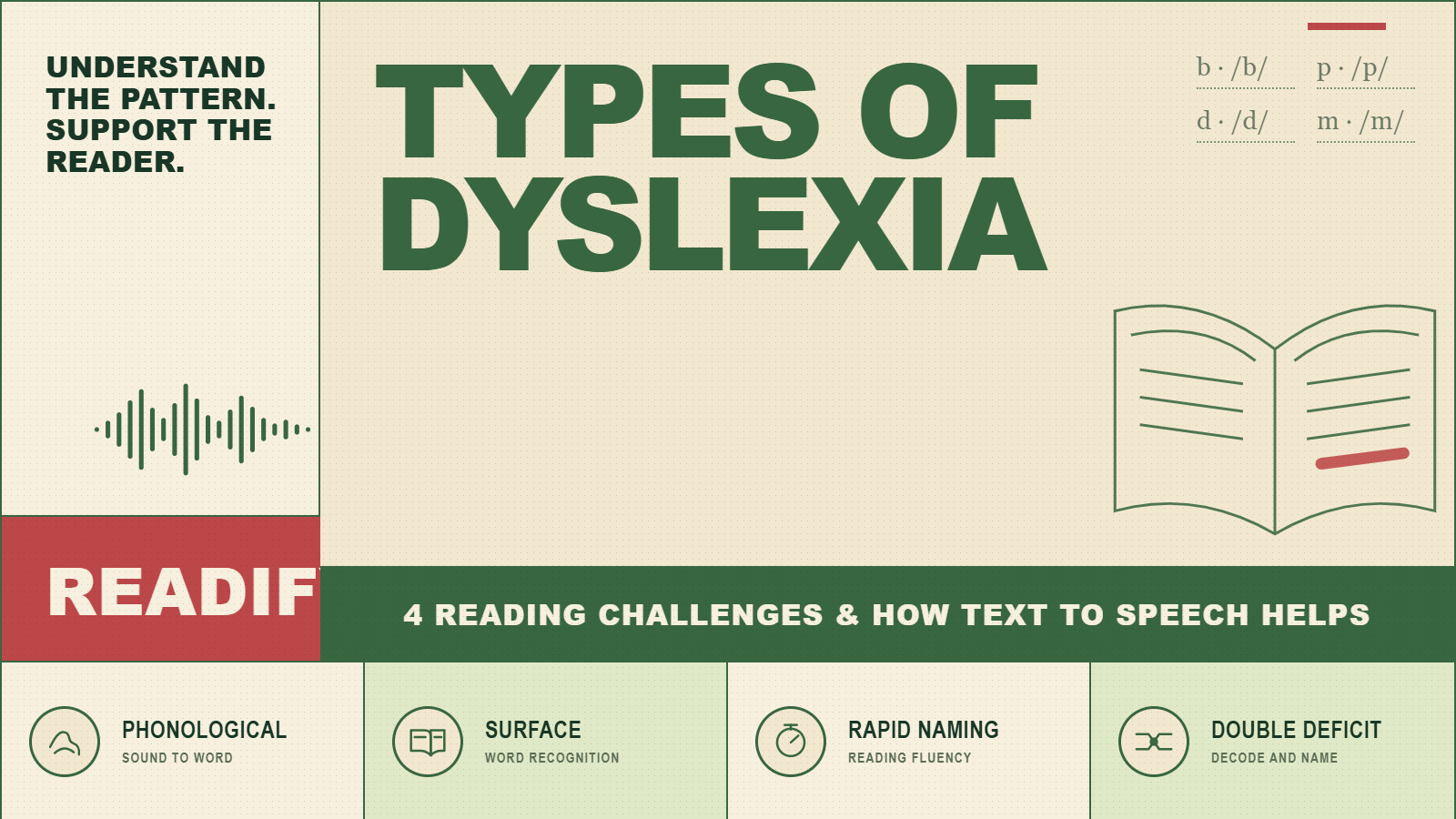
Reading with dyslexia could be considered as accomplishing two jobs at the same time: decoding the words and understanding the message of the text. Before a challenging word becomes understandable, the sentence itself could have gone unnoticed. One person with dyslexia gets stuck decoding the words he or she does not know; another decodes perfectly but too slowly; the third understands an entire chapter while reading it aloud but cannot comprehend it when the same text is written. And that is why people talk about different kinds of dyslexia. Dyslexia is a convenient term, but there are no separate types of dyslexia, no four boxes. Types of dyslexia illustrate the patterns of difficulty reading rather than separate diagnoses. Text-to-speech does not diagnose, teach, or replace support from professionals, but it can help to find alternative ways of accessing the information provided in written form. Listening to spoken audio, synchronizing highlighting, controlling the pace of reading, and replaying the content will allow a dyslexic reader to pay less attention to every single word and concentrate on the meaning of the text. If it sounds helpful, you can try Readify text-to-speech on a document or a book of your choice.

What is dyslexia?
Dyslexia is a learning difference that commonly affects accurate or fluent word recognition, decoding, and spelling. It can look different from one reader to another, so this article describes four recurring reading challenges rather than using the word “type” as a formal diagnosis.
Are there really different types of dyslexia?
Terminology such as phonological dyslexia and surface dyslexia helps to discuss the reading profiles of dyslexics, but it is not four separate diagnoses that are identified in online checklists. Dyslexia assessment involves a detailed analysis of history, language background, decoding, spelling, fluency, phonological processing, rapid naming and comprehension. Types of dyslexia in this guide are a map of reading problems, not a diagnosis.
Four typical reading problems in case of dyslexia
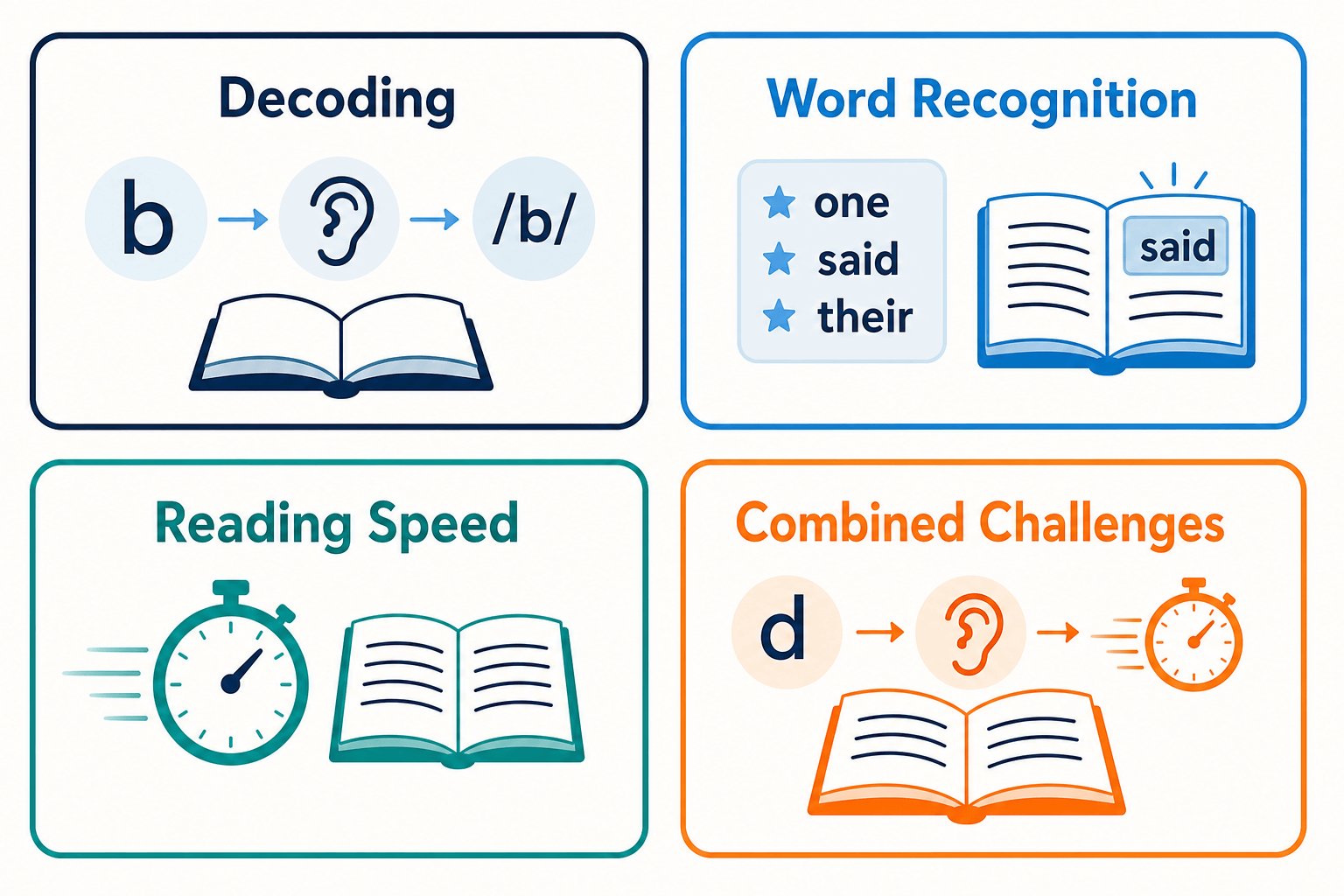
1. Phonological dyslexia: problems with decoding of unfamiliar words
Phonological decoding is the ability to associate written graphemes with the corresponding sounds in a word. If decoding is difficult, the reader recognizes a known word but finds it hard to pronounce an unknown one. Imagine a student who understands a science topic in a discussion but keeps getting stuck on words such as photosynthesis and chlorophyll. Decoding every word makes comprehending the explanation impossible. Names and academic terms could also serve as a blockage. Text-to-speech will pronounce these words in the context of the text. It does not teach the patterns of spelling but will help to avoid getting stuck on one particular word and missing the whole idea. Listening to the word and seeing it at the same time will help the reader to perceive its phonetic and graphical structure. TTS gives an instant spoken model of the word, reduces the load of decoding, keeps the flow of the sentence, and allows to replay any word or passage. To use the feature on a long PDF or ebook, use Readify text-to-speech reader.
2. Surface dyslexia: slow recognition of familiar words
The term surface dyslexia is used for the difficulty with fast recognition of words, especially the words that are pronounced according to irregular spelling patterns. English is full of these words: said, one, enough, though, and yacht. The reader with such a pattern of reading will sound out every word. Reading will be accurate but slow, making the rhythm and meaning of the sentence hard to track. Listening to audio and synchronization with the highlighting will help the reader to follow which sentence is read now, recognize the visual form of the word, and keep on track of the page. There is no need to race. Calm and slow reading is usually more effective than a dramatic narration.
3. Rapid naming difficulties: slow reading
Some dyslexics can decode words but take much more time to pronounce names, letters, numbers, or words. This problem is typically described as rapid automatized naming and in everyday terms means slow reading, broken rhythm, frequent pauses, and fatigue on long passages. Using text-to-speech will create an external rhythm. The reader will be able to listen to the audio, follow the highlighting, and pause only when necessary to think about the information, not the mechanics of reading. The most helpful reading speed is the one at which a reader is able to explain the listened information: it could be slower for a textbook and faster for a well-known article.
4. Double deficit pattern: decoding and rapid naming difficulties combined
Double deficit hypothesis describes readers with difficulties in both phonological processing and rapid naming. In everyday terms, it means that unfamiliar words are hard to decode and familiar information is not retrieved fast enough. In this case, text-to-speech can help with multiple obstacles: listening to the audio will help to decode words, highlighting to follow the flow, speed controls to adapt to the material and replay to revisit the confusing part. None of these options replace the reading instruction but they can make school, workplace and personal reading easier during the instruction.
How text-to-speech can help with reading with dyslexia
Dyslexia is a learning difference that commonly affects accurate or fluent word recognition, decoding, and spelling. It can look different from one reader to another, so this article describes four recurring reading challenges rather than using the word “type” as a formal diagnosis.
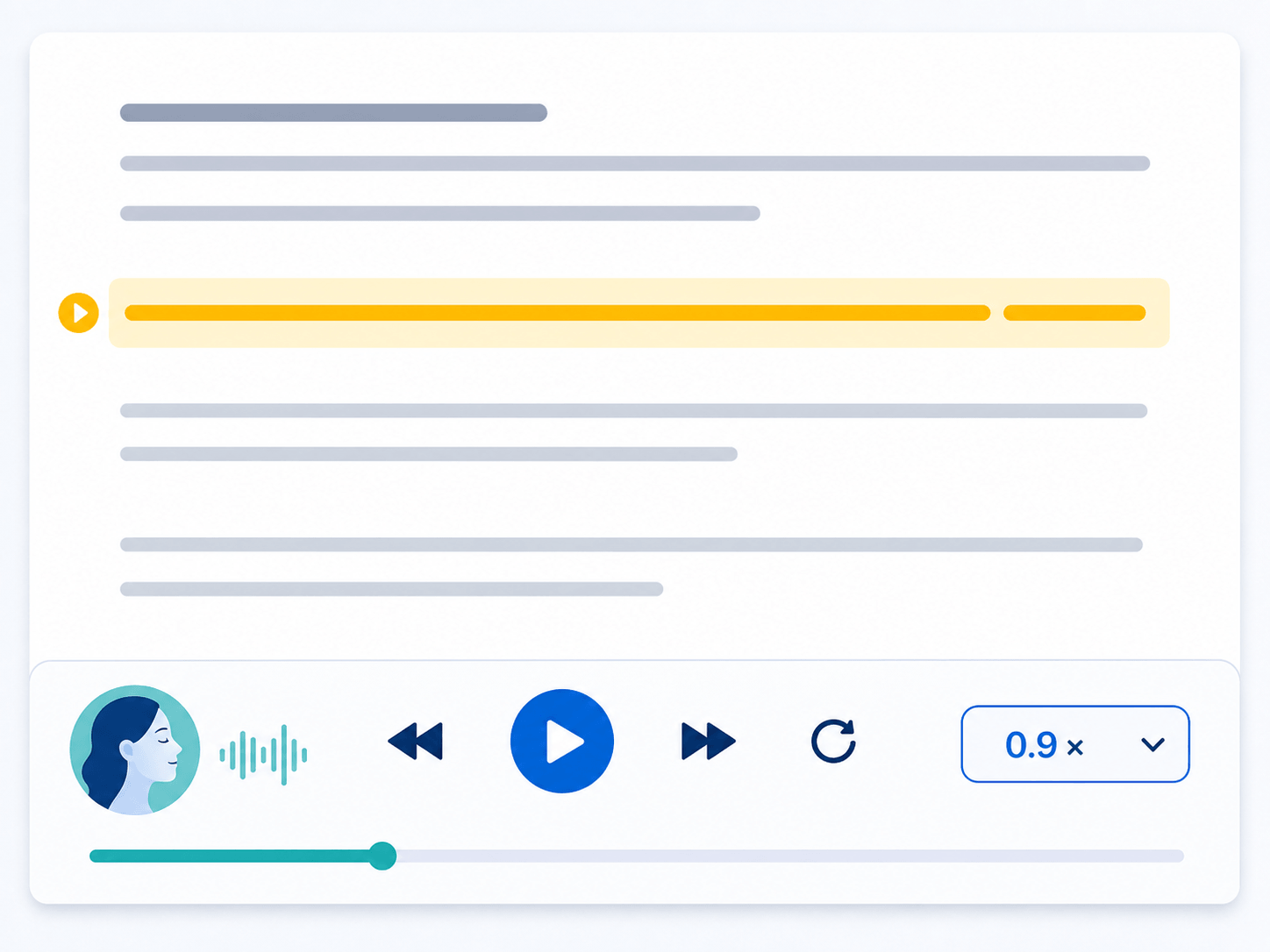
With text-to-speech, the reader can replay the sentence, adjust the speed and listen to the audio while taking notes. This kind of audio reading for dyslexics could make a long assignment, report, or book more manageable.
How to use text-to-speech for dyslexia reading support
The simplest way to use the technology is to start with one actual reading task, not with trying out all the options.
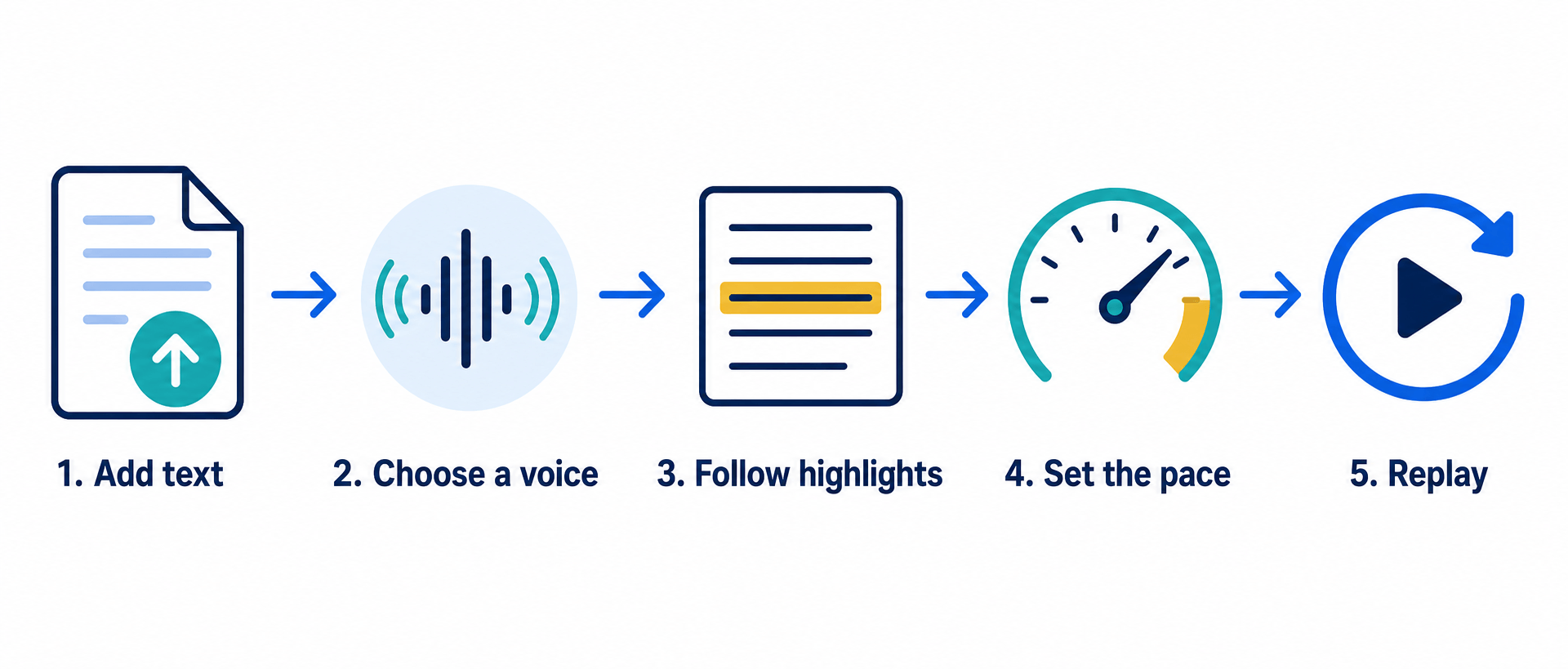
1. Adding the Text or PDF You Need to Read
Add the actual material the reader needs to understand, such as a homework chapter, article, email, instruction sheet, or PDF. General tools such as Foxit PDF Reader and Adobe Acrobat Reader can open, view, annotate, and organize PDF files. However, a PDF reader is not automatically a complete dyslexia reading tool. For audio-assisted reading, also check for spoken narration, synchronized highlighting, adjustable speed, and sentence replay.
2. Choosing clarity over personality
Choose the voice with a natural rhythm and no exaggerations. Test a paragraph before committing to the whole text.
3. Keeping the text visible
Wherever possible, follow the highlighted text instead of listening to TTS as background audio. Seeing and hearing at the same time will help the reader to stay on track. If the screen seems to be overwhelming, read smaller chunks of text.
4. Adjusting the reading pace
Start with the pace of speaking. After a paragraph, try to summarize the main idea. If you can do it, the pace is fine. Lower the speed or raise it only when the comprehension is still clear.
5. Replaying and taking notes selectively
Replay the exact sentence that causes difficulties and take notes about the idea in your own words. This way, the passive listening turns into active reading.
6. Synchronized Speech Highlighting vs. Grammar Highlighting
Synchronized speech highlighting should not be confused with grammatical color coding. Tools such as Edward’s English Syntax Highlighter and the IWL Parts of Speech Highlighter identify nouns, verbs, adjectives, and other grammatical categories. This can help with language analysis, but it is different from TTS highlighting, where the current word or sentence moves in sync with the spoken audio.
Why Readify may be suitable for your reading routine
Readify allows you to turn a long written text into a combination of listening and reading. The software supports common document and ebook formats and lets the reader follow the highlighting, control the playback and return to the previous place. For a reader with dyslexia-related problems, a school PDF, a workplace document, an article or a personal book could become easier to read. The text can be split into smaller reading sessions, and the difficult parts can be replayed. Readify is not an assessment service, and it should not substitute for instruction, accommodation agreed with a school or workplace, or the advice of specialists. It is a reading tool - one more option for a dyslexic reader. When you decide to try the reading routine with your own material, use Readify text-to-speech.
Tips for parents, students, and adult readers
Parents can start with short sessions and let the child choose the voice and the speed of reading. Students can listen once to catch the main idea, follow the text for the second time, and replay only what is necessary for taking notes. Adults can start with postponed emails, policies, reports, forms, and training manuals. Use dyslexia reading support with Readify when decoding prevents access to the content.
Conclusion
Dyslexia looks differently for every reader. The four types of dyslexia mentioned above - phonological, surface, rapid naming and double-deficit patterns - explain why two people may experience the same page differently. Text-to-speech can reduce the decoding demands, provide constant rhythm, help to follow the text and reduce the frustration of repetition. It does not substitute the instruction and professional support, but can make everyday reading tasks more manageable. Start with one document, choose a comfortable voice and try out a short reading session. You can make reading easier with Readify without changing the ideas you want to explore - only the route to them.
FAQs
What are the types of dyslexia?
Phonological dyslexia, surface dyslexia, rapid naming difficulties and double-deficit pattern are the main types of dyslexia.
Can text-to-speech help people with dyslexia?
Yes, it can help some people by reading words aloud, reducing decoding efforts, providing visual tracking and making the reading of long texts easier.
Does TTS substitute dyslexia instruction?
No. Text-to-speech will provide access to the text; it does not substitute structured literacy instruction, assessment and professional support from teachers and specialists.
Is Readify helpful for adults with dyslexia?
Adults can use Readify to read aloud reports, articles, training materials, emails, forms, ebooks, and any other lengthy content. Adjustable speed, replay and visual highlighting could make reading more organized for a dyslexic reader.
Should the reader follow the text while listening?
Usually, yes. Following the highlighting will help the reader to follow and connect the spoken and written word. Some tasks are better suited for listening only, but for studying and deep reading, it is better to try to read and listen simultaneously.
