One side makes you grow taller, the other side makes you grow shorter
The rule "One side makes you grow taller, the other side makes you grow shorter" is the central principle governing the magical mushroom in Wonderland, revealed by the Caterpillar and used by Alice to control her size throughout her adventures. It functions as the key mechanism by which Alice navigates the physical and social challenges of Wonderland, embodying the story's themes of instability, identity, and the absurdity of arbitrary rules.
Origin and Revelation
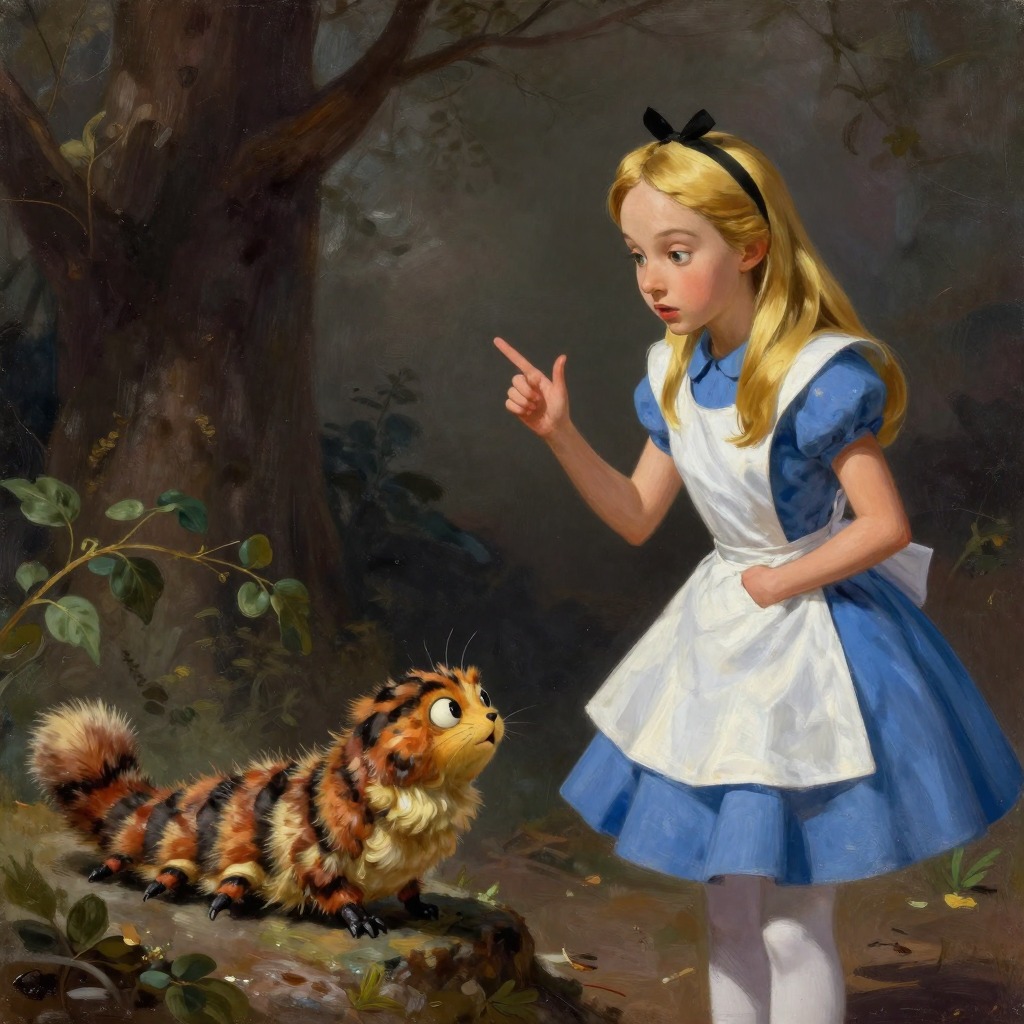
The rule is first articulated by the Caterpillar, who, after a frustrating and contradictory conversation with Alice about her identity and her constant changes in size, finally offers a piece of practical advice. As it prepares to depart, the Caterpillar remarks, "One side will make you grow taller, and the other side will make you grow shorter." This cryptic instruction is given without specifying which side is which, leaving Alice to discover the effects through trial and error. The Caterpillar's delivery is characteristically abrupt and unhelpful; it does not wait for Alice's questions but simply crawls away into the grass, leaving her to puzzle over the mushroom's properties. The rule thus enters the story as a piece of incomplete information, a puzzle that Alice must solve herself.
Application and Consequences
Alice immediately puts the rule to the test. She stretches her arms around the perfectly round mushroom and breaks off a bit of the edge with each hand, then nibbles a little of the right-hand bit. The effect is immediate and violent: she feels a blow under her chin, which turns out to be her own foot, as she shrinks rapidly. In a panic, she eats some of the left-hand bit, which causes her neck to stretch to an immense length, rising like a stalk above the trees. This leads to a comical and frightening encounter with a Pigeon, who mistakes her for a serpent. Through careful, alternating nibbles from each piece, Alice eventually manages to bring herself back to her usual height. The rule thus gives her a degree of control over her size, but the process is clumsy, dangerous, and requires constant adjustment. Later, when she approaches the March Hare's house, she nibbles more of the left-hand bit to raise herself to about two feet high, and before entering the garden, she nibbles the mushroom she has kept in her pocket until she is about a foot high, demonstrating her growing, if still imperfect, mastery of the rule.
Thematic Significance
The rule is a perfect emblem of Wonderland's logic: it is a rule that is both precise and useless, offering a binary choice (taller or shorter) without any guidance on how to achieve a desired outcome. It forces Alice into a constant state of experimentation and improvisation, mirroring her broader struggle to find stable ground in a world where identity, size, and meaning are perpetually in flux. The rule's arbitrary nature—the fact that the two sides of a round mushroom are functionally identical yet produce opposite effects—underscores the absurdity of the systems of order that govern Wonderland. Alice's repeated use of the rule, from her initial panicked trials to her more deliberate adjustments, charts her growing agency and her ability to work within the illogical framework of the dream world. Ultimately, the rule is not a solution to her problems but a tool that allows her to participate in the chaos, a small piece of reliable magic in a world where nothing else stays the same.