White Rabbit's trumpet
The White Rabbit's trumpet appears in the climactic trial scene of Alice's Adventures in Wonderland as a ceremonial instrument of the Queen of Hearts' court. It is a small trumpet, carried by the White Rabbit in his role as herald, and its blasts mark the formal stages of the legal proceedings against the Knave of Hearts. The trumpet is first seen when the White Rabbit, standing near the King and Queen of Hearts, holds it in one hand while a scroll of parchment is in the other, ready to read the accusation. Its sound—three blasts—initiates the reading of the charge and later summons the first witness, the Hatter, into the court. The trumpet thus functions as an auditory signal that structures the trial, transforming the chaotic Wonderland setting into a parody of formal judicial ritual. Its use underscores the absurdity of the proceedings, where the instrument's solemnity contrasts with the nonsensical testimony and the Queen's arbitrary commands for execution. The trumpet is not mentioned elsewhere in the narrative, appearing only in the trial chapter, but its presence there is decisive: it is the tool through which the White Rabbit exercises his official capacity, and its blasts punctuate the farcical legal drama that culminates in Alice's defiance and the collapse of the court's authority.
Appearance and Context
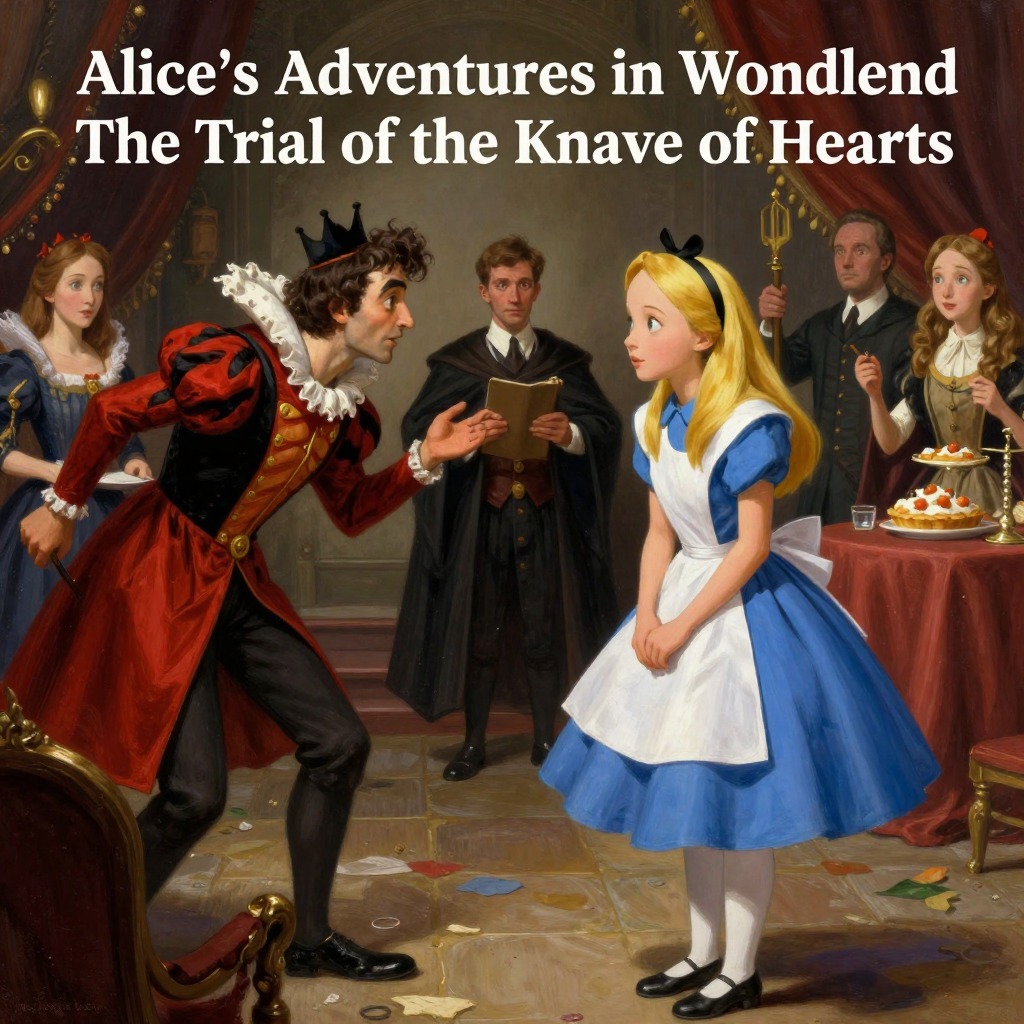
The trumpet is introduced in Chapter XI, "Who Stole the Tarts?", when Alice arrives at the court of the King and Queen of Hearts. The White Rabbit stands near the throne, holding the trumpet in one hand and a scroll of parchment in the other, ready to perform his heraldic duties. The court is crowded with birds, beasts, and the entire pack of cards, and the Knave of Hearts stands before them in chains, guarded by soldiers. The trumpet is the first object that signals the formal beginning of the trial, as the White Rabbit blows three blasts before unrolling the scroll and reading the accusation: "The Queen of Hearts, she made some tarts, / All on a summer day: / The Knave of Hearts, he stole those tarts, / And took them quite away!" The trumpet thus establishes the mock-legal atmosphere, mimicking the conventions of a real courtroom where a herald announces the charges.
Function in the Trial
The trumpet is used twice more in the trial. After the accusation is read, the King tells the jury to consider their verdict, but the White Rabbit interrupts, insisting there is more evidence to come. He then blows three blasts on the trumpet again and calls out, "First witness!" This summons the Hatter, who enters with a teacup and bread-and-butter, still unfinished from his tea. The trumpet's blasts thus serve as a formal call to witnesses, a parody of legal procedure that is immediately undercut by the absurdity of the Hatter's testimony. Later, when the cook is called as the next witness, the White Rabbit fumbles over the list before reading out Alice's name, though the trumpet is not explicitly mentioned at that moment. The instrument's role is limited to these two key moments, but it is essential to the trial's structure: without it, the proceedings would lack even the pretense of order. The trumpet's sound is the only thing that momentarily imposes a semblance of ritual on the chaos, as the Queen's constant shouting of "Off with his head!" and the jury's frantic writing on slates otherwise dominate the scene.
Symbolic Significance
The White Rabbit's trumpet embodies the tension between order and absurdity that defines the trial. It is a real, functional object—a trumpet that produces sound—but its use in a court where the King invents rules on the spot, the jury writes down "stupid things!" as evidence, and the Queen demands sentence before verdict reveals the emptiness of the ritual. The trumpet's three blasts are a precise, formal gesture, yet they introduce witnesses whose testimony is incoherent (the Hatter's rambling about tea and bread-and-butter) or defiant (the cook's single word "Shan't"). The instrument thus becomes a symbol of the gap between the appearance of justice and its reality in Wonderland. It is also a marker of the White Rabbit's own anxious servility: he uses the trumpet to perform his duty, but his nervous demeanor—smiling at everything, fumbling over the list—shows that he is as much a victim of the Queen's tyranny as anyone else. The trumpet, like the White Rabbit himself, is a tool of the court's authority, but that authority is revealed to be hollow.
Narrative Role and Ending
The trumpet does not appear after the trial's climax. When Alice grows to her full size and declares the court "nothing but a pack of cards," the entire pack rises into the air and flies down upon her, and she wakes up on the riverbank with her sister. The trumpet, like the rest of the Wonderland apparatus, vanishes with the dream. Its absence in the final scene underscores the trial's irrelevance: the instrument that once commanded attention is forgotten, and the arbitrary power it represented dissolves. The trumpet's narrative role is thus confined to the trial, where it serves as a prop in the parody of justice, but its significance lies in how it highlights the absurdity of the Queen's rule. It is a small but telling detail in Carroll's satire of legal systems, where the form of authority—the herald's trumpet, the judge's wig, the jury's slates—is meticulously maintained even as the substance of justice is entirely absent.