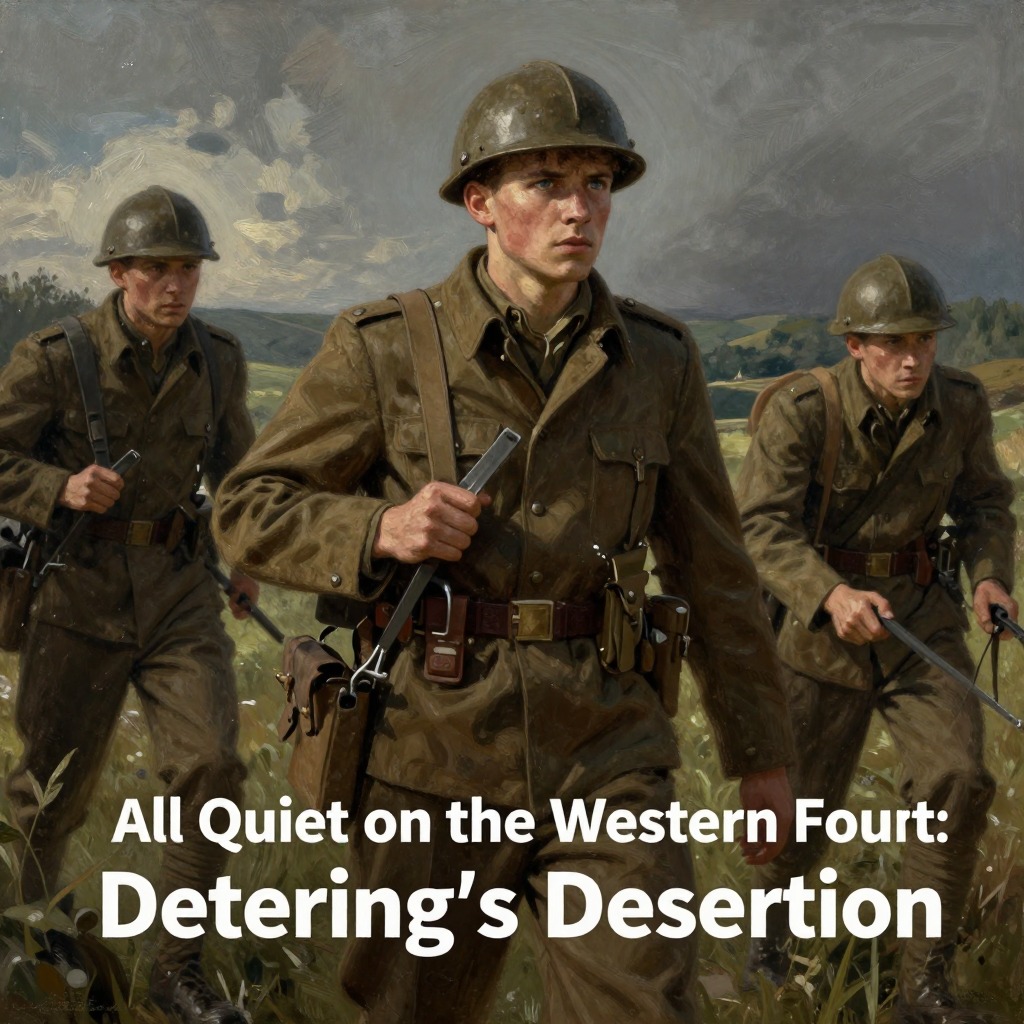
Detering's Desertion
Detering's Desertion is one of the most quietly devastating episodes in Erich Maria Remarque's All Quiet on the Western Front, a moment when the accumulated pressure of the war finally shatters a man who had seemed the most stable and self-contained of the group. Unlike the younger soldiers, who had no established life before the war, Detering was a peasant whose entire identity was bound up with his farm, his wife, and the seasonal rhythms of the land. His flight is not an act of cowardice or political defiance but a desperate, irrational yearning for home that overrides every instinct for self-preservation. The event reveals how the war destroys not only bodies but the deepest, most private attachments that make life worth living, and it foreshadows the gradual dissolution of the entire company as the old certainties crumble one by one.
Causes and Background
Detering was one of the older soldiers in the company, a peasant who thought of nothing but his farmyard and his wife. Throughout the novel, he is sparing with words but deeply affected by the war's assault on the natural world. Earlier, during the bombardment of the horses, he had been driven nearly to madness by the animals' screams, cursing and demanding that they be shot, and declaring it "the vilest baseness to use horses in the war." His attachment to the land was not sentimental but practical and visceral; he read the newspapers every day to see whether it was raining in his corner of Oldenburg, and he worried that the hay had not yet been brought in. When asked what he would do if peace came, he gave only one sentence: "I would go straight on with the harvesting." This single-minded devotion to his farm made him the most rooted of the soldiers, but also the most vulnerable to the shock of displacement.
What Happens
The trigger was a cherry tree. Returning from the front line near their billets one morning, the company passed a garden where a cherry tree stood in full white blossom, without leaves, a vision of pure, fragile beauty in the grey twilight. That evening, Detering was missing. When he finally returned, he had a couple of branches of cherry blossom in his hand. His comrades made fun of him, asking if he was going to a wedding, but he gave no answer and lay down on his bed. During the night, Paul Bäumer heard him making a noise, as if packing, and sensed something was wrong. When Paul confronted him, Detering evaded the question, saying only that he could not sleep. He spoke of his orchard at home, with its cherry trees that from the hay loft looked "like one single sheet, so white." Paul tried to reassure him that he might get leave soon, or even be sent back as a farmer, but Detering was far away, his expression a strange mixture of cow and yearning god, half stupid and half rapt. Paul stayed awake to watch him, but nothing happened that night. The second morning, however, Detering was gone. Paul noticed but said nothing, hoping to give him time to get through. Others had already made it to Holland. But at roll call, Detering was missed. A week later, word came that he had been caught by the field gendarmes, the despised military police. He had headed toward Germany, a hopeless direction, and had done everything else just as idiotically. His flight was only homesickness and a momentary aberration, but a court-martial a hundred miles behind the front line knew nothing of that. Nothing more was heard of Detering.
Consequences and Aftermath
Detering's desertion had no tactical consequence for the war, but it marked a significant psychological milestone for the company. It demonstrated that even the most reliable, uncomplaining soldier could be broken by the accumulated weight of longing and loss. The event is narrated by Paul as part of a larger reflection on the madness that lurks just beneath the surface of every front-line soldier, a "danger" that could break out "as from an overheated boiler." Paul immediately follows the story of Detering with the story of Berger, who went mad and ran into the barrage to rescue a wounded messenger dog, and was himself killed. These episodes form a pattern: the war does not merely kill men; it drives them to destroy themselves. Detering's fate also underscores the isolation of the individual soldier. His comrades, though sympathetic, could not stop him; the military system, which treated his flight as a crime, could not understand him. The event deepens the novel's argument that the war annihilates not only the body but the soul, and that the men who survive will return rootless and broken, unable to find their way back to the lives they once knew.