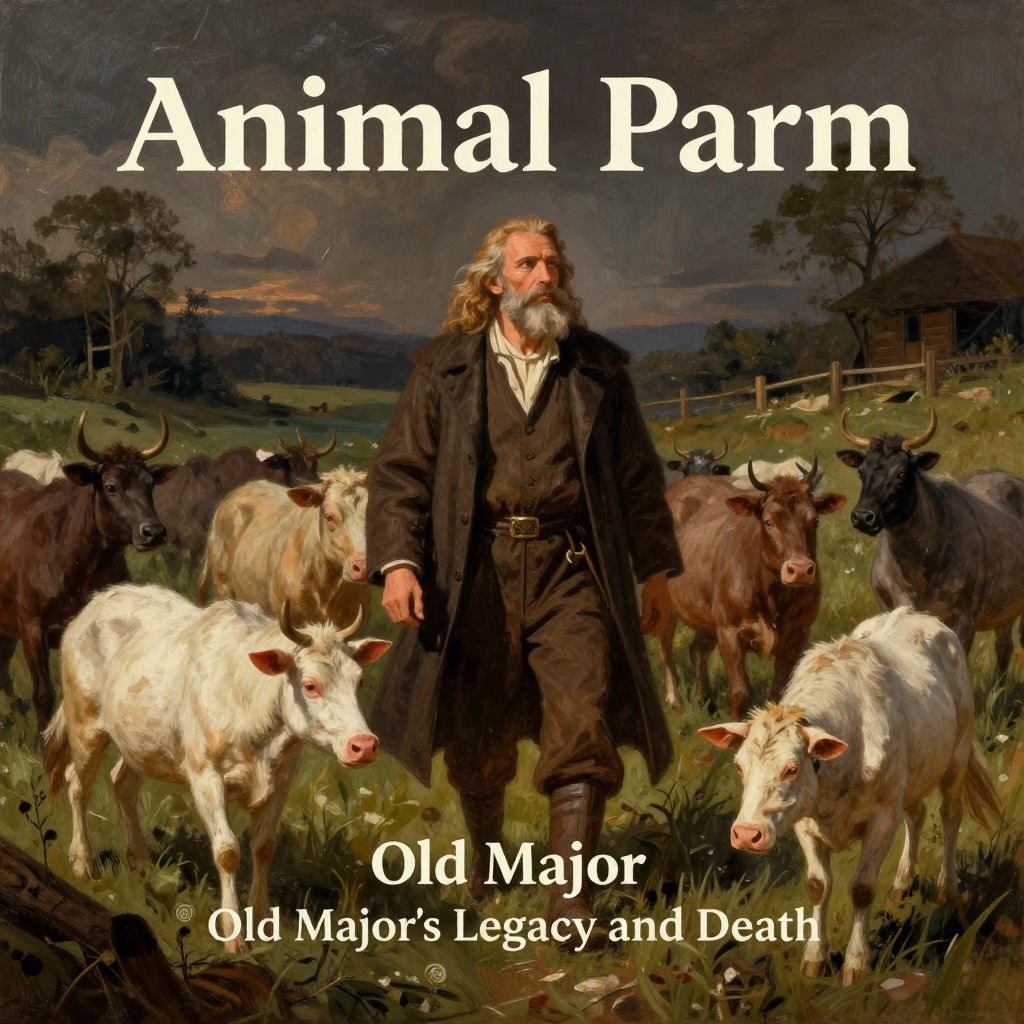
Old Major's Skull
Old Major's Skull is the preserved cranium of the founding prophet of Animalism, which after his death is disinterred and transformed into a ritual object whose veneration becomes a compulsory weekly ceremony that marks the transition from revolutionary debate to authoritarian obedience.
Origin and Disinterment
Old Major, the prize Middle White boar whose visionary speech inspired the Rebellion, died peacefully in his sleep three nights after that first meeting. His body was buried at the foot of the orchard. Months later, after Snowball's expulsion and the abolition of the Sunday-morning Meetings, the pigs ordered the skull disinterred. Now clean of flesh, it was set up on a stump at the foot of the Flagstaff, beside the gun that had been captured in the Battle of the Cowshed and was fired twice a year on the anniversaries of the Rebellion and that battle.
Ritual Function and Weekly Veneration
Every Sunday morning at ten o'clock the animals assembled in the big barn to receive their orders for the week. After the hoisting of the green flag—which Snowball had explained represented the green fields of England and the future Republic of the Animals—the animals were required to file past the skull in a reverent manner before entering the barn. This compulsory act of veneration replaced the open debates that had once characterized the Meetings. The skull thus became the central object of a weekly ritual that transformed the animals from participants in democratic discussion into passive recipients of commands. Napoleon, with Squealer and the poet Minimus, sat on the front of the raised platform, the nine young dogs forming a semicircle round them, while the rest of the animals faced them from the main body of the barn. Napoleon read out the orders for the week in a gruff soldierly style, and after a single singing of 'Beasts of England', all the animals dispersed.
Later Suppression
Years later, when the farm had grown more prosperous and the pigs had fully consolidated their power, the ritual was abolished. At a banquet attended by neighbouring farmers, Napoleon announced that the strange custom of marching every Sunday morning past a boar's skull nailed to a post in the garden would be suppressed, and that the skull had already been buried. This suppression coincided with a series of other changes: the abolition of the word "Comrade," the removal of the hoof and horn from the green flag, and the restoration of the farm's original name, "The Manor Farm." The burial of the skull marked the final erasure of the revolutionary origins that the ritual had once been designed to commemorate and control.
Narrative Significance
The trajectory of Old Major's Skull—from honoured relic of a revered founder to compulsory object of weekly veneration to quietly buried embarrassment—mirrors the arc of the Revolution itself. The skull was first used to create a sacred aura around the new order, then became a tool for enforcing discipline and hierarchy, and was finally discarded when its revolutionary symbolism no longer suited the pigs' alliance with the human farmers. Its presence at the foot of the Flagstaff, beside the gun, linked the founding prophecy to military victory and authoritarian command. Its eventual removal completed the transformation of Animal Farm back into Manor Farm, with the pigs now walking on their hind legs, carrying whips, and wearing human clothes.