Raspberry cordial (currant wine)
The raspberry cordial—or, as it turns out, the currant wine—is a deceptively simple domestic object that, through a single act of misidentification, triggers a crisis of friendship, reputation, and maternal authority in Anne Shirley's first year at Green Gables. What begins as a hospitable gesture toward her beloved bosom friend Diana Barry ends in accusations of deliberate intoxication, a broken friendship, and a painful lesson in the gap between intention and consequence. The object itself, a bottle of Marilla's three-year-old homemade currant wine stored on the top shelf of the sitting-room pantry, becomes a material witness to the fragility of trust and the power of a mistake to reshape relationships.
Appearance and Domestic Context
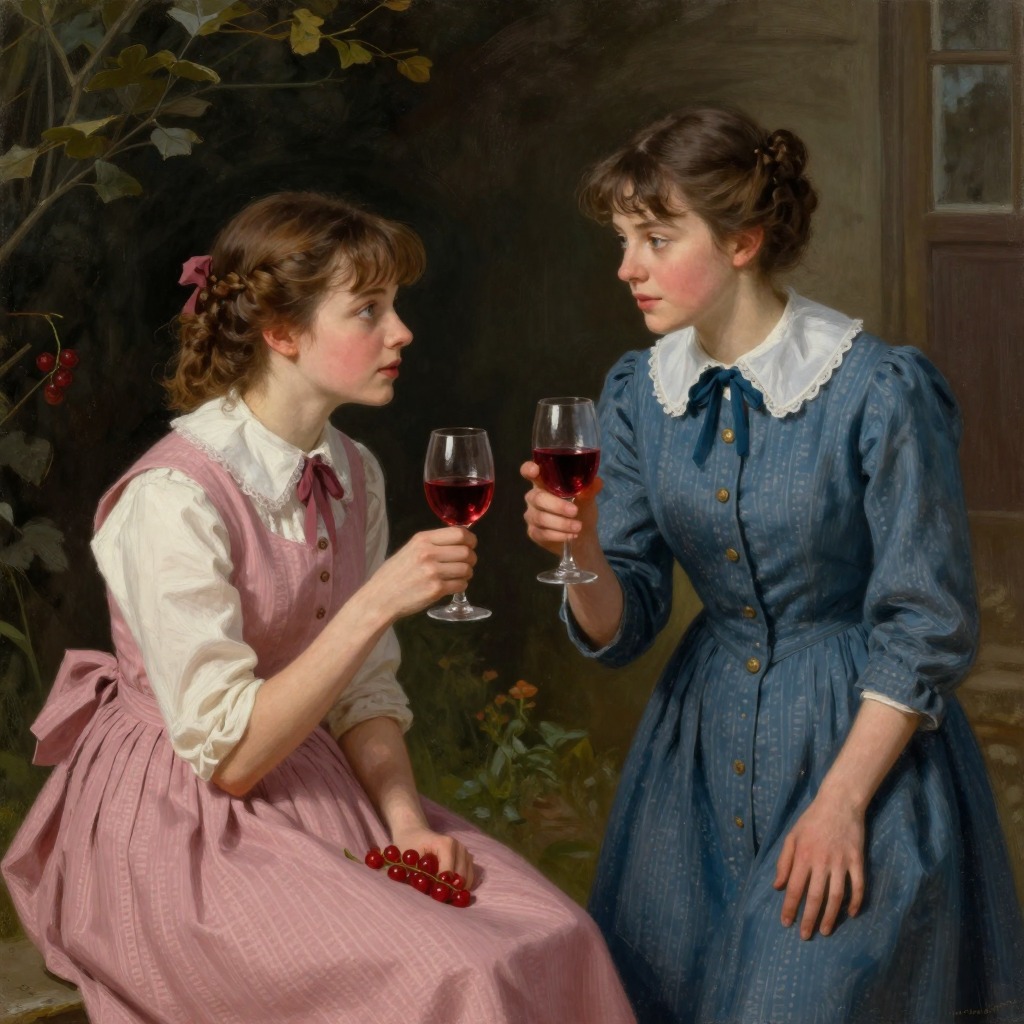
The raspberry cordial that Marilla intends for Anne and Diana's tea party is, in fact, a bottle of her celebrated homemade currant wine, which she had put down in the cellar rather than in the pantry as she told Anne. The wine is a source of local renown: Marilla is "celebrated in Avonlea" for it, though certain of the stricter sort, Mrs. Barry among them, disapprove strongly of it. Marilla herself keeps the bottle "for sickness" and has not made any for three years, ever since she discovered that the minister did not approve. The bottle that Anne retrieves from the top shelf of the pantry—after searching the second shelf where she expected to find the cordial—is thus an object with a hidden history, a domestic product whose social meaning is contested even before the mistake occurs.
The Mistake and Its Immediate Consequences
On the afternoon of Diana's visit to tea, Anne, acting as hostess while Marilla is at an Aid Society meeting, pours Diana three generous tumblerfuls of what she believes to be raspberry cordial. Diana drinks them eagerly, pronouncing it "awfully nice" and "ever so much nicer than Mrs. Lynde's." The effect is swift and severe: Diana becomes dizzy, unsteady, and must be sent home without tea, walking "very dizzily" down the lane. Anne, bewildered and distressed, weeps all the way back to Green Gables, unable to understand why her hospitality has gone so wrong. The next day, Mrs. Barry, having learned from Mrs. Lynde what happened, is in "an awful state": she declares that Anne set Diana drunk and sent her home in a disgraceful condition, and she forbids Diana ever to play with Anne again. Anne, sobbing to Marilla, insists she never thought raspberry cordial would set people drunk, "not even if they drank three big tumblerfuls." It is only when Marilla goes to the pantry and finds the bottle of currant wine—and remembers that she had put the raspberry cordial in the cellar—that the truth emerges.
Social and Moral Repercussions
The currant wine incident reverberates far beyond the immediate crisis of friendship. Mrs. Barry's anger is cold and sullen, and she refuses to believe Anne's explanation, even after Marilla goes to Orchard Slope to plead the girl's case. Marilla, for her part, is furious at Mrs. Barry's unreasonableness, telling her plainly that "currant wine wasn't meant to be drunk three tumblerfuls at a time" and that if a child she had to do with was so greedy, she would "sober her up with a right good spanking." The incident also becomes a handle for those in Avonlea who disapprove of Marilla's winemaking, giving them fresh ammunition for criticism. Anne, in a desperate last attempt to salvage the friendship, goes alone to Mrs. Barry's door at dusk, white-lipped and eager-eyed, and delivers a passionate speech of apology, but Mrs. Barry is unmoved, telling her coldly that she is not a fit little girl for Diana to associate with. The rupture lasts for weeks, during which Anne and Diana communicate only through secret notes passed in school and a solemn farewell by the Dryad's Bubble, where they exchange locks of hair and vows of eternal friendship.
Resolution and Thematic Significance
The currant wine incident is resolved not through apology or persuasion but through action: when Minnie May Barry falls desperately ill with croup, Anne's quick thinking and practical skill—learned from her years of caring for the Hammond twins—save the child's life. Mrs. Barry, overcome with gratitude and remorse, comes to Green Gables to apologize, acknowledging that she now knows Anne did not mean to set Diana drunk. The friendship is restored, and Anne and Diana resume their place as bosom friends. The incident thus serves as a turning point in Anne's relationship with the adult community of Avonlea, demonstrating that her worth is measured not by her mistakes but by her capacity for genuine kindness and competence. The object itself—the bottle of currant wine—fades back into domestic obscurity, but its brief moment of visibility reveals the complex interplay of intention, perception, and social judgment that governs life in a small community. Anne's mistake, born of ignorance and good intentions, becomes a lesson in the limits of imagination when confronted with the stubborn materiality of the world.