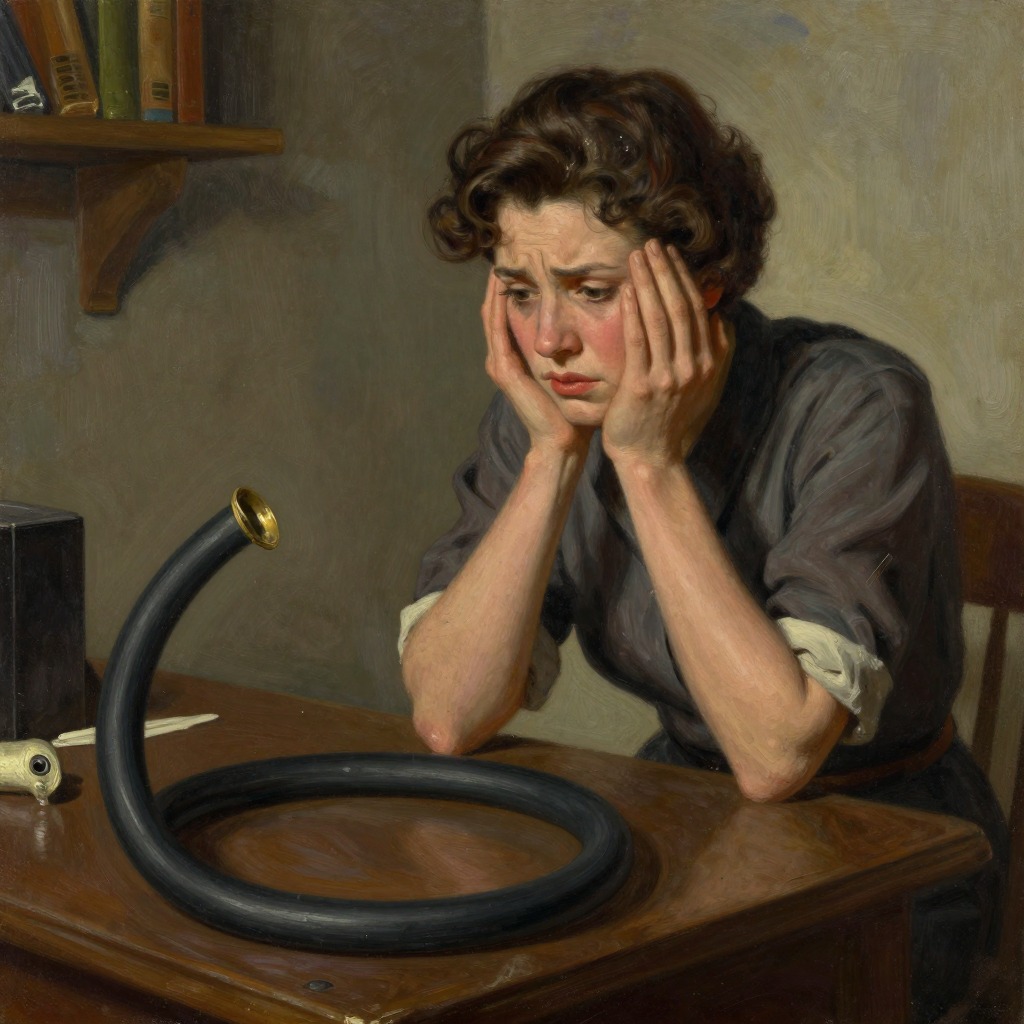
Rubber hose (gas pipe)
The rubber hose (gas pipe) is a length of rubber tubing that Linda Loman discovers behind the fuse box in the cellar, attached to a new nipple on the water heater's gas pipe. It is the physical evidence of Willy Loman's repeated attempts to kill himself by asphyxiation. The object moves through the play from concealment to revelation, from a private shame managed by Linda to a weapon in the climactic argument between Willy and Biff, and finally to an absent presence that confirms the family's tragedy.
Discovery and Concealment
Linda finds the rubber hose by accident when she goes down to the cellar to look for a fuse after the lights blow out. She describes the discovery to her sons with great difficulty, telling them that behind the fuse box "it happened to fall out — was a length of rubber pipe — just short." She immediately understands its purpose: there is "a little attachment on the end of it" and, on the bottom of the water heater, "a new little nipple on the gas pipe." Rather than confronting Willy or removing the hose permanently, Linda develops a daily ritual of concealment: every day she goes down and takes the little rubber pipe away, but when Willy comes home, she puts it back where it was. She explains to Biff and Happy that she cannot bring herself to mention it to him, saying, "How can I insult him that way?" The hose thus becomes a silent, daily negotiation between husband and wife — a secret that Linda carries alone, a measure of her desperate attempt to keep Willy alive while preserving his dignity.
Biff's Discovery and the Confrontation
Later that same night, Biff, unable to sleep, comes down to the kitchen and sees the gas heater glowing through the wall. He reaches behind the heater and draws out the length of rubber tubing. He is horrified, turning his head toward Willy's room, from which the strains of Linda's desperate humming rise. Biff wraps the tubing around his hand and quickly goes up the stairs. The object now passes from Linda's secret management into Biff's horrified knowledge. In the climactic confrontation of Act Two, Biff whips the rubber tube out of his pocket and slams it on the kitchen table. When Linda moves to grab it, Biff holds it down with his hand and commands, "Leave it there! Don't move it!" Willy, caged and wanting to escape, denies ever seeing it, saying, "I never saw that." Biff counters, "You saw it. The mice didn't bring it into the cellar!" He then uses the hose to accuse his father of trying to make himself a hero through suicide, shouting, "What is this supposed to do, make a hero out of you? This supposed to make me sorry for you?" The rubber hose, once a hidden instrument of self-destruction, becomes the undeniable proof of Willy's despair and the catalyst for Biff's final, brutal honesty.
Aftermath and Thematic Significance
After the confrontation, Biff leaves the hose on the table. The object is not mentioned again in the play's final scenes, but its presence has already done its work. It has forced into the open what the family had been circling for years: Willy's suicidal intent, Linda's complicit silence, and Biff's anguished recognition that his father's dream is lethal. The hose is the material counterpart to the play's central themes of denial and revelation. It is a thing that, once brought into the light, cannot be put back into hiding. It represents the physical reality of Willy's despair, a despair that his son can no longer ignore or excuse. The rubber hose is not merely a prop; it is the object around which the family's crisis crystallizes, the tangible evidence that the American dream, for Willy Loman, has become a death wish.