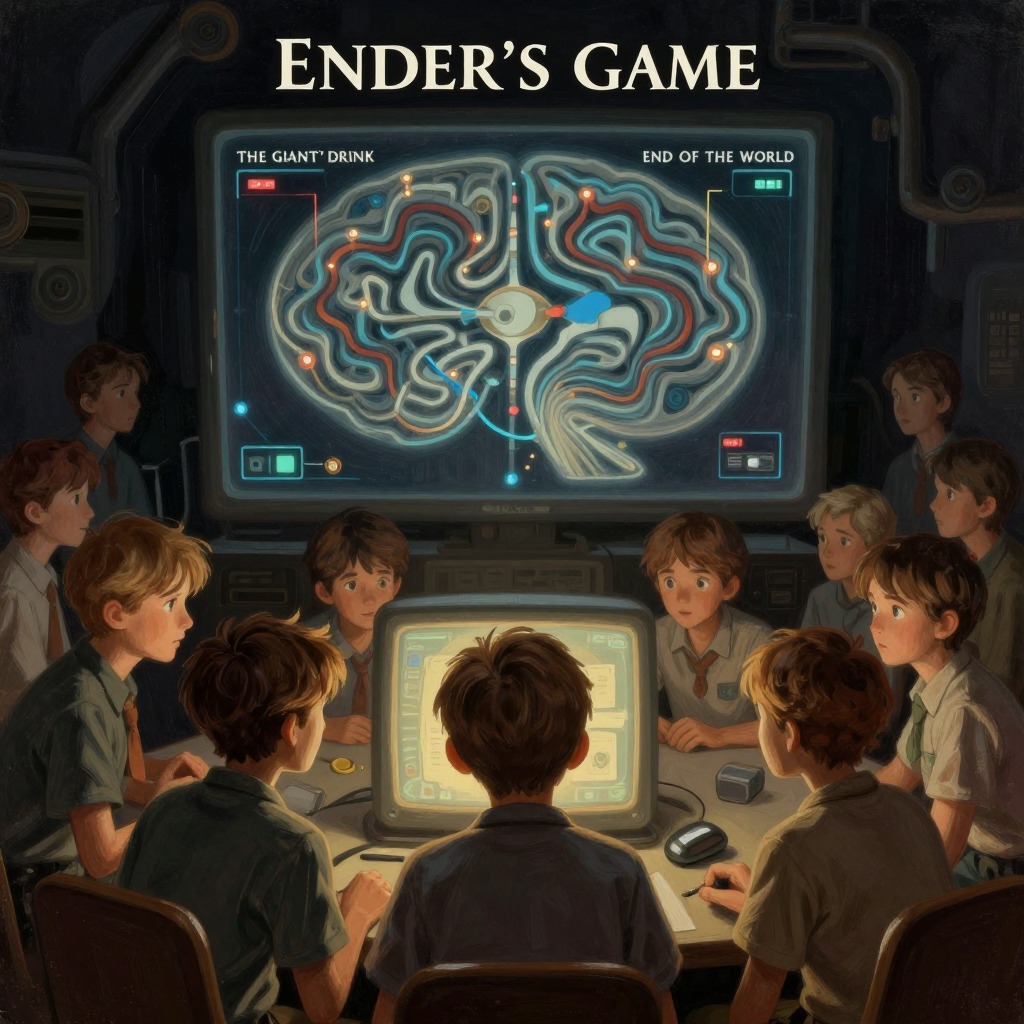
Giant's Drink Victory
The Unbeatable Game and Ender's Frustration
During private study time, Ender engaged in the mind game's Free Play, a shifting, crazy kind of game in which the school computer kept bringing up new things, building a maze that you could explore. His figure on the screen had started out as a little boy, changed into a bear, and was now a large mouse with long and delicate hands. He had played with the cat a lot, but it was now boring—too easy to dodge, he knew all the furniture. He told himself he was sick of the Giant, a dumb game he could never win, but he went through the mousehole anyway, over the small bridge in the garden, avoiding the ducks and the divebombing mosquitoes. He found himself going up the rolling hills, where landslides began. At first he had got caught again and again, crushed in an exaggerated blot of gore oozing out from under a rock pile. Now, though, he had mastered the skill of running up the slopes at an angle to avoid the crush, always seeking higher ground. The landslides finally stopped being jumbles of rock; the face of the hill broke open and instead of shale it was white bread, puffy, rising like dough as the crust broke away and fell. When he jumped down off the bread, he was standing on a table, with a giant loaf of bread behind him, a giant stick of butter beside him, and the Giant himself leaning his chin in his hands, looking at him. Ender's figure was about as tall as the Giant's head from chin to brow.
The Giant, as always, set two huge shot glasses, as tall as Ender's knees, on the table in front of him, filled with different liquids that had never repeated, not that he could remember. This time the one had a thick, creamy looking liquid; the other hissed and foamed. "One is poison and one is not," said the Giant. "Guess right and I'll take you into Fairyland." Guessing meant sticking his head into one of the glasses to drink. He never guessed right. Sometimes his head was dissolved, sometimes he caught on fire, sometimes he fell in and drowned, sometimes he fell out, turned green, and rotted away. It was always ghastly, and the Giant always laughed. Ender knew that whatever he chose he would die; the game was rigged. On the first death, his figure would reappear on the Giant's table, to play again; on the second death, he'd come back to the landslides; then to the garden bridge; then to the mousehole. And then, if he still went back to the Giant and played again, and died again, his desk would go dark, "Free Play Over" would march around the desk and Ender would lie back on his bed and tremble until he could finally go to sleep. The game was rigged but still the Giant talked about Fairyland, some stupid childish three-year-old's Fairyland that probably had some stupid Mother Goose or Pac-Man or Peter Pan, it wasn't even worth getting to, but he had to find some way of beating the Giant to get there.
The Decision to Cheat and the Murder of the Giant
This time, instead of running away or standing there, Ender walked his figure up to the Giant's face and kicked him in the chin. The Giant stuck out his tongue and Ender fell to the ground. "How about a guessing game?" asked the Giant. So it didn't make any difference—the Giant only played the guessing game. Stupid computer. Millions of possible scenarios in its memory, and the Giant could only play one stupid game. He drank the creamy liquid and immediately began to inflate and rise like a balloon; the Giant laughed. He was dead again. He played again, and this time the liquid set, like concrete, and held his head down while the Giant cut him open along the spine, deboned him like a fish, and began to eat while his arms and legs quivered. He reappeared at the landslides and decided not to go on. He even let the landslides cover him once. But even though he was sweating and he felt cold, with his next life he went back up the hills till they turned into bread, and stood on the Giant's table as the shot glasses were set before him. He stared at the two liquids, trying to guess what kind of death each one held, hating the game, knowing it wasn't fair, it was stupid, it was rotten. And instead of pushing his face into one of the liquids, he kicked one over, then the other, and dodged the Giant's huge hands as the Giant shouted, "Cheater, cheater!" He jumped at the Giant's face, clambered up his lip and nose, and began to dig in the Giant's eye. The stuff came away like cottage cheese, and as the Giant screamed, Ender's figure burrowed into the eye, climbed right in, burrowed in and in. The Giant fell over backward, the view shifted as he fell, and when the Giant came to rest on the ground, there were intricate, lacy trees all around. A bat flew up and landed on the dead Giant's nose. Ender brought his figure up out of the Giant's eye. "How did you get here?" the bat asked. "Nobody ever comes here." Ender could not answer, of course. So he reached down, took a handful of the Giant's eyestuff, and offered it to the bat. The bat took it and flew off, shouting as it went, "Welcome to Fairyland."
Aftermath and Psychological Turmoil
He had made it. He ought to explore. He ought to climb down from the Giant's face and see what he had finally achieved. Instead he signed off, put his desk in his locker, stripped off his clothes and pulled his blanket over him. He hadn't meant to kill the Giant. This was supposed to be a game. Not a choice between his own grisly death and an even worse murder. "I'm a murderer, even when I play. Peter would be proud of me." The victory was immediately shadowed by guilt and self-loathing, as Ender recognized in himself the same capacity for destruction that he feared in his brother Peter. This internal conflict would continue to haunt him, as the Giant's corpse became a recurring image in his dreams and in the mind game itself, eventually eroding into a hill entwined with grass and vines, with only the crest of the Giant's face still visible as white bone, like limestone protruding from a discouraged, withering mountain. The victory also had a profound effect on the teachers, who saw it as proof that Ender could do the impossible. In a conversation about the event, one officer noted, "Isn't it nice to know that Ender can do the impossible?" while another questioned, "The player's deaths have always been sickening. I've always thought the Giant's Drink was the most perverted part of the whole mind game, but going for the eye like that—this is the one we want to put in command of our fleets?" The answer was that what mattered was that he won the game that couldn't be won.
Significance and Foreshadowing
The Giant's Drink Victory is a crucial turning point in Ender's development, revealing his capacity for ruthless, unconventional problem-solving. It is the first time he deliberately breaks the rules of a game to achieve victory, a strategy he will later employ in the final battle against the buggers, where he ignores the enemy and moves against the enemy's gate, destroying the entire planet. The event also foreshadows Ender's later discovery of the bugger queen's cocoon, as the mind game's landscape—the Giant's corpse, the playground, the End of the World—is later found to have been built by the buggers on their home world, a message left for him across the lightyears. The Giant's Drink, with its impossible choice between two deaths, becomes a symbol of the rigged games Ender is forced to play throughout his life, and his victory by cheating establishes a pattern of winning by refusing to accept the rules as given. This moment of triumph, however, is also a moment of profound moral disturbance, as Ender immediately recoils from what he has done, seeing himself as a murderer even in play. The guilt he feels here will echo through his later actions, culminating in his devastation upon learning that he has actually killed the buggers, not just played a game.