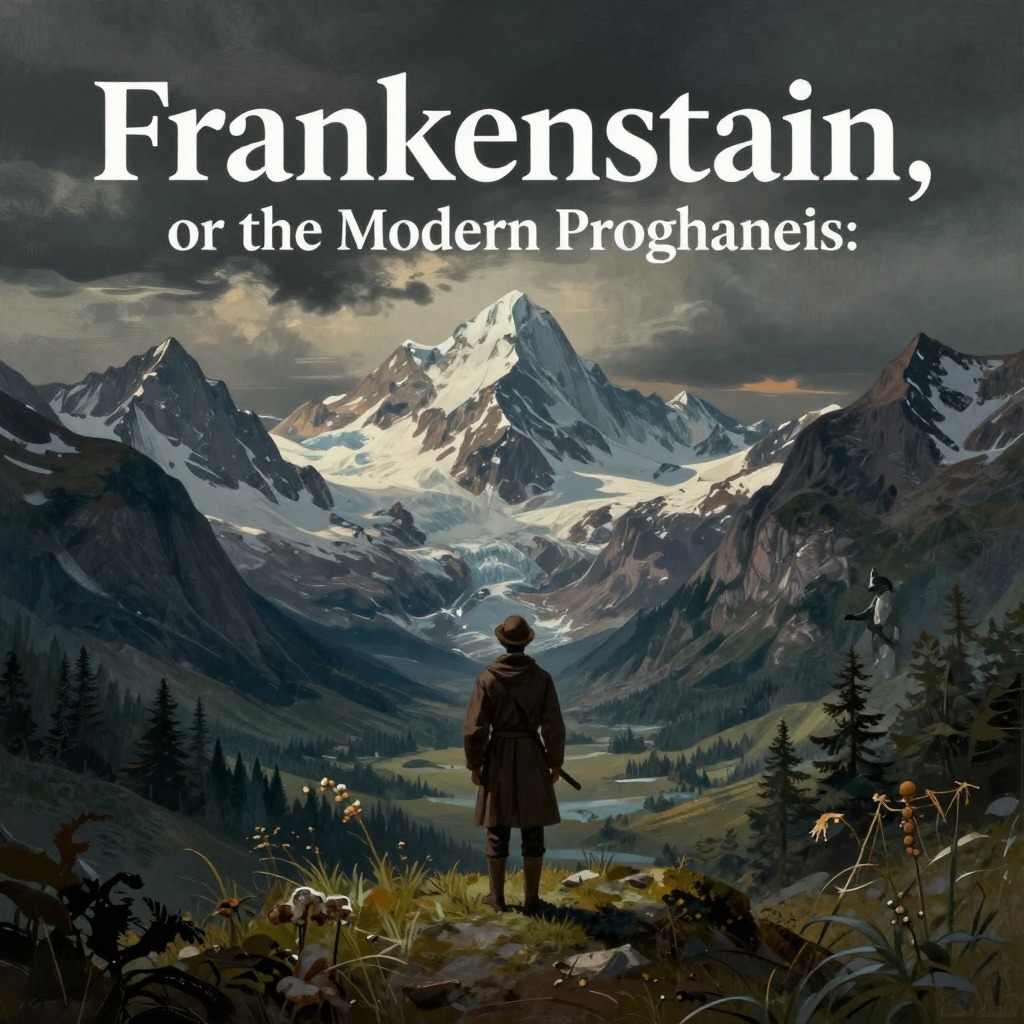
Chamounix
Chamounix, the Alpine valley in the shadow of Mont Blanc, serves as the pivotal setting where Victor Frankenstein's flight from grief collides with the monster's demand for justice, transforming a landscape of sublime beauty into the stage for the novel's central confrontation. It is here, amid glaciers and precipices, that Victor, driven by despair after the executions of William and Justine, seeks to forget his human sorrows in the magnificence of eternal scenes, only to be met by the creature he abandoned, who forces him to listen to a tale of misery and to agree to create a female companion.
Victor's Flight to the Valley
Nearly two months after Justine's death, Victor, overwhelmed by remorse and the fear that the monster will commit further crimes, suddenly leaves his family home in Geneva and bends his steps toward the near Alpine valleys. He performs the first part of his journey on horseback, then hires a mule for the rugged roads, and plunges deeper into the ravine of the Arve. The immense mountains and precipices, the sound of the river raging among the rocks, and the dashing of waterfalls speak to him of a power mighty as Omnipotence, and he ceases to fear any being less almighty than that which created the elements. As he ascends, the valley assumes a more magnificent character: ruined castles hang on precipices of piny mountains, the impetuous Arve flows below, and cottages peep forth from among the trees, all augmented by the mighty Alps whose white and shining pyramids and domes tower above as if belonging to another earth. He passes the bridge of Pelissier, enters the valley of Chamounix, and finds it more wonderful and sublime than the valley of Servox, though less beautiful and picturesque. Immense glaciers approach the road; he hears the rumbling thunder of falling avalanches and marks the smoke of their passage. Mont Blanc, supreme and magnificent, raises its tremendous dome above the surrounding aiguilles, overlooking the valley. A tingling, long-lost sense of pleasure often comes across him during this journey, as some turn in the road or some new object reminds him of days gone by and the lighthearted gaiety of boyhood, but the kindly influence soon ceases, and he finds himself fettered again to grief. At length he arrives at the village of Chamounix, exhausted in body and mind, and watches the pallid lightnings playing above Mont Blanc while listening to the rushing of the Arve, until sleep creeps over him and he blesses the giver of oblivion.
The Ascent to Montanvert and the Encounter
The following day, Victor roams through the valley, standing beside the sources of the Arveiron, which rise in a glacier advancing slowly down from the summit of the hills. The abrupt sides of vast mountains are before him; the icy wall of the glacier overhangs him; a few shattered pines are scattered around; and the solemn silence of this glorious presence-chamber of imperial nature is broken only by brawling waves, the fall of vast fragments, the thunder sound of avalanches, and the cracking of accumulated ice. These sublime scenes afford him the greatest consolation he is capable of receiving, elevating him from all littleness of feeling and subduing and tranquillizing his grief. But the next morning, dark melancholy clouds every thought; rain pours in torrents, and thick mists hide the summits of the mountains. Determined to penetrate the misty veil, he resolves to ascend to the summit of Montanvert without a guide, for he is well acquainted with the path and the presence of another would destroy the solitary grandeur of the scene. The ascent is precipitous, the path cut into continual short windings, and the scene terrifically desolate, with traces of winter avalanches everywhere, trees broken and strewed on the ground, and ravines of snow down which stones continually roll. It is nearly noon when he arrives at the top of the ascent and sits upon a rock overlooking the sea of ice. A mist covers both the glacier and the surrounding mountains until a breeze dissipates the cloud, and he descends onto the glacier, whose surface is very uneven, rising like the waves of a troubled sea and interspersed by deep rifts. He spends nearly two hours crossing the field of ice, which is almost a league in width, and remains in a recess of the rock, gazing on the wonderful and stupendous scene. His heart, before sorrowful, swells with something like joy, and he exclaims to wandering spirits, allowing him this faint happiness or taking him as their companion away from the joys of life. As he says this, he suddenly beholds the figure of a man advancing toward him with superhuman speed, bounding over crevices in the ice among which he had walked with caution. The stature, as it approaches, seems to exceed that of man. Victor is troubled; a mist comes over his eyes, and he feels faintness seize him, but he is quickly restored by the cold gale of the mountains. He perceives that the shape is the wretch he created, and he trembles with rage and horror, resolving to wait his approach and close with him in mortal combat.
The Confrontation and the Monster's Tale
The monster approaches, his countenance bespeaking bitter anguish combined with disdain and malignity, his unearthly ugliness almost too horrible for human eyes. Victor, deprived of utterance by rage and hatred, recovers only to overwhelm him with words of furious detestation and contempt, calling him devil and vile insect and threatening to trample him to dust. The monster replies that all men hate the wretched, but that Victor, his creator, is bound to him by ties only dissoluble by the annihilation of one of them. He demands that Victor do his duty toward him, promising to leave him and the rest of mankind at peace if he will comply with his conditions, but threatening to glut the maw of death with the blood of Victor's remaining friends if he refuses. Victor, his rage without bounds, springs on him, but the monster easily eludes him and entreats him to be calm and listen before giving vent to his hatred. He reminds Victor that he has made him more powerful than himself, but that he will be mild and docile to his natural lord and king if Victor will perform his part. He declares that he was benevolent and good, that misery made him a fiend, and that if Victor makes him happy, he shall again be virtuous. Victor, still refusing to hear him, insists there can be no community between them, but the monster persists, arguing that the guilty are allowed by human laws to speak in their own defense before they are condemned. He leads the way across the ice to a hut upon the mountain, where the sun is still high, and Victor, partly urged by curiosity and partly by a sense of the duties of a creator toward his creature, follows and consents to listen. The monster seats himself by the fire he has lighted and begins his tale, which occupies the whole day. When he finishes, he demands that Victor create a female companion for him, with whom he can live in the interchange of those sympathies necessary for his being. Victor initially refuses, but after the monster reasons with him, arguing that he is malicious only because he is miserable and that if he had a companion he would quit the neighborhood of man forever, Victor is moved. He reflects on the promise of virtues the monster displayed at the opening of his existence and the subsequent blight of all kindly feeling by the loathing and scorn of his protectors, and concludes that justice demands he comply. He consents to the demand on the monster's solemn oath to quit Europe forever. The monster swears by the sun, the blue sky of heaven, and the fire of love that burns his heart, and then suddenly quits Victor, descending the mountain with greater speed than the flight of an eagle and quickly lost among the undulations of the sea of ice.
Aftermath and Significance
Victor, his heart heavy and his steps slow, descends toward the valley as night advances. He weeps bitterly and clasps his hands in agony, exclaiming to the stars, clouds, and winds that they are all about to mock him. Morning dawns before he arrives at the village of Chamounix; he takes no rest but returns immediately to Geneva, his haggard and wild appearance awakening intense alarm in his family. He feels as if placed under a ban, with no right to claim their sympathies, yet he loves them to adoration and resolves to dedicate himself to his most abhorred task to save them. Chamounix thus functions as the geographical and emotional pivot where Victor's personal tragedy expands into a cosmic confrontation, and where the monster's voice, first heard in full, transforms him from a silent horror into a complex, suffering being whose demand for a companion sets the remainder of the plot in motion. The valley's sublime landscape—its glaciers, avalanches, and towering peaks—mirrors the overwhelming scale of the moral and emotional forces at play, providing a setting where the boundaries between human and monstrous, creator and creature, are violently redrawn.