Justine Moritz's trial and execution
The trial and execution of Justine Moritz is the novel's first great crisis of injustice, a legal proceeding that condemns an innocent servant girl for the murder of William Frankenstein while the true killer—the creature Victor Frankenstein brought to life—remains at large. The event marks a decisive turn: Victor's silence, born of terror that his tale would be taken for insanity, makes him complicit in a second death, and the judicial machinery of Geneva, swayed by circumstantial evidence and a coerced confession, proves incapable of distinguishing guilt from innocence. Justine's fate transforms the Frankenstein household from a place of mourning into a site of permanent moral fracture, and it establishes the creature's method of destroying Victor through the suffering of those he loves.
The Trial and the Evidence
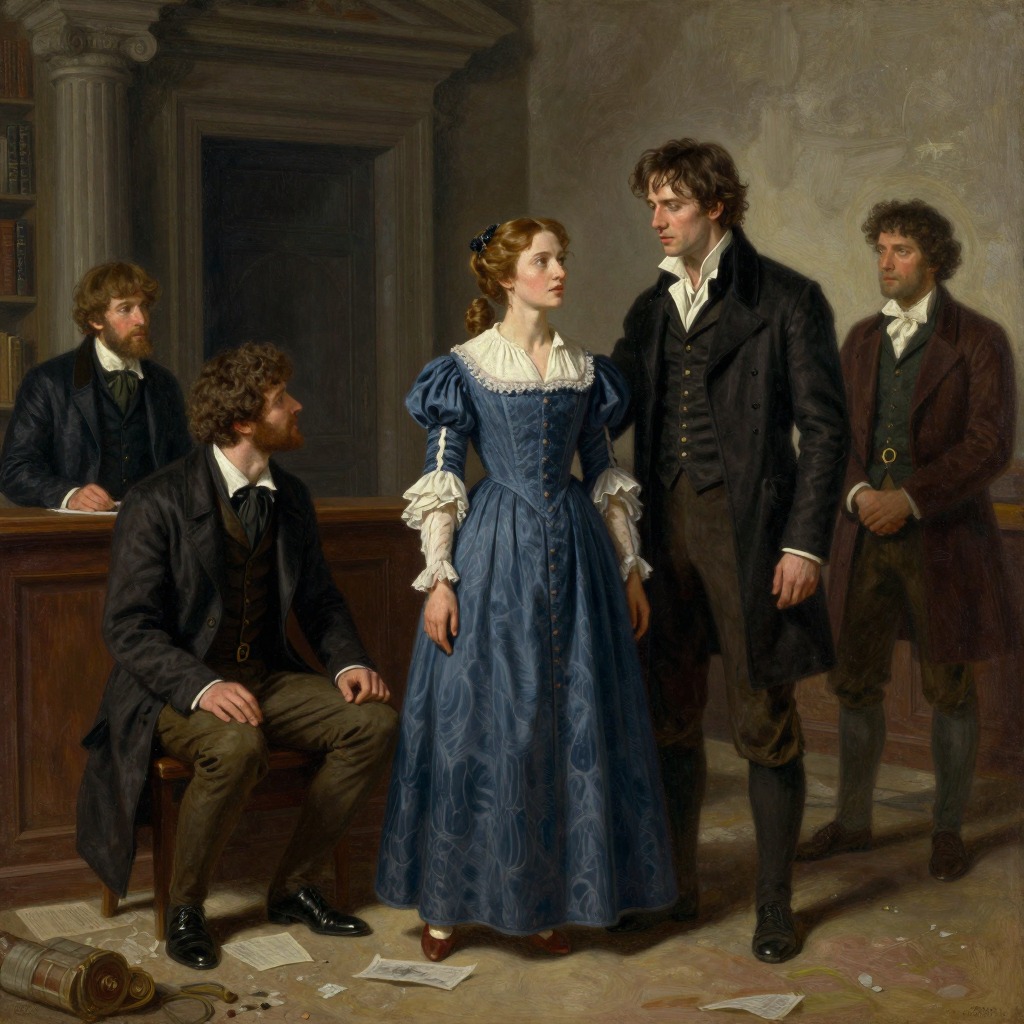
The trial began at eleven o'clock on the morning after Victor's return to Geneva, with the entire Frankenstein family obliged to attend as witnesses. Victor later described the proceeding as a "wretched mockery of justice" that subjected him to "living torture," for he knew that the result of his "curiosity and lawless devices" would determine whether two innocent beings—William and now Justine—would die. Justine entered the court dressed in mourning, her countenance "exquisitely beautiful" despite the solemnity of the occasion, and she appeared confident in her innocence, though her tranquillity was "evidently constrained." The prosecution presented several damaging facts: Justine had been out the entire night of the murder; a market-woman had seen her near the spot where William's body was later found, and she had given a "confused and unintelligible answer" when questioned; she returned home about eight o'clock and fell into violent hysterics when shown the corpse. Most damning of all, a servant had discovered in Justine's pocket the miniature portrait of Caroline Beaufort that William had been wearing, and Elizabeth Lavenza, in a faltering voice, confirmed that she herself had placed the picture around William's neck an hour before he went missing. A "murmur of horror and indignation" filled the court at this revelation.
Justine's Defense and Elizabeth's Appeal
Called upon to plead, Justine collected her powers and spoke in an "audible although variable voice." She explained that she had spent the evening at her aunt's house in the village of Chene, about a league from Geneva, and that on her return she had met a man who told her the child was lost. She spent several hours searching for William, and when the gates of Geneva were shut, she took shelter in a barn, unwilling to disturb the inhabitants. She insisted that if she had gone near the spot where the body lay, it was without her knowledge, and that her bewilderment when questioned by the market-woman was natural after a sleepless night. Concerning the picture, she could give no account. "I know how heavily and fatally this one circumstance weighs against me," she said, "but I have no power of explaining it." Elizabeth then rose to address the court, describing Justine as "the most amiable and benevolent of human creatures," who had nursed Caroline Beaufort in her last illness and who had acted toward William "like a most affectionate mother." Elizabeth declared her belief in Justine's "perfect innocence" and noted that if Justine had wanted the miniature, she would have given it to her willingly. A "murmur of approbation" followed Elizabeth's appeal, but it was directed at Elizabeth's generosity, not at Justine, and the public indignation against the accused only intensified.
The Verdict and the False Confession
Victor, unable to bear the sight of the judges' condemnation, rushed out of the court in agony. The next morning he learned that the ballots had been thrown—all black—and that Justine was condemned. He also received the shocking news that Justine had confessed her guilt. The officer told him that the confession was "hardly required in so glaring a case" but that the judges were glad of it, as they disliked condemning a criminal on circumstantial evidence alone. Victor returned home and told Elizabeth the result, adding, "She has confessed." Elizabeth, who had relied firmly on Justine's innocence, was devastated. "How shall I ever again believe in human goodness?" she cried. "Justine, whom I loved and esteemed as my sister, how could she put on those smiles of innocence only to betray?"
The Prison Interview and the Truth of the Confession
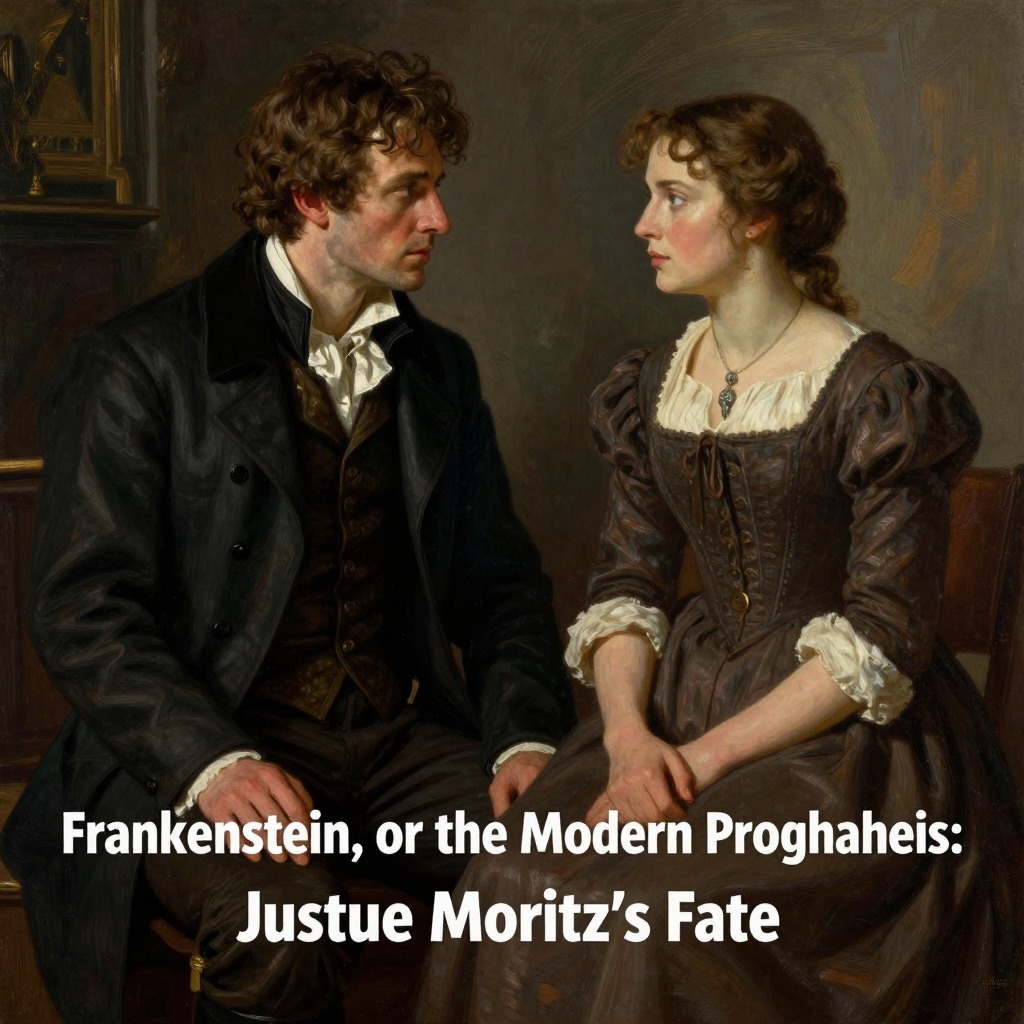
Victor and Elizabeth visited Justine in her prison cell. She was sitting on straw, her hands manacled, her head resting on her knees. When she saw them, she threw herself at Elizabeth's feet, weeping bitterly. Elizabeth asked why she had robbed her of her "last consolation" by confessing. Justine then revealed the truth: she had confessed a lie. Her confessor had "besieged" her, threatening excommunication and hell fire if she remained obdurate, and she had "subscribed to a lie" in an evil hour. "Dear lady, I had none to support me; all looked on me as a wretch doomed to ignominy and perdition," she said. She expressed her horror that Elizabeth might believe her capable of such a crime, and she spoke of her consolation in the hope of seeing William again in heaven. Elizabeth, weeping, vowed to prove Justine's innocence, but Justine shook her head mournfully. "I do not fear to die," she said; "that pang is past." Victor, standing in a corner of the cell, could barely contain his anguish. He gnashed his teeth and groaned from his inmost soul, but he could not bring himself to reveal the truth. Justine thanked him for his kindness and said she could die in peace now that her innocence was acknowledged by Elizabeth and Victor.
The Execution and Its Aftermath
On the following day, Justine died on the scaffold. Elizabeth's "heart-rending eloquence" failed to move the judges, and Victor's "passionate and indignant appeals" were lost upon them. He realized that to proclaim the truth would only make him seem a madman and would not revoke the sentence. Justine perished as a murderess. Victor later reflected that he, "the true murderer," felt "the never-dying worm alive in my bosom, which allowed of no hope or consolation." The execution deepened the family's grief and shattered Elizabeth's worldview; she told Victor that she now saw men as "monsters thirsting for each other's blood" and felt as if she were "walking on the edge of a precipice." Victor's father, Alphonse, tried to console him with arguments drawn from his own "serene conscience and guiltless life," but Victor found the advice inapplicable, for his grief was mingled with remorse and terror. The event also marked the creature's first successful act of indirect vengeance: by planting the miniature on Justine, he had caused the death of an innocent woman and deepened Victor's isolation and despair. Victor later, in his fevered ravings during his imprisonment in Ireland, called himself "the murderer of William, of Justine, and of Clerval," and in his final confession to Walton, he listed Justine among the victims whose names Walton should call upon when thrusting his sword into the creature's heart.