Safie
Safie, the Arabian daughter of a wealthy Turkish merchant, enters the narrative of Frankenstein as a figure of remarkable agency and romantic determination, and her story serves as a crucial mirror to the monster's own desperate search for love and belonging. Her arrival at the De Laceys' cottage transforms the household, and the history of her escape from her father's plans and her journey across Europe to find her beloved Felix provides the monster with his most profound education in human virtue, prejudice, and the possibility of happiness. More than a mere romantic interest, Safie embodies a spirit of independence that challenges the patriarchal and cultural constraints of her world, and her successful integration into a loving family stands in stark contrast to the monster's own tragic rejection.
Identity and Background
Safie is the daughter of a Turkish merchant who, for reasons the monster could not learn, became obnoxious to the French government and was cast into prison on the very day she arrived in Paris from Constantinople to join him. He was tried and condemned to death, a sentence widely considered flagrantly unjust, motivated by his religion and wealth rather than any crime. Safie's mother was a Christian Arab who had been seized and made a slave by the Turks, but who won the heart of Safie's father and married him. This mother, born in freedom, spurned the bondage to which she was reduced and instructed her daughter in the tenets of her religion, teaching her to aspire to higher powers of intellect and an independence of spirit forbidden to the female followers of Muhammad. These lessons were indelibly impressed on Safie's mind, and she sickened at the prospect of returning to Asia and being immured within the walls of a harem, allowed only to occupy herself with infantile amusements. The prospect of marrying a Christian and remaining in a country where women were allowed to take a rank in society was enchanting to her.
Arrival and Relationship with the De Laceys
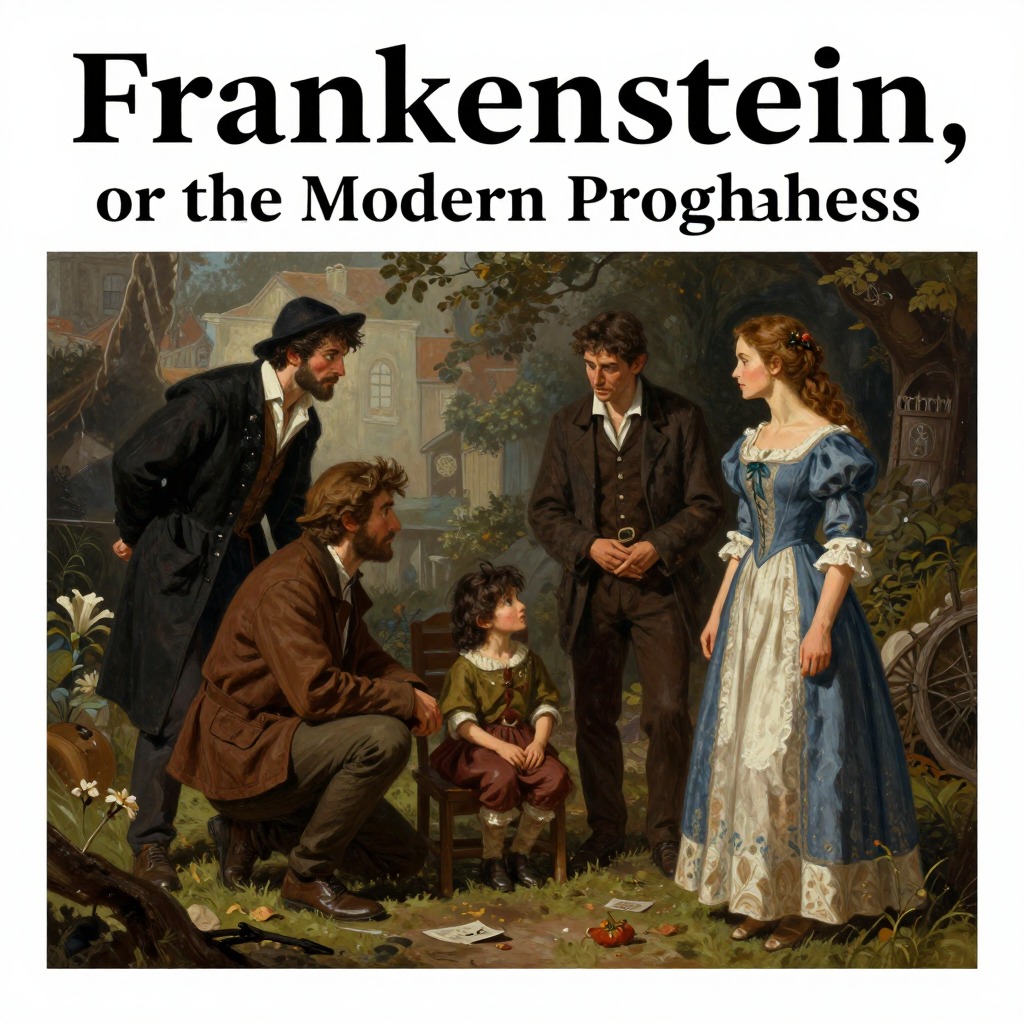
Safie first appears at the De Laceys' cottage on a spring day when the family is resting from labor. She arrives on horseback, accompanied by a countryman as a guide, dressed in a dark suit and covered with a thick black veil. When she sees Felix, she throws up her veil, revealing a countenance of angelic beauty and expression, with hair of a shining raven black, dark but gentle eyes, features of regular proportion, and a complexion wondrously fair with each cheek tinged with a lovely pink. Felix is ravished with delight; every trait of sorrow vanishes from his face, and he calls her his "sweet Arabian." She does not appear to understand him but smiles. She kneels at the old De Lacey's feet and would have kissed his hand, but he raises her and embraces her affectionately. Although Safie utters articulate sounds and appears to have a language of her own, she is neither understood by nor herself understands the cottagers at first. Her presence diffuses gladness through the cottage, dispelling their sorrow as the sun dissipates the morning mists. Felix seems peculiarly happy, and Agatha kisses the hands of the lovely stranger. Safie immediately begins to learn the cottagers' language, and the monster, watching from his hovel, resolves to make use of the same instructions. She learns about twenty words at the first lesson, and the monster profits by the others. She sings and plays the guitar, drawing tears of sorrow and delight from the monster's eyes with her entrancingly beautiful airs, her voice flowing in a rich cadence like a nightingale of the woods.
The History of the De Laceys' Ruin and Safie's Role
The monster learns the history of his beloved cottagers from observing them and from the letters of Felix and Safie that fall into his hands. The old man, De Lacey, was a good French family man who had lived in affluence in Paris. Safie's father, the Turk, was the cause of their ruin. Felix had been present at the Turk's trial and, horrified by the unjust sentence, vowed to deliver him. He gained access to the Turk's dungeon through a grated window and made known his intentions. The Turk, amazed and delighted, endeavored to kindle Felix's zeal by promises of reward and wealth, which Felix rejected with contempt. However, when Felix saw the lovely Safie, who was allowed to visit her father and who expressed her lively gratitude through gestures, he could not help owning to himself that the captive possessed a treasure that would fully reward his toil and hazard. The Turk quickly perceived the impression his daughter had made on Felix and promised her hand in marriage once he was safe. Felix was too delicate to accept this offer but looked forward to the probability of the event. During the preparations for the escape, Felix's zeal was warmed by several letters from Safie, who found means to express her thoughts in the language of her lover with the aid of an old servant who understood French. She thanked him in the most ardent terms for his intended services towards her parent and gently deplored her own fate. Felix procured passports in the name of his father, sister, and himself, and conducted the fugitives through France to Lyons and across Mont Cenis to Leghorn, where the Turk decided to wait for an opportunity to pass into the Turkish dominions. Safie resolved to remain with her father until his departure, and the Turk renewed his promise that she should be united to his deliverer. Felix remained with them, enjoying the society of the Arabian, who exhibited towards him the simplest and tenderest affection. They conversed through an interpreter and sometimes through the interpretation of looks, and Safie sang to him the divine airs of her native country.
Betrayal and Safie's Independent Journey
The Turk, however, loathed the idea of his daughter marrying a Christian and secretly planned to take her with him when he departed. His plans were facilitated when the French government discovered Felix's plot and threw De Lacey and Agatha into prison. Felix, upon hearing this, quickly arranged with the Turk that if the latter should find a favorable opportunity for escape before Felix could return to Italy, Safie should remain as a boarder at a convent at Leghorn. Felix then hastened to Paris and delivered himself up to the law, hoping to free his father and sister. He did not succeed; they remained confined for five months before the trial, which deprived them of their fortune and condemned them to perpetual exile. They found a miserable asylum in the cottage in Germany where the monster discovered them. The treacherous Turk, on discovering that his deliverer was reduced to poverty and ruin, became a traitor to good feeling and honor, quitted Italy with his daughter, and insultingly sent Felix a pittance of money. When the news reached Leghorn that Felix was deprived of his wealth and rank, the merchant commanded his daughter to think no more of her lover and to prepare to return to her native country. Safie's generous nature was outraged by this command; she attempted to expostulate with her father, but he left her angrily, reiterating his tyrannical mandate. A few days later, the Turk told her hastily that his residence at Leghorn had been divulged and that he had hired a vessel to sail for Constantinople in a few hours, intending to leave her under the care of a confidential servant to follow later. When alone, Safie resolved on her own plan of conduct. A residence in Turkey was abhorrent to her; her religion and her feelings were alike averse to it. By some papers of her father that fell into her hands, she heard of the exile of her lover and learned the name of the spot where he then resided. Taking with her some jewels and a sum of money, she quitted Italy with an attendant, a native of Leghorn who understood the common language of Turkey, and departed for Germany. She arrived safely at a town about twenty leagues from the De Laceys' cottage, where her attendant fell dangerously ill. Safie nursed her with the most devoted affection, but the poor girl died, leaving Safie alone, unacquainted with the language of the country and utterly ignorant of its customs. She fell into good hands, however; the woman of the house where they had lived took care that Safie should arrive safely at the cottage of her lover.
Narrative Role and Significance
Safie's story, as witnessed and internalized by the monster, serves multiple critical functions within the novel. Her successful escape from an oppressive father and her determined journey across a foreign continent to reunite with her beloved Felix provide a powerful contrast to the monster's own experience of rejection and isolation. While the monster is spurned by the very family he loves, Safie is welcomed with open arms and becomes an integral part of the De Lacey household. Her presence diffuses happiness and prosperity; the family is assisted by servants, and they spend more time in amusement and conversation. The monster, observing this, feels his own wretchedness more keenly. Furthermore, Safie's story reveals the De Laceys' tragic past and the injustice they suffered, deepening the monster's understanding of human cruelty and virtue. Her letters, which the monster later shows to Walton, serve as tangible proof of the truth of his narrative. Ultimately, Safie represents the possibility of love, integration, and happiness that the monster is forever denied, and her story deepens his despair and fuels his rage against his creator and all of humanity.