Walton's rescue of Frankenstein
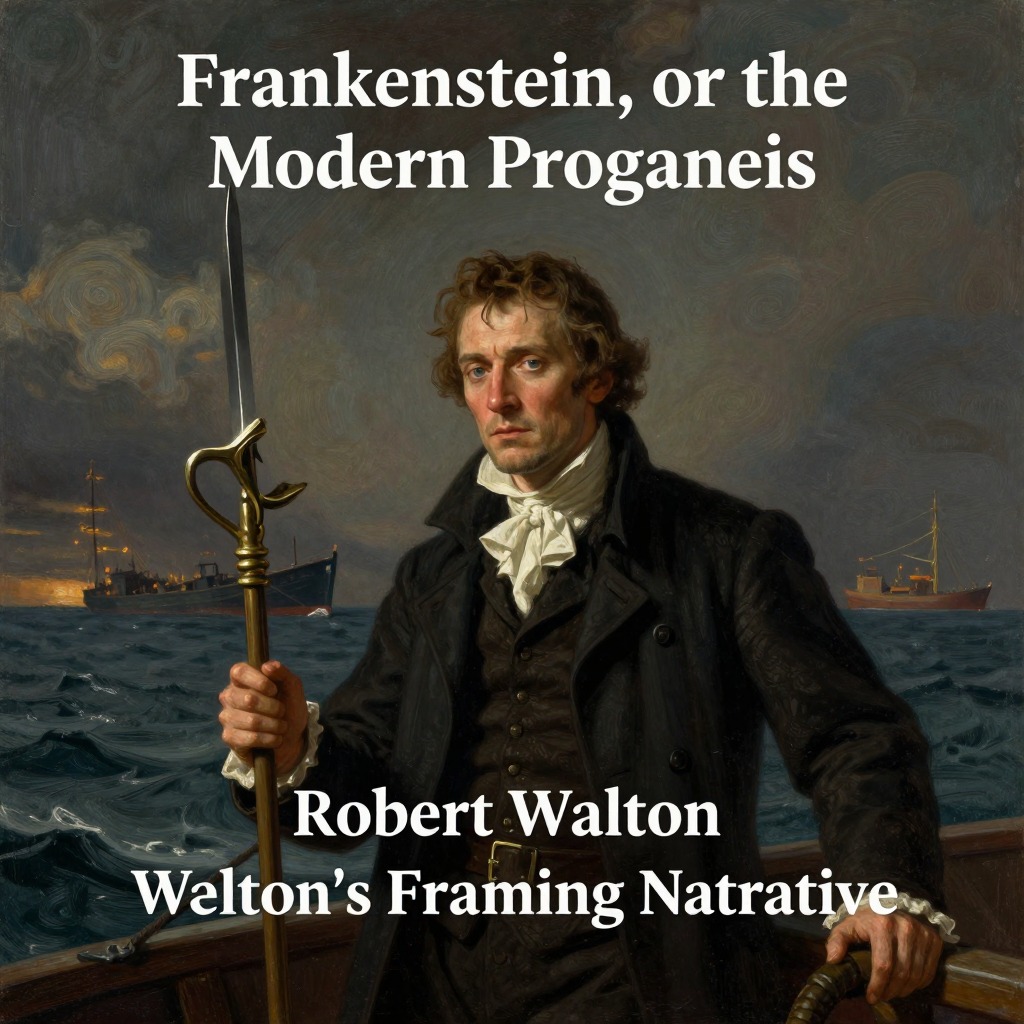
Walton's rescue of Frankenstein is the pivotal framing event that brings the novel's two principal narrators together on the Arctic ice, transforming a failed polar expedition into the occasion for Frankenstein's confession and the story's transmission to the reader. The encounter occurs in Letter 4, when Walton's ship is trapped by ice and the crew spots a sledge driven by a gigantic figure; the next morning, a second sledge drifts toward the vessel carrying a single emaciated European, whom the sailors persuade to come aboard. This rescue sets in motion the entire embedded narrative of Frankenstein's creation and its consequences, and it ultimately shapes Walton's own moral education.
The Rescue and First Impressions
On the morning after the crew had seen the giant figure on the ice, they discovered a sledge that had drifted toward the ship on a large fragment of ice; only one dog remained alive, but a human being was inside. The stranger, though near death, insisted on knowing the ship's destination before accepting help, asking Walton, "Before I come on board your vessel, will you have the kindness to inform me whither you are bound?" When Walton replied that they were on a voyage of discovery toward the northern pole, the stranger appeared satisfied and consented to come aboard. His condition was dire: his limbs were nearly frozen, his body dreadfully emaciated by fatigue and suffering, and he fainted as soon as he left the fresh air. The crew restored him with brandy and soup, wrapped him in blankets, and placed him near the kitchen stove. For two days he could not speak, and Walton feared his sufferings had deprived him of understanding. Once he recovered enough to be moved, Walton removed him to his own cabin and attended him as much as duty would permit. Walton found him an intensely interesting figure: his eyes generally expressed wildness and even madness, but when anyone performed an act of kindness toward him, his whole countenance was "lighted up, as it were, with a beam of benevolence and sweetness that I never saw equalled." Yet he was generally melancholy and despairing, sometimes gnashing his teeth as if impatient of the weight of woes that oppressed him.
The Revelation of Purpose and the Beginning of the Tale
When the lieutenant asked why the stranger had come so far upon the ice in such a strange vehicle, his countenance assumed an aspect of deepest gloom, and he replied, "To seek one who fled from me." Learning that the crew had seen a sledge with a man in it the day before, he asked a multitude of questions about the route the "demon" had pursued. Soon after, alone with Walton, he acknowledged that he had excited curiosity but praised Walton's considerateness in not making inquiries. Walton replied that it would be "very impertinent and inhuman" to trouble him with inquisitiveness, but the stranger insisted that Walton had rescued him from a strange and perilous situation and had benevolently restored him to life. From that time, a new spirit animated his decaying frame; he manifested the greatest eagerness to be on deck to watch for the sledge, but Walton persuaded him to remain in the cabin, promising that someone would watch for him. Walton's affection for his guest grew daily; he found him gentle, wise, and cultivated, with unparalleled eloquence. The stranger, though unhappy, interested himself deeply in Walton's projects, and when Walton spoke with fervor of sacrificing fortune, existence, and every hope to the furtherance of his enterprise, the listener's countenance darkened with a dark gloom. He placed his hands before his eyes, tears trickled from between his fingers, and a groan burst from his heaving breast. "Unhappy man!" he cried. "Do you share my madness? Have you drunk also of the intoxicating draught? Hear me; let me reveal my tale, and you will dash the cup from your lips!"
The Promise to Narrate and Walton's Recording
After recovering from the paroxysm of grief, the stranger asked Walton about his earlier years and his desire for a friend. Walton spoke of his thirst for a more intimate sympathy with a fellow mind, and the stranger replied that they were "unfashioned creatures, but half made up" without such a friend. He revealed that he had once had a friend, the most noble of human creatures, and was entitled to judge respecting friendship. "You have hope, and the world before you," he said, "and have no cause for despair. But I — I have lost everything and cannot begin life anew." The next day, the stranger told Walton that he had suffered great and unparalleled misfortunes and had determined that the memory of these evils should die with him, but Walton had won him to alter that determination. He warned Walton that the gratification of his wishes might be "a serpent to sting you, as mine has been," and offered to relate his story so that Walton might deduce an apt moral from it. Walton eagerly accepted, and the stranger promised to begin the next day. Walton resolved to record the narrative as nearly as possible in the stranger's own words, making notes each night. "Even now, as I commence my task," Walton wrote, "his full-toned voice swells in my ears; his lustrous eyes dwell on me with all their melancholy sweetness; I see his thin hand raised in animation, while the lineaments of his face are irradiated by the soul within."
The Impact on Walton and the Crew
Walton's admiration for Frankenstein deepened as he listened to the tale. He described Frankenstein as a "divine wanderer" with an intuitive discernment, a quick and never-failing power of judgment, a penetration into the causes of things unequalled for clearness and precision, and a voice whose varied intonations were "soul-subduing music." Even broken in spirit, Frankenstein felt the beauties of nature deeply; the starry sky, the sea, and every sight afforded by the wonderful regions still had the power of elevating his soul from earth. Walton observed that Frankenstein seemed to have a "double existence": he might suffer misery and be overwhelmed by disappointments, yet when he retired into himself, he was "like a celestial spirit that has a halo around him, within whose circle no grief or folly ventures." When Frankenstein's tale was complete, Walton's thoughts and every feeling of his soul were drunk up by interest for his guest. He wished to soothe him but could not counsel one so infinitely miserable to live; the only joy Frankenstein could now know would be when he composed his shattered spirit to peace and death. Yet Frankenstein enjoyed one comfort: he believed that when in dreams he held converse with his friends, they were not creations of his fancy but the beings themselves visiting him from a remote world. This faith gave a solemnity to his reveries that Walton found almost as imposing and interesting as truth.
The Final Confrontation and Frankenstein's Death
As the ship remained trapped in ice, Frankenstein's health declined daily; a feverish fire still glimmered in his eyes, but he was exhausted and often sank into apparent lifelessness. When the sailors demanded that Walton promise to return south if the vessel should be freed, Frankenstein roused himself with momentary vigor and delivered a passionate speech urging them to be men, to be steady to their purposes and firm as a rock. The men were moved, but ultimately Walton consented to return. Frankenstein, learning this, declared, "Do so, if you will; but I will not. You may give up your purpose, but mine is assigned to me by heaven, and I dare not." He attempted to spring from the bed but fell back and fainted. The surgeon pronounced that he had not many hours to live. In his final moments, Frankenstein told Walton that he felt justified in desiring the death of his adversary, but he could not ask Walton to renounce his country and friends to fulfill that task. "Seek happiness in tranquillity and avoid ambition," he advised, "even if it be only the apparently innocent one of distinguishing yourself in science and discoveries." His voice became fainter, and after pressing Walton's hand feebly, his eyes closed forever, while the irradiation of a gentle smile passed away from his lips. Walton's tears flowed, and his mind was overshadowed by a cloud of disappointment as he journeyed toward England, carrying the completed manuscript of Frankenstein's tale.