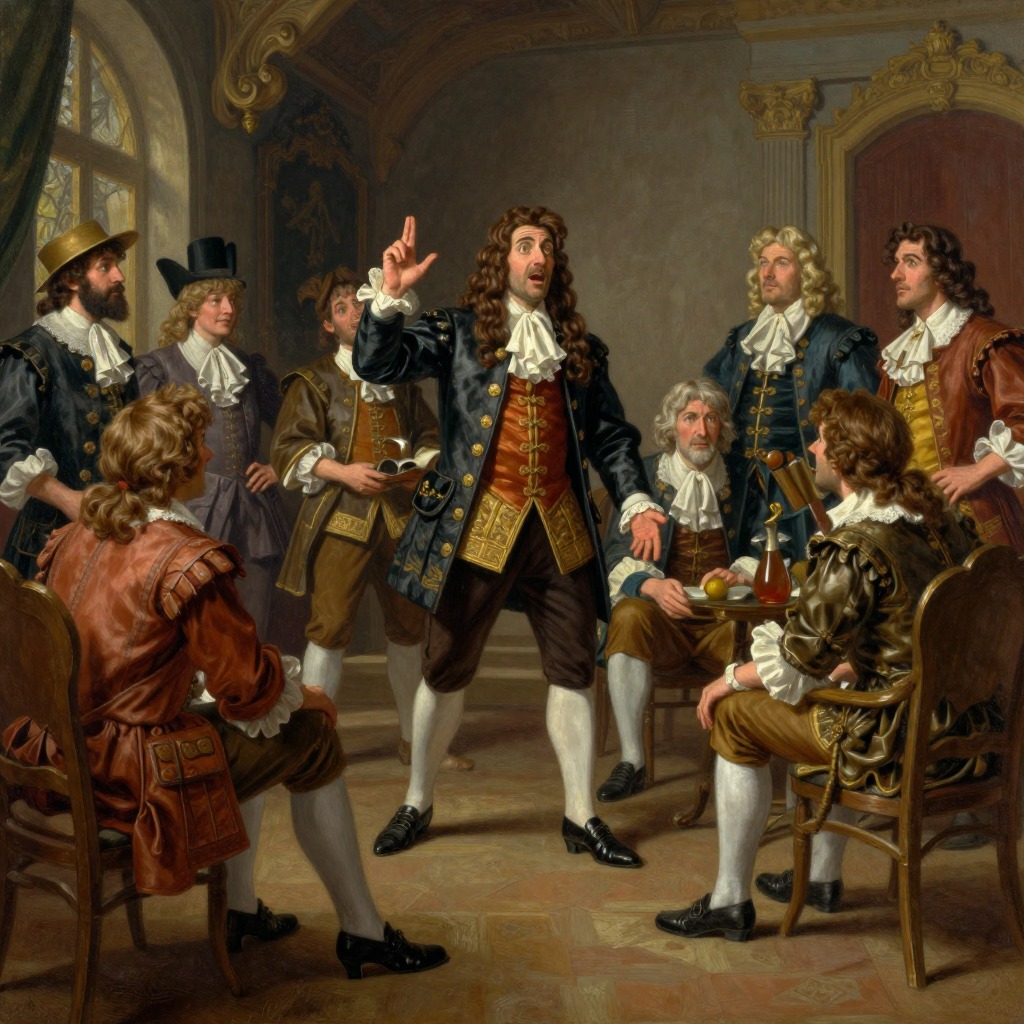
Articles of impeachment
The Articles of impeachment are the formal legal instrument through which the Lilliputian court, led by a cabal of ministers, sought to destroy Lemuel Gulliver after his great services to the empire. The document was prepared by a secret committee of the council and presented to the emperor, who, despite his own inclination toward leniency, allowed the proceedings to move forward. The articles were delivered to Gulliver by his friend Reldresal, the principal secretary for private affairs, who had procured a copy at great personal risk. The impeachment represents the culmination of a two-month intrigue against Gulliver, driven by the enmity of Skyrris Bolgolam, the high admiral, and Flimnap, the lord high treasurer, and supported by Limtoc the general, Lalcon the chamberlain, and Balmuff the grand justiciary.
Contents of the Articles
The Articles of impeachment contained four principal charges, each framed as a violation of Lilliputian law. The first article accused Gulliver of high treason for having, under color of extinguishing a fire in the imperial apartment, maliciously and traitorously pulled the empress by the arms and lifted her high in the air in both his hands, in direct breach of a statute enacted in the reign of Emperor Calin Deffar Plune that made it a capital offense to lay hands upon the empress or any of the royal children. The second article charged that Gulliver, having brought the imperial fleet of Blefuscu into the royal port, was afterward commanded by his imperial majesty to seize all the other ships of that empire, reduce it to a province, and destroy all the Big-endian exiles and all who would not forsake the Big-endian heresy, but that he, like a false traitor, petitioned to be excused upon pretense of unwillingness to force consciences or destroy the liberties and lives of an innocent people. The third article alleged that when certain ambassadors arrived from the court of Blefuscu to sue for peace, Gulliver did, like a false traitor, aid, abet, comfort, and divert them, although he knew them to be servants to a prince who was lately an open enemy. The fourth article charged that Gulliver, contrary to the duty of a faithful subject, was preparing to make a voyage to the court and empire of Blefuscu, for which he had received only verbal license, and under color of that license did falsely and traitorously intend to aid, comfort, and abet the emperor of Blefuscu, so late an enemy. These four articles were the most important, though there were others of lesser weight.
The Council's Debate and the Sentence
In the several debates upon the impeachment, the emperor gave many marks of his great lenity, often urging the services Gulliver had done him and endeavoring to extenuate his crimes. Bolgolam and Flimnap insisted that Gulliver should be put to the most painful and ignominious death, by setting fire to his house at night, with the general attending with twenty thousand men armed with poisoned arrows to shoot him in the face and hands. Some of his servants were to have private orders to strew a poisonous juice on his shirts and sheets, which would soon make him tear his own flesh and die in the utmost torture. For a long time there was a majority against him, but the emperor, resolving if possible to spare his life, at last brought off the chamberlain. Reldresal, commanded by the emperor to deliver his opinion, allowed that Gulliver's crimes were great but argued that there was still room for mercy. He proposed that if his majesty would please to spare Gulliver's life and only give orders to put out both his eyes, justice might in some measure be satisfied, and all the world would applaud the emperor's lenity. The loss of his eyes, Reldresal argued, would be no impediment to his bodily strength, and blindness is an addition to courage by concealing dangers. This proposal was received with the utmost disapprobation by the whole board. Bolgolam rose up in fury, saying he wondered how the secretary durst presume to give his opinion for preserving the life of a traitor, and that the services Gulliver had performed were, by all true reasons of state, the great aggravation of his crimes. The treasurer showed to what straits his majesty's revenue was reduced by the charge of maintaining Gulliver, and argued that the secretary's expedient of putting out his eyes would probably increase the expense, as blinding some sorts of fowls made them feed faster and grow sooner fat. The emperor, fully determined against capital punishment, was graciously pleased to say that since the council thought the loss of his eyes too easy a censure, some other might be inflicted hereafter. Reldresal, humbly desiring to be heard again, proposed that by gradually lessening Gulliver's establishment, for want of sufficient food he would grow weak and faint, lose his appetite, and consume in a few months, and that immediately upon his death five or six thousand of his majesty's subjects might cut his flesh from his bones, take it away by cart-loads, and bury it in distant parts to prevent infection, leaving the skeleton as a monument of admiration to posterity. Thus, by the great friendship of the secretary, the whole affair was compromised. It was strictly enjoined that the project of starving him by degrees should be kept a secret, but the sentence of putting out his eyes was entered on the books, none dissenting except Bolgolam, who, being a creature of the empress, was perpetually instigated by her majesty to insist upon his death, she having borne perpetual malice against him on account of the illegal method he took to remove her and her children the night of the fire.
Gulliver's Response and Escape
Gulliver, having been informed of the entire plot by his friend at court, was left alone under many doubts and perplexities of mind. He sometimes thought of standing his trial, for although he could not deny the facts alleged in the several articles, he hoped they would admit of some extenuation. But having perused many state-trials, which he ever observed to terminate as the judges thought fit to direct, he durst not rely on so dangerous a decision in so critical a juncture and against such powerful enemies. Once he was strongly bent upon resistance, for while he had liberty the whole strength of that empire could hardly subdue him, and he might easily with stones pelt the metropolis to pieces, but he soon rejected that project with horror, remembering the oath he had made to the emperor, the favors he received from him, and the high title of nardac he had conferred upon him. At last he fixed upon a resolution: having his imperial majesty's license to pay his attendance upon the emperor of Blefuscu, he took this opportunity before the three days were elapsed to send a letter to his friend the secretary, signifying his resolution of setting out that morning for Blefuscu pursuant to the leave he had got, and without waiting for an answer, he went to that side of the island where the fleet lay, seized a large man-of-war, tied a cable to the prow, and lifting up the anchors, stripped himself, put his clothes together with his coverlet into the vessel, and drawing it after him, between wading and swimming arrived at the royal port of Blefuscu. The Articles of impeachment thus became the immediate cause of his departure from Lilliput and the beginning of his new adventures in Blefuscu and beyond.
Thematic Significance
The Articles of impeachment encapsulate the central political satire of the Lilliputian voyage. They demonstrate how a court that had benefited enormously from Gulliver's services—the capture of the Blefuscu fleet, the extinguishing of the palace fire—could turn on him with deadly malice over a refusal to commit further atrocities and over a technical violation of a law designed to protect the royal family. The charges are a tissue of legalistic distortions: the act of putting out the fire is recast as a traitorous assault on the empress; the refusal to enslave a whole nation is called treason; the polite reception of peace ambassadors is labeled abetting the enemy. The debate over the sentence reveals the cynicism of the ministers, who propose starvation, poisoning, and mutilation while the emperor's public speeches praise his own lenity. The entire episode is a devastating portrait of court intrigue, ingratitude, and the corruption of justice, and it foreshadows Gulliver's later disillusionment with all forms of political power.