Big-endian and Small-endian controversy
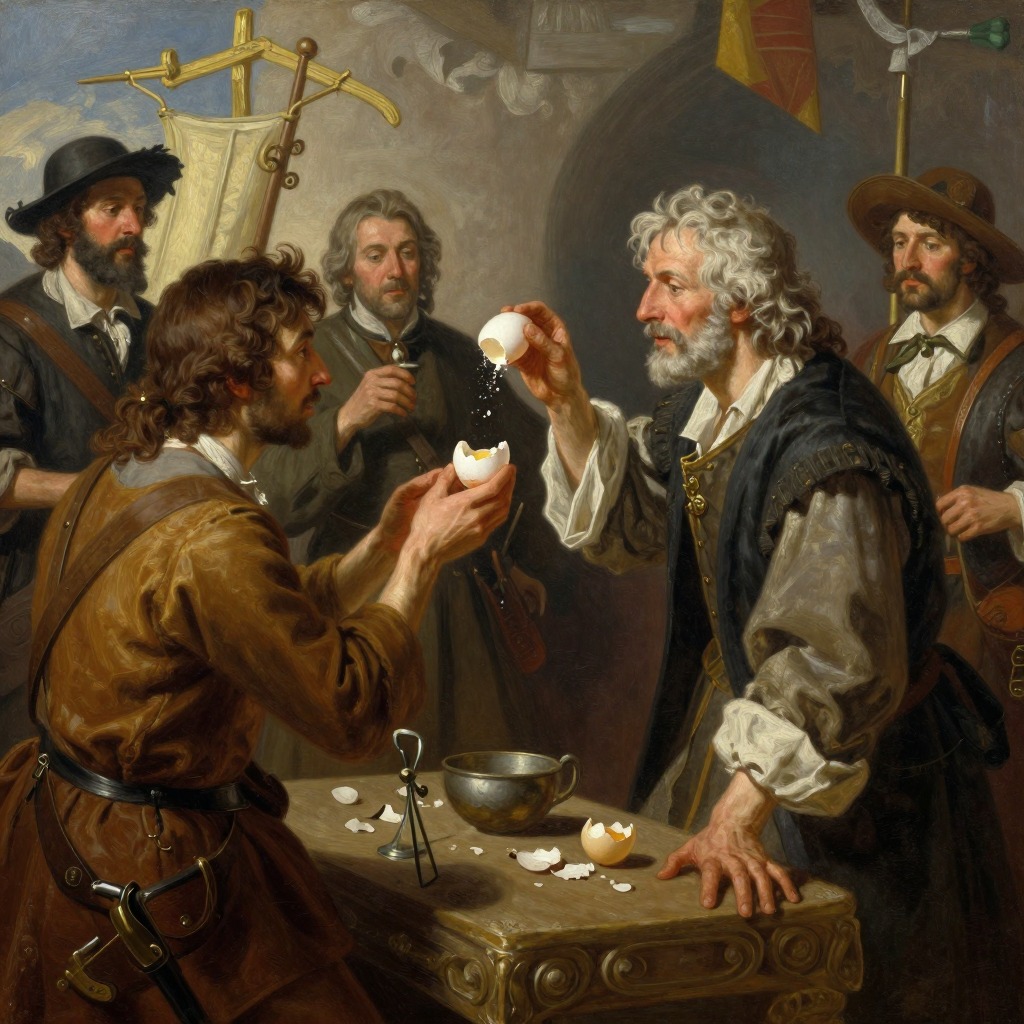
The Big-endian and Small-endian controversy is the foundational religious and political conflict in the empire of Lilliput, a dispute so absurd in its origin and so devastating in its consequences that it stands as Jonathan Swift's most concentrated satire on the irrationality of European sectarian warfare. The entire quarrel turns on a single question: at which end should a boiled egg be broken before eating? The controversy, which has cost tens of thousands of lives, driven exiles to a neighboring empire, and sustained a war of thirty-six moons, began with a trivial accident in the imperial family and was then codified into law, spawning rebellions, religious schism, and a permanent state of enmity between Lilliput and Blefuscu.
Origins and the Imperial Edict
The controversy traces its origin to the grandfather of the reigning Emperor of Lilliput. While still a boy, this prince attempted to eat an egg and broke it according to the ancient practice—that is, upon the larger end. In doing so, he happened to cut one of his fingers. The emperor his father, reacting to this mishap, published an edict commanding all his subjects, under great penalties, to break the smaller end of their eggs. This decree, rather than settling the matter, ignited a firestorm of resistance. The people resented the law so deeply that, according to Lilliputian histories, six rebellions were raised on that account. In the course of these civil commotions, one emperor lost his life and another lost his crown. The exiles from these failed uprisings constantly fled for refuge to the island empire of Blefuscu, whose monarchs fomented the unrest from abroad.
Religious Doctrine and the Schism
The controversy was not merely political but was framed as a matter of religious doctrine. The Lilliputians' great prophet Lustrog, in the fifty-fourth chapter of the Blundecral (their sacred book, analogous to the Koran), had declared that "all true believers break their eggs at the convenient end." The Big-endians, who insisted on breaking the larger end, argued that the phrase "convenient end" left the matter to individual conscience or to the determination of the chief magistrate. The Small-endians, who followed the imperial edict, accused the Big-endians of making a schism in religion by offending against a fundamental doctrine. The books of the Big-endians were long forbidden, and the entire party was rendered incapable by law of holding any employment. The dispute was thus a perfect parody of the theological hair-splitting that fueled the Reformation and the wars of religion in Europe, where minor differences in ritual or interpretation led to persecution, exile, and massacre.
War with Blefuscu and Its Toll
The Big-endian exiles found so much credit at the court of the Emperor of Blefuscu, and received so much private assistance and encouragement from their party at home in Lilliput, that a bloody war was carried on between the two empires for six-and-thirty moons. The conflict had various success on both sides. Lilliput lost forty capital ships and a much greater number of smaller vessels, together with thirty thousand of its best seamen and soldiers. The damage received by the enemy was reckoned to be somewhat greater. At the time of Gulliver's arrival, the Blefuscudians had equipped a numerous fleet and were preparing to make a descent upon Lilliput. It was this imminent invasion that gave Gulliver the opportunity to perform his great service—seizing the entire Blefuscu fleet—and thereby to win the highest title of honor in Lilliput, that of nardac.
The Controversy in the Brobdingnag Context
The Big-endian and Small-endian controversy is not confined to Lilliput; it echoes through the later voyage to Brobdingnag as a measure of the King of Brobdingnag's wisdom and moral clarity. When Gulliver, in his long discourses on the state of England, recounts the history of his own country, the king is perfectly astonished. He protests that the historical account is "only a heap of conspiracies, rebellions, murders, massacres, revolutions, banishments, the very worst effects that avarice, faction, hypocrisy, perfidiousness, cruelty, rage, madness, hatred, envy, lust, malice, and ambition could produce." The king's final verdict on Gulliver's countrymen is that they are "the most pernicious race of little odious vermin that nature ever suffered to crawl upon the surface of the earth." This judgment, delivered after Gulliver has tried to put the best face on English politics, implicitly condemns the egg-breaking war as the epitome of such folly. The king's rejection of gunpowder technology—he would rather lose half his kingdom than be privy to such a secret—further underscores the contrast between Brobdingnagian moral reason and the petty, destructive obsessions of Lilliput and, by extension, of Europe.
Thematic Significance: Satire of Religious and Political Faction
The Big-endian and Small-endian controversy is Swift's most devastating satire on the causes of human conflict. By reducing the casus belli of a long and bloody war to a choice between breaking an egg at the larger or the smaller end, Swift exposes the absurdity of religious and political disputes that are, at bottom, about nothing more than arbitrary custom, power, and prejudice. The controversy mirrors the real-world conflicts of Swift's own time: the wars between Catholics and Protestants, the struggles between High Church and Low Church, and the factional battles between Whigs and Tories. The Lilliputian parties of Tramecksan and Slamecksan—the high heels and the low heels—are another such trivial distinction that divides the nation. The emperor's own preference for low heels in administration, and the heir apparent's hobbling gait because one heel is higher than the other, show how these absurdities are perpetuated even within the royal family. The egg-breaking controversy, with its six rebellions, its thousands of deaths, its exiles, and its war, is the ultimate proof that human beings will kill and die for the most ridiculous of reasons, and that the institutions of religion and state are all too willing to sanctify and enforce such folly.