Blefuscu navy
The Blefuscu navy was the principal instrument of the island empire of Blefuscu, Lilliput's great rival, and its entire battle fleet was famously seized by Lemuel Gulliver in a daring single-handed operation that prevented an invasion of Lilliput and set off a chain of political consequences leading to Gulliver's own flight from the kingdom.
Composition and Disposition
The Blefuscu fleet consisted of about fifty men-of-war, along with a great number of transports, all lying at anchor in the harbor of Blefuscu, ready to sail with the first fair wind. The channel separating Blefuscu from Lilliput was only eight hundred yards wide, and at high water in the middle it was about six feet deep—seventy glumgluffs in Lilliputian measure—while the rest was at most fifty glumgluffs deep. The fleet was thus poised for a direct descent upon Lilliput, a threat that the Lilliputian court took with the utmost seriousness.
Gulliver's Capture of the Fleet
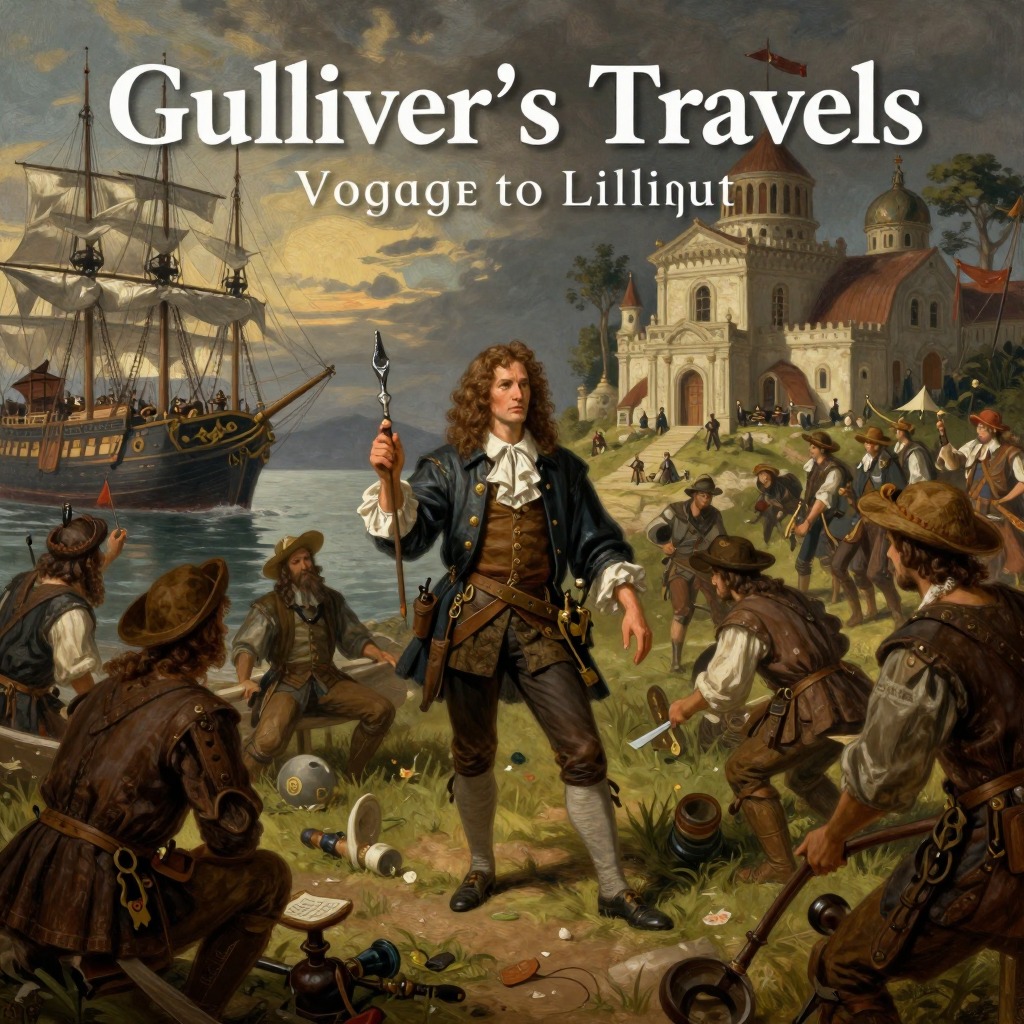
Gulliver, having obtained intelligence of the intended invasion, formed a project to seize the enemy's entire fleet. He first consulted experienced seamen on the depth of the channel, then walked to the northeast coast of Lilliput opposite Blefuscu, where he lay down behind a hillock and viewed the enemy's fleet through his pocket perspective glass. Returning to his house, he obtained a warrant and procured a great quantity of the strongest cable and bars of iron. The cable was about as thick as packthread, and the bars the length and size of a knitting needle; he trebled the cable and twisted three of the iron bars together, bending the extremities into a hook. Having thus fixed fifty hooks to as many cables, he went back to the northeast coast, put off his coat, shoes, and stockings, and walked into the sea in his leathern jerkin about half an hour before high water. He waded with all haste and swam in the middle about thirty yards until he felt ground, arriving at the fleet in less than half an hour. The enemy were so frightened at the sight of him that they leaped out of their ships and swam to shore, where there could not be fewer than thirty thousand souls. Gulliver then fastened a hook to the hole at the prow of each ship and tied all the cords together at the end. While thus employed, the enemy discharged several thousand arrows, many of which stuck in his hands and face; his greatest apprehension was for his eyes, which he saved by taking out his spectacles from a private pocket and fastening them upon his nose. Having fastened all the hooks, he began to pull, but not a ship would stir, for they were all too fast held by their anchors. He therefore let go the cord, resolutely cut with his knife the cables that fastened the anchors—receiving above two hundred shots in his face and hands—then took up the knotted end of the cables and drew fifty of the enemy's largest men-of-war after him. The Blefuscudians, who had not the least imagination of what he intended, were at first confounded with astonishment; when they perceived the whole fleet moving in order and saw him pulling at the end, they set up such a scream of grief and despair as is almost impossible to describe or conceive. Gulliver stopped to pick out the arrows that stuck in his hands and face, rubbed on some of the same ointment given him at his first arrival, took off his spectacles, and waited about an hour until the tide was a little fallen, then waded through the middle with his cargo and arrived safe at the royal port of Lilliput.
Consequences and Aftermath
The capture of the Blefuscu fleet had immediate and far-reaching consequences. The Emperor of Lilliput, standing on the shore with his whole court, received Gulliver with all possible encomiums and created him a nardac upon the spot, the highest title of honor among them. The emperor then desired Gulliver to take some other opportunity to bring all the rest of the enemy's ships into his ports, seeming to think of nothing less than reducing the whole empire of Blefuscu into a province and compelling that people to break the smaller end of their eggs. Gulliver, however, endeavored to divert him from this design by arguments drawn from policy and justice, plainly protesting that he would never be an instrument of bringing a free and brave people into slavery. This open, bold declaration was so opposite to the emperor's schemes that he could never forgive Gulliver; from this time began an intrigue between his majesty and a junto of ministers maliciously bent against Gulliver, which broke out in less than two months and had like to have ended in his utter destruction. About three weeks after the exploit, a solemn embassy arrived from Blefuscu with humble offers of peace, which was soon concluded upon conditions very advantageous to the Lilliputian emperor. The six ambassadors, with a train of about five hundred persons, made a magnificent entry, and when their treaty was finished, they made Gulliver a visit in form, complimenting him upon his valor and generosity and inviting him to that kingdom. Gulliver's intercourse with these ambassadors was later represented by Flimnap and Bolgolam as a mark of disaffection, contributing to the conspiracy against him. When Gulliver eventually fled to Blefuscu to escape the Lilliputian court's plot to blind him, the Emperor of Blefuscu, having taken three days to consult, returned an answer to the Lilliputian envoy that sending Gulliver bound was impossible, and that he had found a prodigious vessel on the shore which he had given orders to fit up, hoping in a few weeks both empires would be freed from so insupportable an incumbrance. The Blefuscu navy, once a formidable invading force, thus became the catalyst for Gulliver's greatest service to Lilliput, the peace between the two empires, and ultimately the instrument of his own departure from both.