Brobdingnag
Brobdingnag is the kingdom of giants that Lemuel Gulliver visits after his voyage on the "Adventure," a land where everything—people, animals, plants, and buildings—exists on a colossal scale, and where the king's rational and humane governance stands in stark contrast to the corruption and folly of European courts. The kingdom is a peninsula, terminated to the northeast by a range of impassable mountains thirty miles high, and bounded on the other three sides by the ocean. It has no sea-ports, and its coasts are so full of pointed rocks and rough seas that the inhabitants are wholly excluded from commerce with the rest of the world. The whole extent of the prince's dominions reaches about six thousand miles in length and from three to five in breadth. The country is well inhabited, containing fifty-one cities, near a hundred walled towns, and a great number of villages. The metropolis, Lorbrulgrud, or "Pride of the Universe," stands on a river and contains above eighty thousand houses and about six hundred thousand inhabitants; it is fifty-four English miles long and two and a half broad. The king's palace is a heap of buildings about seven miles round, with chief rooms generally two hundred and forty feet high. The king's kitchen is a noble building vaulted at top and about six hundred feet high, and the great oven is nearly as wide as the cupola at St. Paul's. The chief temple's tower, though the highest in the kingdom, is not above three thousand feet high, which Gulliver finds disappointing compared to Salisbury steeple, though its walls are nearly a hundred feet thick and built of hewn stone forty feet square, adorned with statues of gods and emperors cut in marble larger than life.
Geography and Scale
The kingdom of Brobdingnag is a vast peninsula, its northeast border sealed by a ridge of mountains thirty miles high, impassable due to volcanoes on their peaks. The ocean bounds it on the other three sides, and the coasts are so treacherous—full of pointed rocks and rough seas—that no boat can venture out, leaving the people entirely isolated from the rest of the world. The large rivers, however, are full of vessels and abound with excellent fish, for the sea-fish are of the same size as those in Europe and not worth catching. Whales, sometimes dashed against the rocks, are brought in hampers to Lorbrulgrud as curiosities; Gulliver saw one in a dish at the king's table, but the king was not fond of it. The country is well inhabited, with fifty-one cities, near a hundred walled towns, and a great number of villages. The metropolis, Lorbrulgrud, is fifty-four English miles long and two and a half broad, containing above eighty thousand houses and about six hundred thousand inhabitants. The king's palace is a heap of buildings about seven miles round, with chief rooms generally two hundred and forty feet high. The king's kitchen is a noble building vaulted at top and about six hundred feet high, and the great oven is nearly as wide as the cupola at St. Paul's. The chief temple's tower, though the highest in the kingdom, is not above three thousand feet high, which Gulliver finds disappointing compared to Salisbury steeple, though its walls are nearly a hundred feet thick and built of hewn stone forty feet square, adorned with statues of gods and emperors cut in marble larger than life.
Government and Military
The king of Brobdingnag is a prince of much gravity and austere countenance, educated in philosophy and mathematics, and possessed of a clear apprehension and exact judgment. He lives wholly secluded from the rest of the world, which Gulliver blames for his narrow thinking, but the king's own governance is marked by justice, lenity, and a profound moral sense. The king's army consists of a hundred and seventy-six thousand foot and thirty-two thousand horse, made up of tradesmen and farmers commanded by the nobility and gentry without pay or reward. They are perfect in their exercises and under very good discipline. Gulliver has seen the militia of Lorbrulgrud drawn out to exercise in a great field twenty miles square, with twenty-five thousand foot and six thousand horse; a cavalier mounted on a large steed might be about ninety feet high, and when the whole body of horse draws their swords at once, it looks like ten thousand flashes of lightning darting from every quarter of the sky. The king keeps about six hundred horses in his stables, generally from fifty-four to sixty feet high, and on solemn days he is attended by a militia guard of five hundred horse.
Laws and Learning
The learning of Brobdingnag is very defective, consisting only in morality, history, poetry, and mathematics, wherein they excel. Mathematics is wholly applied to what may be useful in life, to the improvement of agriculture and all mechanical arts. No law of that country may exceed in words the number of letters in their alphabet, which consists only of twenty-two; they are expressed in the most plain and simple terms, and to write a comment upon any law is a capital crime. Their precedents are so few that they have little reason to boast of any extraordinary skill in civil or criminal causes. They have had the art of printing time out of mind, but their libraries are not very large; the king's library, the largest, does not amount to above a thousand volumes, placed in a gallery of twelve hundred feet long. Their style is clear, masculine, and smooth, but not florid, for they avoid multiplying unnecessary words. The king, when Gulliver offers him the secret of gunpowder, is struck with horror and protests that he would rather lose half his kingdom than be privy to such a secret, which he commands Gulliver never to mention again. He confines the knowledge of governing within very narrow bounds, to common sense and reason, to justice and lenity, and gives it for his opinion that whoever could make two ears of corn or two blades of grass to grow upon a spot of ground where only one grew before would deserve better of mankind than the whole race of politicians put together.
Narrative Significance
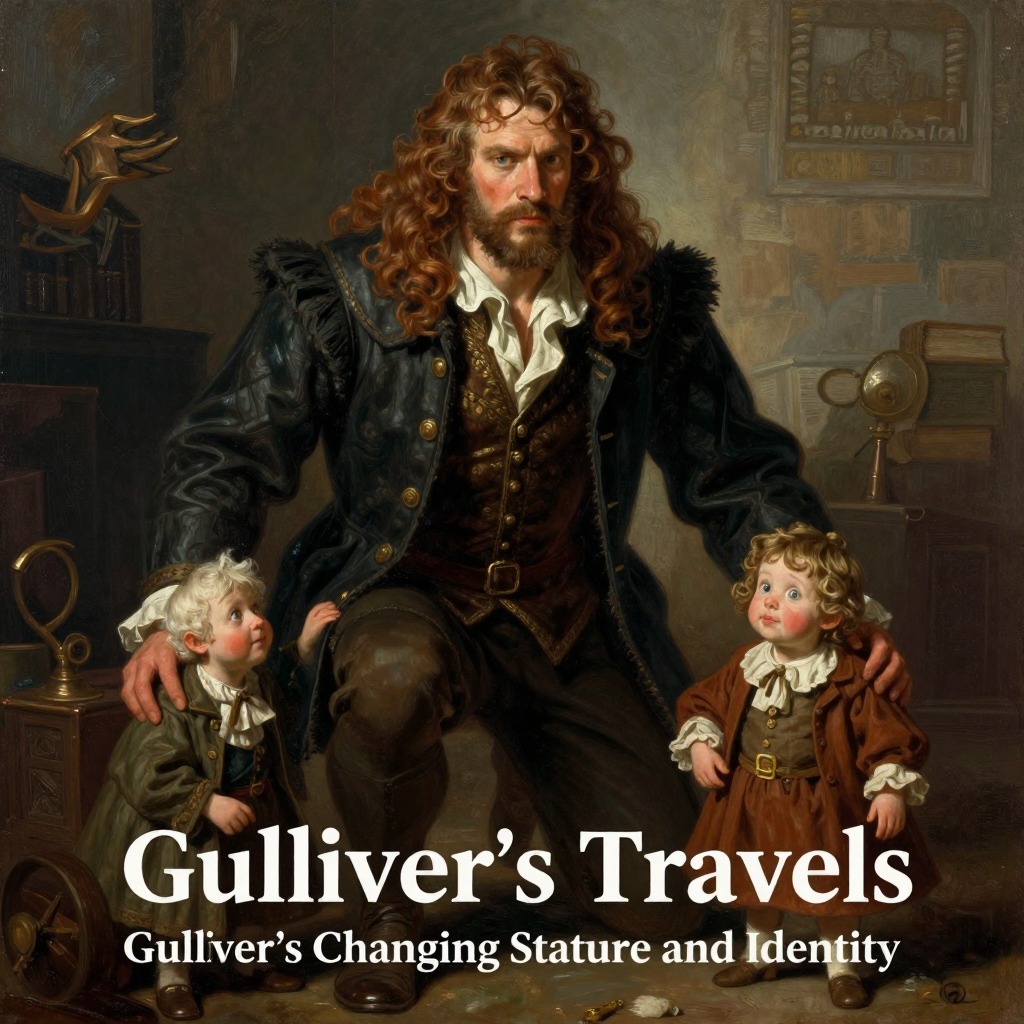
Brobdingnag functions as a satirical device that reverses the power dynamics of Gulliver's earlier adventure in Lilliput. Where Gulliver was a giant among tiny people, here he is a diminutive curiosity, a "splacnuck" or "lusus naturae" (freak of nature), whose European pretensions are exposed as contemptible by the king's rational scrutiny. The king's rejection of gunpowder and his condemnation of European history as "a heap of conspiracies, rebellions, murders, massacres, revolutions, banishments" directly challenges the reader's assumptions about progress and civilization. Gulliver's own psychological adaptation to the giant scale—his difficulty readjusting to normal human size upon his return, stooping to enter his own house, and addressing his wife as if she were a pygmy—underscores the relativity of perspective that is the book's central theme. The kingdom's isolation from the rest of the world, enforced by its impassable mountains and treacherous coasts, makes it a kind of moral laboratory where the king's uncorrupted judgment can pass sentence on European corruption without ever having seen it.