Brobdingnag military system
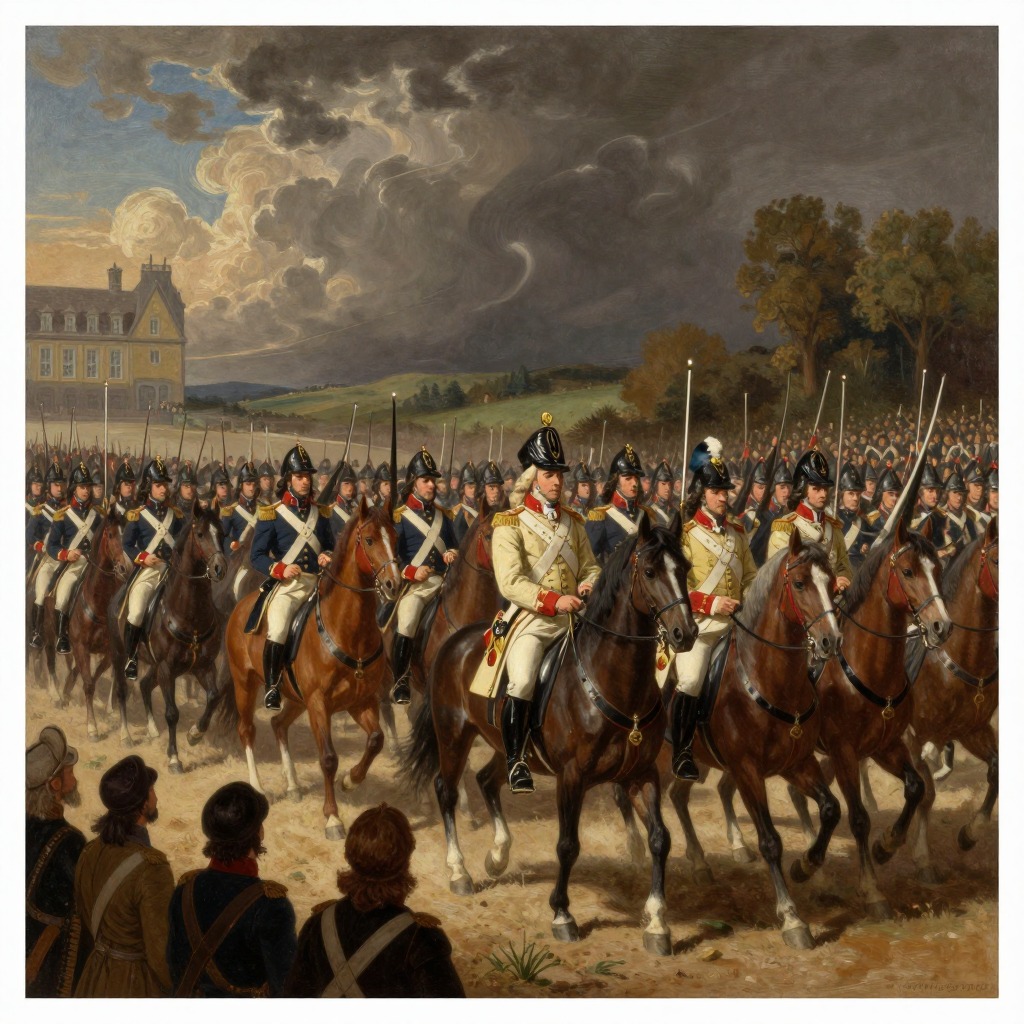
The military system of Brobdingnag stands as a deliberate contrast to the professional, mercenary armies of Europe, embodying the kingdom's principles of simplicity, self-reliance, and moral restraint. Unlike the standing armies that Gulliver describes from his own country, the Brobdingnag forces are a militia of citizens—tradesmen from the cities and farmers from the countryside—whose commanders are drawn from the nobility and gentry, serving without pay or reward. This structure reflects a society that has no external enemies to fear, being a peninsula isolated by impassable mountains and a rough ocean, and whose military history is one of internal conflict rather than foreign war. The system is thus a product of the kingdom's unique geography and its king's rejection of aggressive expansion, and it serves as a vehicle for Swift's satire of European militarism and political ambition.
Composition and Command
The Brobdingnag army is composed entirely of civilians: the king's forces are said to number one hundred seventy-six thousand foot and thirty-two thousand horse, but these are not professional soldiers. Instead, they are ordinary subjects—tradesmen from the various cities and farmers from the countryside—who are called to service when needed. Their commanders are the nobility and gentry, who lead without any financial compensation. This arrangement is possible because every farmer is under the command of his own landlord, and every citizen under that of the principal men in his own city, chosen by ballot in a manner resembling the Venetian system. The militia is thus a direct extension of the social hierarchy, with local lords responsible for the men on their lands. Gulliver observes that the troops are perfect enough in their exercises and under very good discipline, but he finds little merit in this, arguing that it could hardly be otherwise given the structure of command.
Size and Spectacle
Gulliver witnesses the militia of Lorbrulgrud, the metropolis, drawn out to exercise in a great field near the city, measuring twenty miles square. The force on display consisted of no more than twenty-five thousand foot and six thousand horse, but the sheer scale of the Brobdingnagian soldiers made the spectacle overwhelming. A single cavalryman mounted on a large steed might be about ninety feet high. When the entire body of horse drew their swords at once and brandished them in the air, Gulliver describes the sight as if ten thousand flashes of lightning were darting from every quarter of the sky—an image of sublime power that no imagination could surpass. This description underscores the awe that the Brobdingnagians inspire in Gulliver, but also the absurdity of such a massive military apparatus in a kingdom with no foreign enemies.
Historical Origins and Purpose
The Brobdingnag military system did not arise from a need to defend against external invasion, but from the same internal diseases that afflict all mankind: the nobility contending for power, the people for liberty, and the king for absolute dominion. Over many ages, these three parties had sometimes violated the laws of the kingdom, occasioning civil wars. The last such war was ended by the current king's grandfather through a general composition, or compact, and the militia was then established with common consent and has since been kept in the strictest duty. The military is thus a domestic peacekeeping force, designed to prevent the very conflicts that had once torn the kingdom apart. This history explains why the king, though he possesses a large army, has no ambition to use it for conquest—a point that becomes central to his rejection of Gulliver's offer of gunpowder.
The King's Rejection of Gunpowder and Its Implications
Gulliver, hoping to ingratiate himself further with the king, offers to teach the Brobdingnagians the secret of gunpowder, describing its power to destroy armies, batter walls, and sink ships. He proposes to direct the king's workmen in making cannon of a size proportionable to the kingdom, which could batter down the strongest town in a few hours. The king's reaction is one of horror. He is amazed that so impotent and groveling an insect as Gulliver could entertain such inhuman ideas, and he protests that he would rather lose half his kingdom than be privy to such a secret. He commands Gulliver, on pain of death, never to mention it again. This rejection is not a sign of ignorance, as Gulliver bitterly claims, but of a moral and political philosophy that values life and liberty over the power to destroy. The king's refusal to adopt gunpowder is consistent with the militia system itself: a military designed for internal balance, not for aggression or tyranny. Gulliver, viewing the matter through European eyes, sees this as a "strange effect of narrow principles and short views," but the narrative makes clear that the king's scruple is a mark of his wisdom and humanity.
Thematic Significance
The Brobdingnag military system, together with the king's rejection of gunpowder, forms a key part of Swift's satire of European politics and warfare. The militia, with its unpaid officers and citizen soldiers, stands in implicit contrast to the professional armies and mercenaries of Europe, which Gulliver elsewhere describes as expensive, quarrelsome, and prone to corruption. The king's horror at gunpowder is a direct rebuke to the European enthusiasm for military technology and conquest. Yet Swift does not present Brobdingnag as a perfect utopia; the kingdom has its own history of civil war and its own flaws. The military system is a practical response to those flaws, not a blueprint for an ideal society. It is, like the kingdom's laws and learning, a product of a confined and isolated world, but one that has, in its own terms, achieved a measure of peace and stability.