Emperor of Blefuscu
The Emperor of Blefuscu is the sovereign of the island empire of Blefuscu, the other great power of the universe in the Lilliputian world, and the primary adversary of the Emperor of Lilliput. His role in Gulliver's narrative is defined by a series of diplomatic and strategic interactions that reveal a ruler of pragmatism, generosity, and a keen sense of political expediency, ultimately serving as the catalyst for Gulliver's final escape from the region.
Identity and Political Context
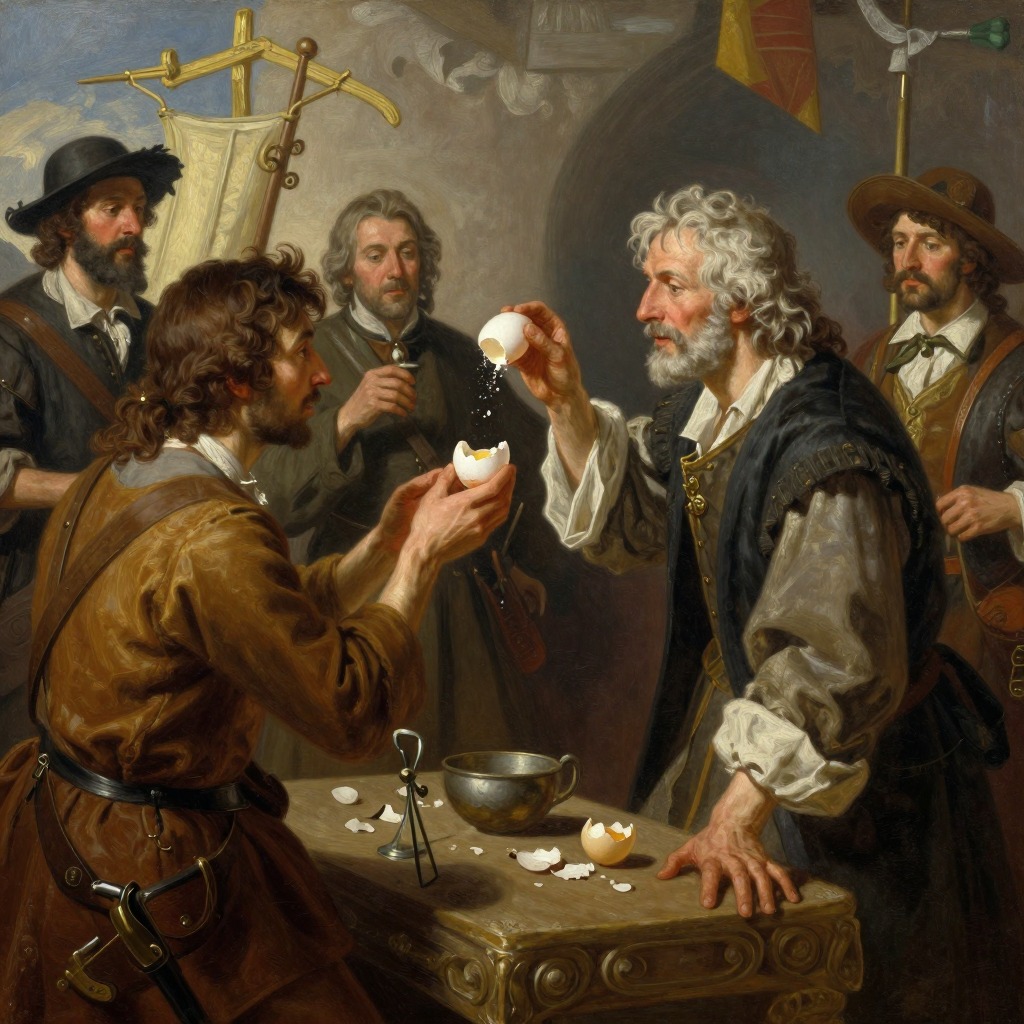
The Emperor of Blefuscu rules an empire that is described as being almost as large and powerful as Lilliput itself. The two nations have been engaged in a bitter and protracted war for six-and-thirty moons, a conflict that originated from a religious schism over the proper end at which to break an egg. The Big-endian exiles, who refused to obey the Lilliputian law requiring eggs to be broken at the smaller end, have found refuge and support at the Blefuscu court, making the emperor a key figure in the ongoing conflict. This war has been costly for both sides, with Lilliput alone losing forty capital ships and thirty thousand men, though the damage to Blefuscu is said to be even greater.
Diplomatic Engagement and the Peace Treaty
Following Gulliver's extraordinary capture of the entire Blefuscu navy, the emperor was compelled to seek peace. About three weeks after that exploit, a solemn embassy of six ambassadors, with a train of about five hundred persons, arrived in Lilliput with humble offers of peace. The treaty was soon concluded on conditions very advantageous to the Lilliputian emperor. During the negotiations, Gulliver, who had gained considerable credit at court, performed several good offices for the Blefuscudian ambassadors. In gratitude, the ambassadors, who had been privately told of his friendship, made a formal visit to Gulliver, complimenting his valor and generosity, and inviting him to their kingdom in the name of their master. This interaction, however, sowed seeds of suspicion in Lilliput, as Flimnap and Skyrris Bolgolam represented Gulliver's intercourse with the ambassadors as a mark of disaffection.
Reception of Gulliver and the Decision to Let Him Go
When Gulliver, fleeing the conspiracy against him in Lilliput, arrived at the royal port of Blefuscu, the emperor's response was one of formal welcome and calculated prudence. The emperor, attended by the royal family and great officers of the court, came out to receive him. Gulliver lay on the ground to kiss his majesty's and the empress's hand. The emperor offered him gracious protection if he would continue in his service, but Gulliver, having learned to distrust princes, declined. The emperor was not at all displeased by this refusal; in fact, Gulliver discovered by a certain accident that the emperor was very glad of his resolution, as were most of his ministers. When an envoy from Lilliput arrived demanding Gulliver's return in chains, the Emperor of Blefuscu, after three days of consultation, returned a polite but firm refusal. He stated that sending Gulliver bound was impossible, and that while Gulliver had deprived him of his fleet, he owed him great obligations for his role in making the peace. He then revealed that Gulliver had found a vessel on the shore, which he had ordered to be fitted up, and expressed the hope that in a few weeks both empires would be freed from so insupportable an incumbrance.
Role in Gulliver's Departure and Final Gifts
The Emperor of Blefuscu actively facilitated Gulliver's departure. He provided five hundred workmen to make sails for the boat, and his ship-carpenters assisted in smoothing the timber for oars and masts. When all was prepared, the emperor and the royal family came out of the palace to bid farewell. Gulliver lay down on his face to kiss the emperor's hand, which he very graciously gave him, as did the empress and the young princes. The emperor presented Gulliver with fifty purses of two hundred sprugs each, along with his picture at full length, which Gulliver immediately put into one of his gloves to keep it from being hurt. This generous send-off, combined with his earlier diplomatic maneuvering, paints a portrait of a ruler who, while an enemy in war, was a pragmatic and courteous host who saw the advantage in peacefully ridding his realm of a potentially destabilizing giant.