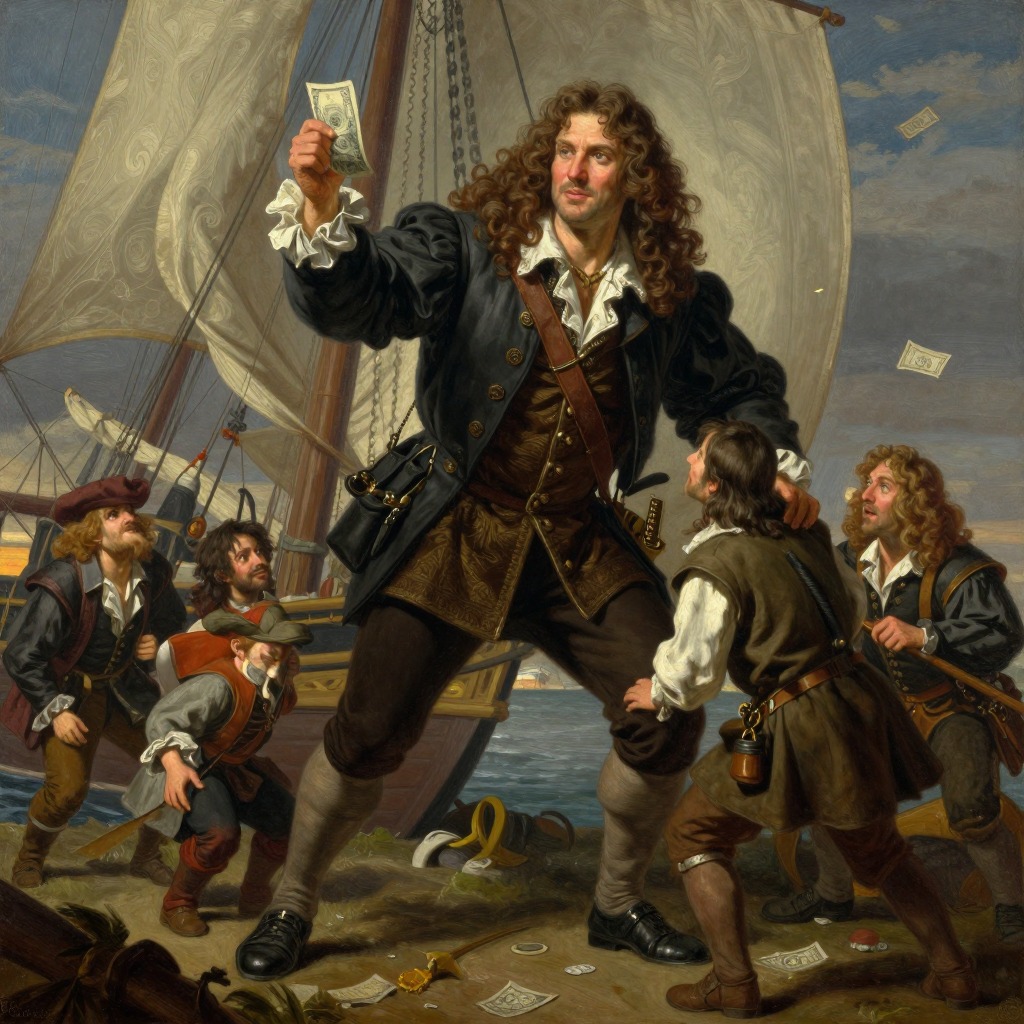
Gulliver's capture by the farmer in Brobdingnag
Gulliver's capture by the farmer in Brobdingnag marks the abrupt end of his brief freedom on the coast of a strange land and the beginning of his life as a captive spectacle. After the shipwreck of the Adventure and a terrifying glimpse of a giant pursuing his shipmates, Gulliver finds himself utterly alone in a landscape where the grass is twenty feet high and the corn rises at least forty feet. His desperate attempt to hide in a field of barley fails when he is discovered by a reaper, a creature as tall as an ordinary spire steeple who takes ten yards at every stride. The farmer, a substantial man who turns out to be the reaper's master, carries Gulliver home, where he is introduced to the farmer's family and subjected to a series of humiliating and dangerous encounters that foreshadow his future as a public exhibition.
Discovery and Capture
Gulliver's ordeal begins on June 16, 1703, when a boy on the topmast of the Adventure spots land. The captain sends a dozen armed men in the long-boat to fetch water, and Gulliver, eager to see the country, obtains leave to join them. Upon landing, the men find no fresh water and wander the shore, while Gulliver walks alone about a mile inland, observing the barren and rocky terrain. Growing weary, he returns toward the creek and sees his shipmates rowing frantically for the ship, pursued by a huge creature wading through the sea. Gulliver runs as fast as he can, climbs a steep hill, and finds himself in a fully cultivated country where the grass is twenty feet high. He follows a high road through a field of barley, the corn rising at least forty feet, and after an hour's walk reaches a stile with steps six feet high and an upper stone above twenty feet. Unable to climb it, he searches for a gap in the hedge and discovers one of the inhabitants in the next field, advancing toward the stile. The creature, as tall as an ordinary spire steeple, calls out in a voice louder than a speaking trumpet, and seven monsters like himself, carrying reaping-hooks the size of six scythes, come toward him. Gulliver hides in the corn, but the reapers begin to reap the field where he lies. He moves with extreme difficulty through the stalks, sometimes no more than a foot apart, until he reaches a part where the corn has been laid by rain and wind, making it impossible to advance. The beards of the fallen ears pierce through his clothes into his flesh, and he hears the reapers not a hundred yards behind him. Overcome by grief and despair, he lies down between two ridges, wishing for death, and reflects bitterly on his folly in undertaking a second voyage against the advice of his friends. He contrasts his former power in Lilliput, where he could draw an imperial fleet, with his current helplessness, and contemplates the philosophical truth that nothing is great or little but by comparison. When one of the reapers approaches within ten yards, Gulliver screams as loud as fear can make him. The huge creature treads short, looks around, and finally espies him on the ground. He considers Gulliver with the caution of one trying to lay hold on a small dangerous animal, then ventures to take him up between his forefinger and thumb, bringing him within three yards of his eyes. Gulliver, resolved not to struggle, raises his eyes to the sun, places his hands together in a supplicating posture, and speaks in a humble melancholy tone. The creature appears pleased with his voice and gestures, and begins to look upon him as a curiosity. Gulliver, in great pain from the pressure of the giant's thumb and finger, groans and sheds tears, letting him know how cruelly he is hurt. The creature seems to understand, lifts up the lappet of his coat, puts Gulliver gently into it, and runs to his master, the same substantial farmer Gulliver had first seen in the field.
Examination by the Farmer and His Family
The farmer, having received an account from his servant, takes a piece of small straw about the size of a walking-staff and lifts up the lappets of Gulliver's coat, which he takes to be some kind of natural covering. He blows Gulliver's hair aside to get a better view of his face, calls his hinds about him, and asks if they have ever seen any little creature like him. He then places Gulliver softly on the ground on all fours, but Gulliver immediately gets up and walks slowly backwards and forwards to show he has no intent to run away. The farmer and his hinds sit down in a circle around him to observe his motions. Gulliver pulls off his hat, makes a low bow, falls on his knees, lifts up his hands and eyes, and speaks several words as loud as he can. He takes a purse of gold out of his pocket and humbly presents it to the farmer, who receives it on his palm, applies it close to his eye, turns it several times with the point of a pin, but cannot make anything of it. Gulliver then pours all the gold into the farmer's palm—six Spanish pieces of four pistoles each, besides twenty or thirty smaller coins—but the farmer, wetting his little finger on his tongue and taking up one of the largest pieces, remains wholly ignorant of what they are. He makes a sign for Gulliver to put them back into his purse and pocket, which Gulliver does after offering it to him several times. Convinced that Gulliver is a rational creature, the farmer speaks to him often, but his voice pierces Gulliver's ears like a water-mill. Gulliver answers as loud as he can in several languages, but they are wholly unintelligible to each other. The farmer sends his servants to their work, takes his handkerchief out of his pocket, doubles and spreads it on his left hand, and makes a sign for Gulliver to step into it. Gulliver obeys, laying himself at full length on the handkerchief for fear of falling, and the farmer laps him up to the head and carries him home. There he calls his wife and shows her Gulliver, but she screams and runs back, as women in England do at the sight of a toad or a spider. However, after observing Gulliver's behavior and how well he follows the signs her husband makes, she is soon reconciled and by degrees grows extremely tender of him.
The First Dinner and Initial Dangers
At about twelve noon, a servant brings in dinner—one substantial dish of meat in a dish about twenty-four feet in diameter. The company consists of the farmer, his wife, three children, and an old grandmother. The farmer places Gulliver at some distance from him on the table, which is thirty feet high from the floor. Gulliver, in a terrible fright, keeps as far as he can from the edge for fear of falling. The wife minces a bit of meat, crumbles some bread on a trencher, and places it before him. Gulliver makes a low bow, takes out his knife and fork, and falls to eat, giving them exceeding delight. The mistress sends her maid for a small dram cup holding about three gallons, fills it with drink, and Gulliver, taking up the vessel with much difficulty in both hands, drinks to her ladyship's health in English, making the company laugh so heartily that he is almost deafened. The liquor tastes like small cider and is not unpleasant. The master makes a sign for Gulliver to come to his trencher-side, but as he walks on the table, he happens to stumble against a crust and falls flat on his face, receiving no hurt. He gets up immediately, takes his hat, waves it over his head, and makes three huzzas to show he has got no mischief. Advancing toward his master, the farmer's youngest son, an arch boy of about ten years old, takes Gulliver up by the legs and holds him so high in the air that Gulliver trembles in every limb. The father snatches Gulliver from him, gives the boy such a box in the left ear as would have felled a European troop of horse, and orders him to be taken from the table. Gulliver, fearing the boy might owe him a spite, falls on his knees and points to the boy, making his master understand that he desires his son might be pardoned. The father complies, the lad takes his seat again, and Gulliver goes to him and kisses his hand. In the midst of dinner, the mistress's favorite cat leaps into her lap. Gulliver hears a noise behind him like that of a dozen stocking-weavers at work and finds it proceeds from the purring of the cat, which seems three times larger than an ox. The fierceness of the creature's countenance discomposes him, though he stands at the further end of the table, above fifty feet off, and the mistress holds her fast. However, the cat takes no notice of him when the master places him within three yards of her. Gulliver, remembering that showing fear before a fierce animal is a certain way to make it attack, walks with intrepidity five or six times before the very head of the cat and comes within half a yard of her, whereupon she draws herself back as if more afraid of him. He has less apprehension concerning the dogs, three or four of which come into the room, including a mastiff equal in bulk to four elephants and a greyhound somewhat taller. When dinner is almost done, the nurse comes in with a child of a year old in her arms, who immediately spies Gulliver and begins a squall that could be heard from London Bridge to Chelsea. The mother, out of pure indulgence, takes Gulliver up and puts him toward the child, who presently seizes him by the middle and gets his head in its mouth. Gulliver roars so loud that the urchin is frightened and lets him drop, and he would infallibly have broken his neck if the mother had not held her apron under him. The nurse, to quiet her babe, makes use of a rattle, a kind of hollow vessel filled with great stones and fastened by a cable to the child's waist. After dinner, the master goes out to his labors, giving his wife a strict charge to take care of Gulliver. Tired and disposed to sleep, Gulliver is put on the mistress's own bed and covered with a clean white handkerchief, larger and coarser than the mainsail of a man-of-war. He sleeps about two hours, dreaming of home, and awakes to find himself alone in a vast room between two and three hundred feet wide and above two hundred high, lying in a bed twenty yards wide. The mistress has locked him in. Presently, two rats creep up the curtains and run smelling backwards and forwards on his bed. One of them comes almost up to his face, and Gulliver rises in a fright and draws out his hanger to defend himself. The horrible animals attack him on both sides, and one holds his forefeet at Gulliver's collar, but Gulliver kills him before he can do any mischief. The other escapes with a good wound on the back. Gulliver measures the tail of the dead rat and finds it to be two yards long wanting an inch, and he thoroughly dispatches it with a strong slash across the neck. These creatures are the size of a large mastiff, but infinitely more nimble and fierce.
Consequences and Significance
This event establishes the fundamental power reversal of the Brobdingnag voyage: Gulliver, who in Lilliput was a colossus capable of drawing an entire fleet, is now a helpless plaything, a "Grildrig" or mannikin, at the mercy of beings who could crush him without noticing. The farmer, recognizing Gulliver's potential as a source of income, soon begins to exhibit him for money, first in the neighboring market-town and later across the kingdom, leading directly to his sale to the Queen of Brobdingnag. The capture also introduces Glumdalclitch, the farmer's nine-year-old daughter, who becomes Gulliver's devoted nurse, teacher, and protector, and whose care and affection he acknowledges as the chief reason for his preservation in that country. The event's vivid depiction of Gulliver's physical vulnerability—his terror at the cat, his near-fatal encounter with the child, his battle with the giant rats—establishes the constant danger and humiliation that characterize his life in Brobdingnag, while his reflections on the relativity of size and power introduce the philosophical and satirical themes that Swift develops throughout the voyage.