Lilliput
Lilliput is the first foreign land Lemuel Gulliver encounters after the shipwreck of the "Antelope" on November 5, 1699. It is an island empire whose inhabitants stand under six inches tall, and whose entire civilization—its capital city Mildendo, its emperor's palace, its farms, forests, and armies—is built to a correspondingly miniature scale. The country is bounded by a channel eight hundred yards wide that separates it from the rival empire of Blefuscu. Gulliver's arrival as a colossal "Man-mountain" (Quinbus Flestrin) immediately disrupts the Lilliputians' established order, and his subsequent adventures there expose a society that is at once ingeniously rational and absurdly corrupt, providing the book's first sustained satirical portrait of European politics, religion, and law.
Geography and Scale
Lilliput is a compact realm whose dimensions Gulliver carefully measures. The metropolis Mildendo is an exact square, each side of its wall five hundred feet long, with two main streets five feet wide crossing at the center; the city can hold five hundred thousand souls. The emperor's palace stands at this central intersection, enclosed by a two-foot-high wall, and its innermost apartments are accessible only through gates eighteen inches high and seven inches wide. The countryside around Mildendo resembles a continued garden, with enclosed fields of forty feet square and the tallest trees reaching seven feet. The entire empire's circumference, as Gulliver later surveys it by pacing, is about twelve miles. The Lilliputians themselves are proportioned to this world: their tallest horses and oxen are between four and five inches high, their sheep an inch and a half, their geese the size of a sparrow. Their sight is correspondingly acute—a cook can pluck a lark no larger than a common fly, and a young girl can thread an invisible needle with invisible silk.
Political Structure and Factions
Lilliput is an absolute monarchy whose emperor, Golbasto Momaren Evlame Gurdilo Shefin Mully Ully Gue, rules from the palace at Belfaborac. He is taller than any of his subjects by almost the breadth of Gulliver's nail, with an Austrian lip, arched nose, olive complexion, and majestic deportment; at the time of Gulliver's arrival he is twenty-eight years and three-quarters old and has reigned about seven years in great felicity. The court is riven by two violent factions: the Tramecksan, or high-heels party, who are more numerous but lack power, and the Slamecksan, or low-heels party, whom the emperor favors and who control all government offices. The heir to the crown has one heel higher than the other, giving him a hobble in his gait and suggesting a dangerous sympathy with the high-heels faction. These domestic animosities are so bitter that the two parties will neither eat, drink, nor talk with each other. The emperor's principal ministers include Flimnap the lord high treasurer, Reldresal the principal secretary for private affairs, and Skyrris Bolgolam the high admiral, each of whom plays a decisive role in Gulliver's fate.
The Big-Endian War and Foreign Relations
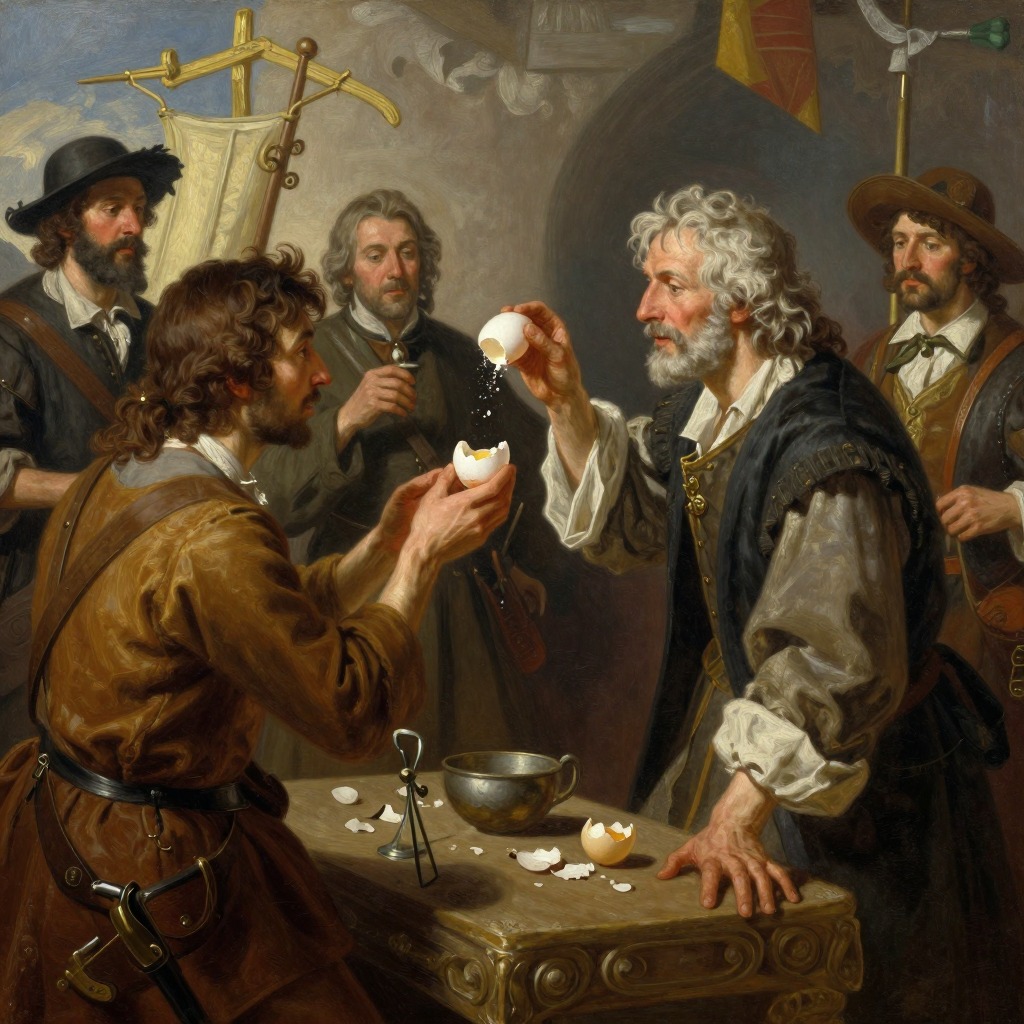
Lilliput's most consuming conflict is the long war with the neighboring island empire of Blefuscu, which has raged for six-and-thirty moons. The war originated in a religious schism over the correct end at which to break an egg: the emperor's grandfather, as a boy, cut his finger breaking an egg according to the ancient practice (the larger end), whereupon his father published an edict commanding all subjects to break the smaller end instead. This decree provoked six rebellions, cost one emperor his life and another his crown, and drove eleven thousand Big-endian exiles to Blefuscu. The Blefuscudian monarchs have constantly fomented these civil commotions, and the war has cost Lilliput forty capital ships, many smaller vessels, and thirty thousand of its best seamen and soldiers. Gulliver's capture of the entire Blefuscu fleet—fifty men-of-war—by wading across the channel and towing them with cables and hooks brings the war to a sudden end, but his refusal to reduce Blefuscu to a province or to compel its people to break their eggs at the smaller end earns him the emperor's lasting enmity.
Laws, Customs, and Education
Lilliput possesses a distinctive legal and educational system that Gulliver describes at length. Fraud is punished more severely than theft, often by death, on the grounds that honesty has no defense against superior cunning. Ingratitude is a capital crime. False accusers are put to ignominious death and must quadruply compensate the innocent person they wronged. The image of Justice in Lilliputian courts has six eyes—two before, two behind, and one on each side—to signify circumspection, and holds a bag of gold open in her right hand and a sword sheathed in her left, showing she is more disposed to reward than to punish. Citizens who strictly observe the laws for seventy-three moons receive the title of snillpall, or legal, along with privileges and a sum from a public fund. Public nurseries in every town educate children of both sexes from the age of twenty moons, with parents allowed to see them only twice a year for one hour. The nurseries for males of noble birth are staffed by grave and learned professors; the children are dressed plainly, fed simply, and trained in honor, justice, courage, modesty, clemency, religion, and love of country. Female nurseries follow a similar pattern, with the young ladies as much ashamed of cowardice and folly as the men. The Lilliputians consider it absurd for parents to be trusted with their own children's education.
Gulliver's Confinement and Liberation
Gulliver is first discovered sleeping on the shore by Lilliputian scouts, who tie him down with numerous slender ligatures while he sleeps. The emperor, learning of his arrival by express, determines in council to keep him alive, and a specially built engine—a frame of wood seven feet long and four wide on twenty-two wheels—is prepared to transport him to the capital. Nine hundred of the strongest men, using eighty poles and many pulleys, raise him into the vehicle while he lies in a profound sleep induced by a soporific medicine mingled in his wine. Fifteen hundred of the emperor's largest horses, each about four and a half inches high, draw him to Mildendo, where he is lodged in an ancient temple that has been polluted by an unnatural murder and is now used for common purposes. His left leg is secured with ninety-one chains and thirty-six padlocks. After he demonstrates his gentle disposition by releasing six captured archers rather than harming them, the emperor grants him a daily allowance of food sufficient for 1,724 Lilliputians—a number calculated by the court mathematicians, who measured his height with a quadrant and found the proportion of twelve to one. Gulliver is eventually released upon swearing to a set of articles that include not departing the dominions without license, not entering the metropolis without express order, confining his walks to the principal high roads, carrying messengers and horses in his pocket for express dispatch, and serving as an ally against Blefuscu. The articles are brought to him by Skyrris Bolgolam in person, and the oath ceremony requires him to hold his right foot in his left hand, place the middle finger of his right hand on the crown of his head, and his thumb on the tip of his right ear.
The Conspiracy and Escape
Despite his services—capturing the Blefuscu fleet and extinguishing a fire in the empress's apartment by an expedient that involved urinating on the flames—Gulliver falls into disfavor. A junto of ministers led by Skyrris Bolgolam and Flimnap prepares articles of impeachment against him for high treason, accusing him of traitorously pulling the empress by the arms during the fire, refusing to reduce Blefuscu to a province, aiding the Blefuscudian ambassadors, and preparing to voyage to Blefuscu with only verbal license. The council debates whether to put him to death by poisoned arrows, fire, or poisoned shirts, but Reldresal, his friend, proposes the milder punishment of blinding him. The emperor, though inclined to lenity, agrees to this sentence. Warned by a friendly lord who visits him secretly at night in a close chair, Gulliver escapes to Blefuscu, where he is received by the emperor and court. The Lilliputian emperor sends an envoy demanding his return in chains, but the Blefuscudian monarch, after three days' consultation, refuses, noting that Gulliver has found a boat on the coast and is preparing to depart. Gulliver leaves Blefuscu on September 24, 1701, and is rescued by an English merchantman, the captain of which, John Biddle, is finally convinced of his story when Gulliver produces the miniature cattle and sheep from his pockets. He returns to England on April 13, 1702, having spent nine months and thirteen days in Lilliput.
Narrative and Thematic Significance
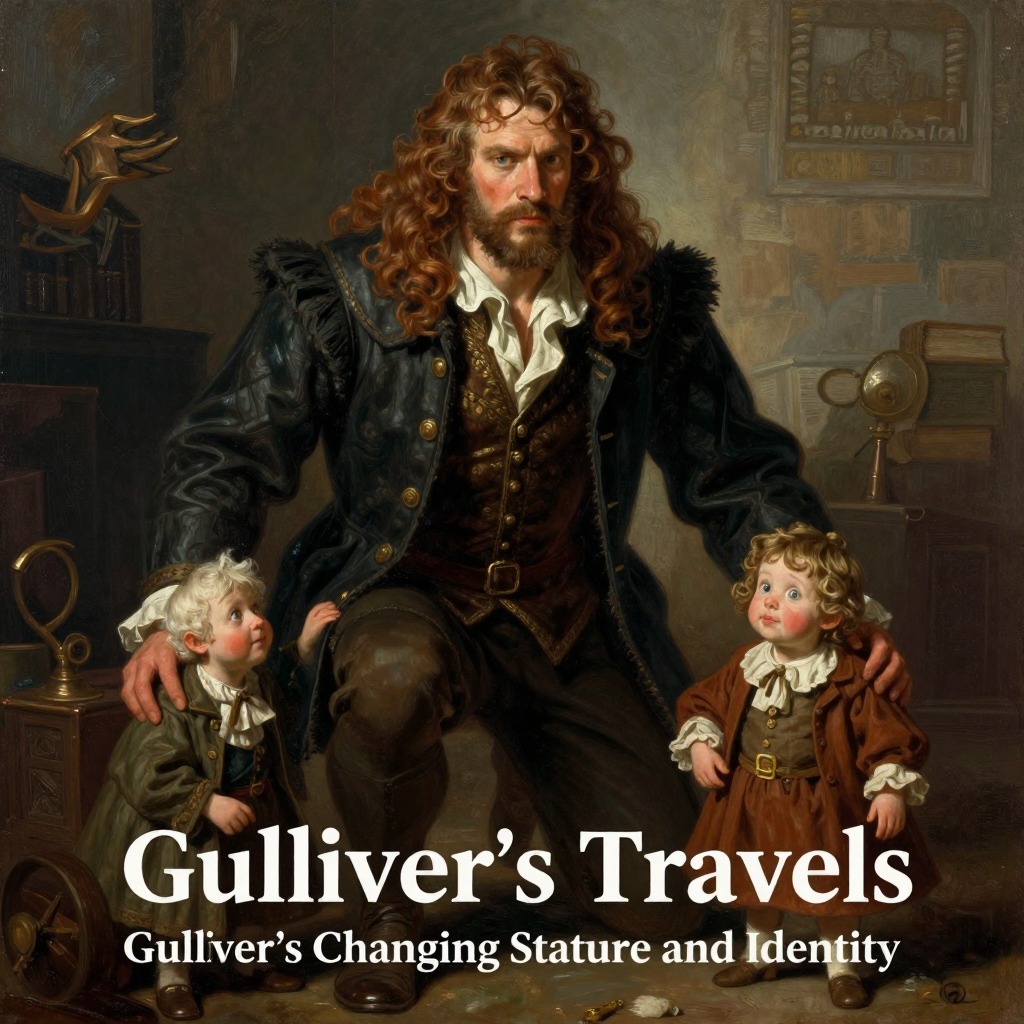
Lilliput functions as the first and most immediately accessible of Swift's satirical mirrors. Its tiny scale allows Gulliver—and the reader—to perceive the absurdity of European political factions, religious wars, and court intrigues when reduced to a size that can be held in the hand. The Big-endian controversy is a transparent parody of the religious disputes between Catholics and Protestants, while the high-heels and low-heels factions mock the trivial distinctions that divided English political parties. The Lilliputian legal system, with its rewards for virtue and severe punishments for fraud and ingratitude, stands in implicit contrast to the corruption Swift saw in English law. Yet Lilliput is not merely a satirical target; its mathematical precision, mechanical ingenuity, and elaborate court ceremonies also display a kind of rational order that Gulliver, for all his physical superiority, must navigate with care. The empire's ultimate ingratitude toward Gulliver—rewarding his greatest services with a sentence of blinding—prefigures the darker view of human nature that will deepen in the later voyages. Gulliver's reflection on his return, when he finds himself afraid of trampling on English travellers and stooping to enter his own house, shows that his experience in Lilliput has permanently altered his perception of scale and proportion, a psychological transformation that becomes a central theme of the book.