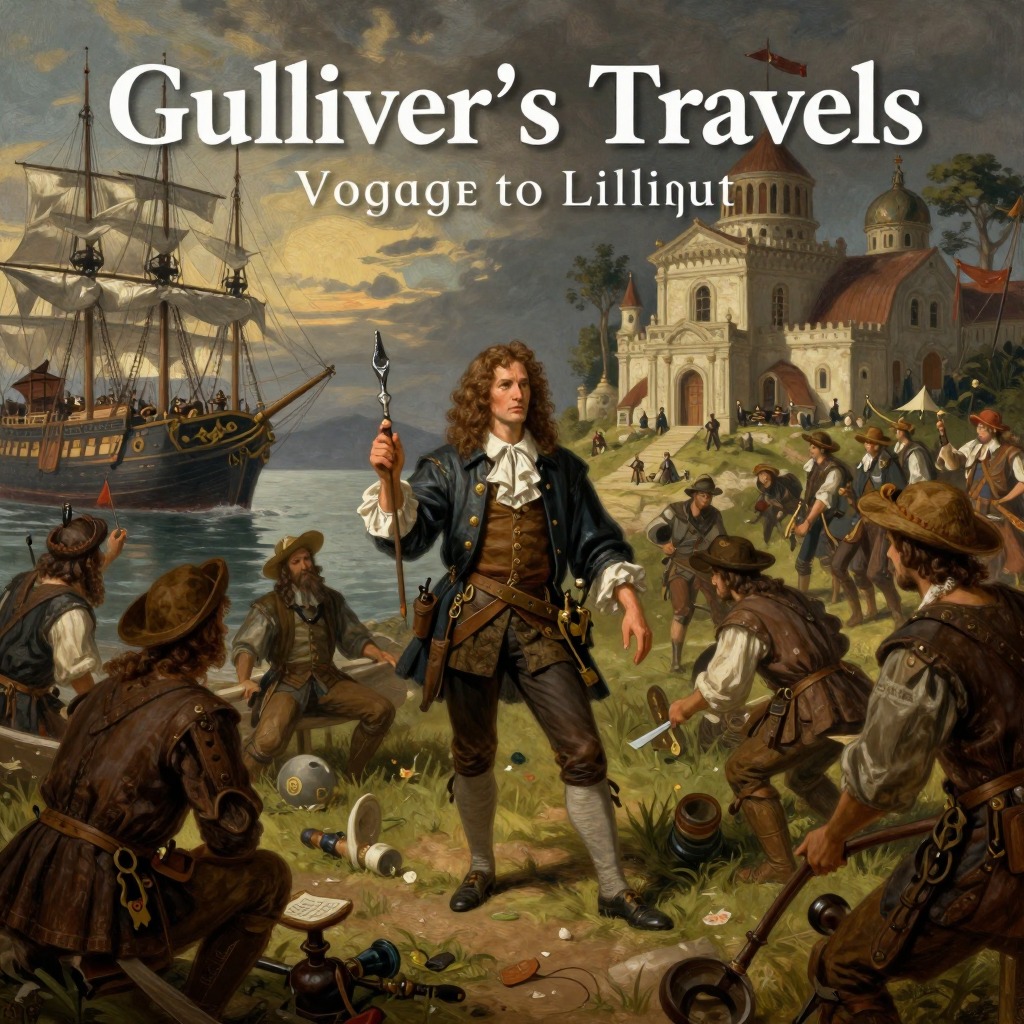
Lilliputian army
The Lilliputian army is the military force of the empire of Lilliput, a diminutive but highly organized and disciplined institution that plays a central role in the nation's defense, internal politics, and the containment of the giant visitor Lemuel Gulliver. Its actions—from the initial capture and transport of Gulliver to the grand military reviews conducted beneath his legs—demonstrate the empire's capacity for strategic planning, its reliance on mathematical precision, and the deep entanglement of military power with court intrigue and the ambitions of the Emperor.
Composition and Organization
The Lilliputian army was a substantial force for a kingdom of its size. When the Emperor desired a grand spectacle, he commanded the part of the army quartered in and about the metropolis to be ready, and the general drew up the troops in close order. This body consisted of three thousand foot and a thousand horse, marching under Gulliver's legs as he stood like a colossus, with the foot going by twenty-four abreast and the horse by sixteen, accompanied by drums beating, colors flying, and pikes advanced. The army's strength was also demonstrated by the nine hundred of the strongest men who were employed to draw up the cords that raised and slung Gulliver into the great transport engine. The Emperor's largest horses, each about four inches and a half high, were used to draw the engine toward the metropolis, and five hundred guards were placed on each side of Gulliver during the night march, half with torches and half with bows and arrows, ready to shoot him if he offered to stir.
Role in Gulliver's Capture and Containment
The army was the primary instrument for managing the threat and spectacle of the Man-mountain. Upon the first intelligence of Gulliver sleeping on the ground, the Emperor determined in council that he should be tied down, which was done in the night while he slept. The initial binding was carried out by the inhabitants, but the subsequent, more elaborate containment was a military operation. When Gulliver struggled and broke his left arm free, the creatures ran off, and a great shout was followed by a volley of over a hundred arrows discharged on his left hand, pricking him like so many needles. Another flight was shot into the air, like bombs in Europe, and some of the creatures attempted with spears to stick him in the sides, though his buff jerkin protected him. The army's readiness to use lethal force was a constant backdrop; the Emperor's troops were ordered to surround Gulliver at a distance with their bows and arrows just ready to discharge when he drew his scimitar. The army also provided the guards who prevented the rabble from crowding him, and when some of the rabble shot arrows at him, the colonel ordered six ringleaders to be seized and delivered bound into Gulliver's hands.
Military Discipline and Display
The Lilliputian army was a source of great pride and entertainment for the court. Gulliver, having gained the Emperor's favor, was able to divert the court by having a troop of twenty-four of the best horse, ready mounted and armed, exercise upon his handkerchief, which he had stretched tight like a drum. They performed mock skirmishes, discharged blunt arrows, drew their swords, fled and pursued, attacked and retired, displaying the best military discipline Gulliver ever beheld. The Emperor was so delighted that he ordered this entertainment repeated several days, and once was pleased to be lifted up and give the word of command himself. The horses of the army, having been daily led before Gulliver, were no longer shy and would come up to his very feet without starting, and the riders would leap them over his hand as he held it on the ground.
Political and Strategic Significance
The army was deeply implicated in the political machinations of the court. The general, Limtoc, was one of the conspirators who prepared articles of impeachment against Gulliver for high treason. During the debates on Gulliver's punishment, the general was to attend with twenty thousand men armed with poisoned arrows to shoot him in the face and hands. The army's existence was also tied to the empire's foreign policy, as the Emperor's ambition extended to reducing the whole empire of Blefuscu into a province, a project that required military force. The army's role in the state was further underscored by the Emperor's establishment of a daily allowance of meat and drink for Gulliver, sufficient for the support of 1724 Lilliputians, a calculation made by the Emperor's mathematicians who had taken the height of Gulliver's body with a quadrant and found the proportion to be twelve to one. This meticulous, mathematical approach to provisioning reflected the same ingenuity and exact economy that characterized the Lilliputian military and its operations.