Lilliputian custom of leaping over stick
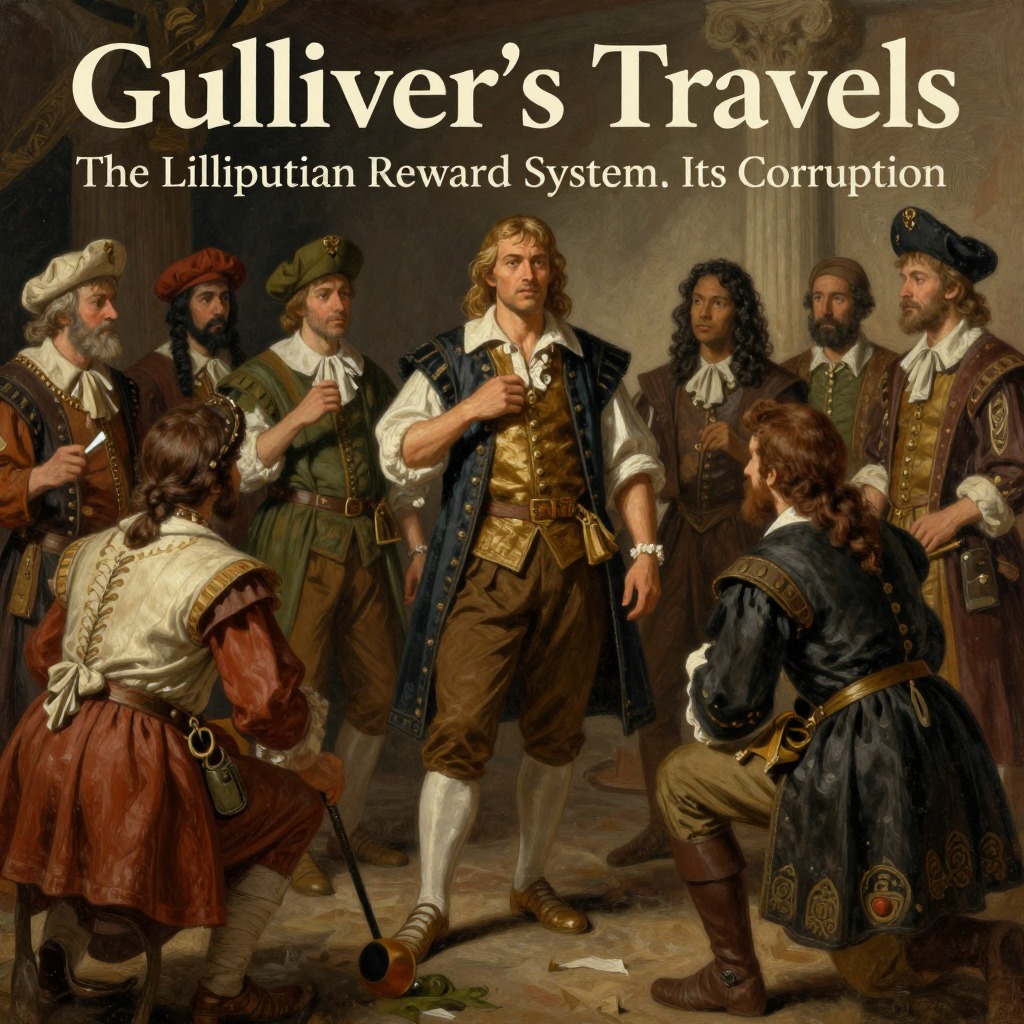
The Lilliputian custom of leaping over a stick is a peculiar court ceremony in which candidates for imperial favor compete for colored silken threads by performing acrobatic feats before the emperor. This diversion, distinct from the more dangerous rope-dancing, is reserved for special occasions and is shown only before the emperor, empress, and first minister. The ceremony takes place in the great chamber of state, where the emperor holds a stick with both ends parallel to the horizon. Candidates advance one by one, sometimes leaping over the stick, sometimes creeping under it, backwards and forwards several times, according to how the stick is advanced or depressed. Occasionally the emperor holds one end of the stick while his first minister holds the other; sometimes the minister manages it entirely alone. Whoever performs with the most agility and holds out the longest in leaping and creeping is rewarded with the blue-colored silk; the yellow is given to the next, and the green to the third. These silken threads, each six inches long, are worn girt twice about the middle, and few great persons at court are not adorned with one of these girdles.
Origins and Corruption
The custom was not part of Lilliput's original institutions but was introduced by the grandfather of the reigning emperor. Over time, it grew to its present height through the gradual increase of party and faction. Gulliver, in relating the laws of Lilliput, distinguishes between the original institutions and the scandalous corruptions into which the people have fallen by the degenerate nature of man. The practice of acquiring great employments by dancing on ropes, or badges of favor and distinction by leaping over sticks and creeping under them, is presented as a corruption of earlier, more virtuous practices. This distinction underscores Swift's satire: what began as a harmless amusement became a mechanism for political patronage and sycophancy.
Comparison with Rope-Dancing
The stick-leaping ceremony is one of two principal diversions at the Lilliputian court, the other being rope-dancing. Rope-dancing is performed on a slender white thread extended about two feet from the ground and is practiced by candidates for great employments and high favor. The rope-dancers are trained from youth and are not always of noble birth or liberal education. When a great office becomes vacant, five or six candidates petition the emperor to entertain the court with a dance on the rope; whoever jumps highest without falling succeeds in the office. Chief ministers themselves are sometimes commanded to show their skill, and Flimnap, the treasurer, is allowed to cut a caper on the straight rope at least an inch higher than any other lord. These diversions are often attended with fatal accidents; Gulliver himself saw two or three candidates break a limb. The danger is greater when ministers compete, as they strain so far that hardly one has not received a fall. In contrast, the stick-leaping ceremony is less physically perilous but equally emblematic of the arbitrary and theatrical nature of court preferment.
Narrative and Thematic Significance
Gulliver's description of the stick-leaping custom is part of his broader account of Lilliputian laws and customs, which he presents as a contrast to those of his own country. The ceremony serves as a satirical device, exposing the frivolity and corruption of court life. The colored silks, worn as badges of honor, are a visible sign of favoritism rather than merit. The fact that the custom was introduced by a previous emperor and has since become entrenched highlights the theme of political decay. Swift uses this seemingly trivial practice to critique the arbitrary nature of political advancement in his own society, where courtiers often gained favor through flattery and performance rather than genuine ability. The ceremony also reinforces the relative perspective of the narrative: what appears as a grand and meaningful ritual to the Lilliputians is, to Gulliver and the reader, a ridiculous and petty spectacle, underscoring the novel's central theme of moral and political relativity.