Lilliputian oath ceremony
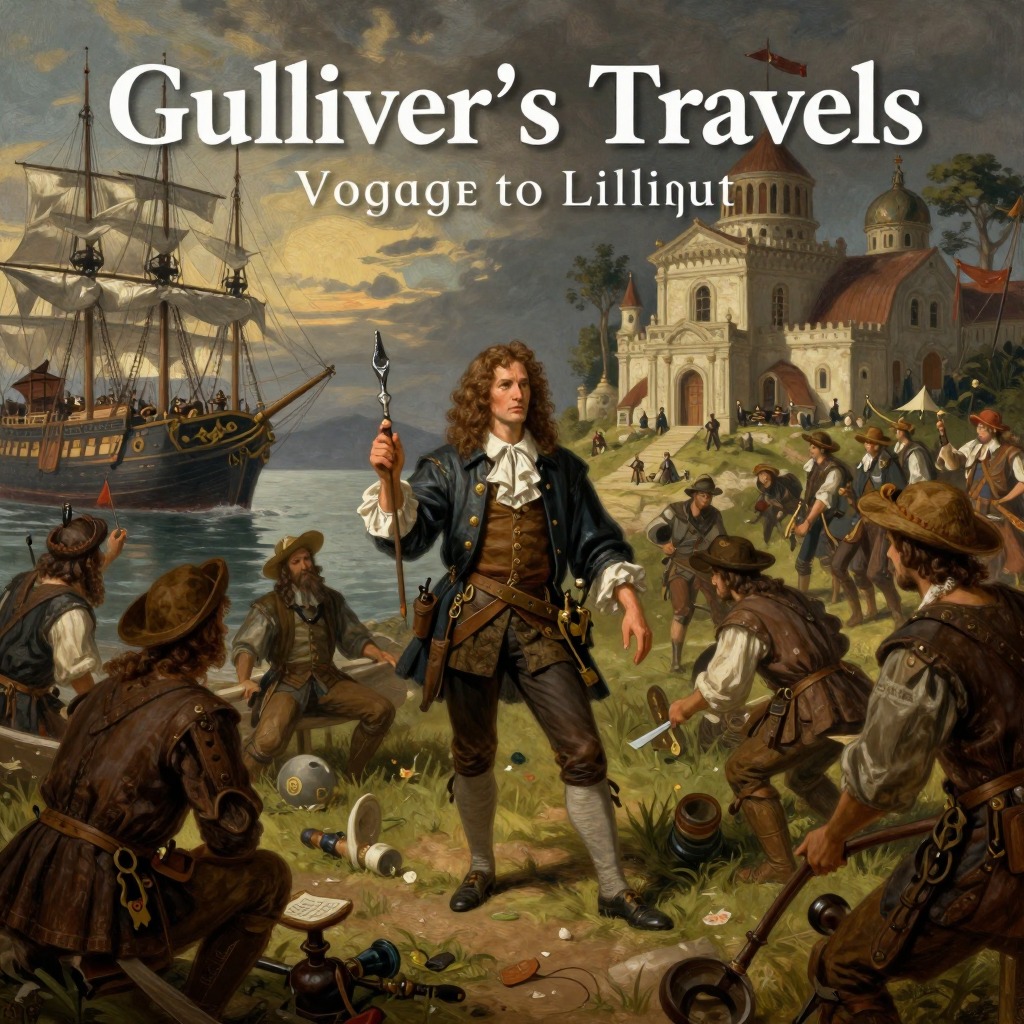
The Lilliputian oath ceremony was the formal procedure by which Lemuel Gulliver, the Man-Mountain, was required to swear his acceptance of the articles of release that granted him his liberty. The ceremony combined a specific, physically contorted posture with a verbal promise, and it was performed twice: first in the manner of Gulliver's own country, and then according to the method prescribed by Lilliputian law. This dual performance underscores the Lilliputians' insistence on their own legal forms while also acknowledging the foreigner's customs, a gesture that is both accommodating and controlling.
The Physical Posture
The Lilliputian method of swearing required the oath-taker to hold his right foot in his left hand, place the middle finger of his right hand on the crown of his head, and his thumb on the tip of his right ear. This awkward, almost acrobatic pose was not merely symbolic but was a legally binding act. The posture's absurdity—a man balancing on one foot while touching his head and ear—mirrors the arbitrary and theatrical nature of Lilliputian court life, where rope-dancing and leaping over sticks determined high office. The physical contortion demanded of Gulliver, a being twelve times their size, further emphasizes the power imbalance: the Lilliputians could compel even a giant to perform their ridiculous rituals.
The Context of the Oath
The oath ceremony was the culmination of a political struggle over Gulliver's fate. The articles of release, drafted by Skyrris Bolgolam, the high admiral and Gulliver's mortal enemy, were brought to him by Bolgolam himself, attended by two under-secretaries and several persons of distinction. After the articles were read aloud, Gulliver was demanded to swear to their performance. The ceremony was conducted in the presence of the Emperor of Lilliput, who did him the honor of attending. Gulliver swore and subscribed to the articles with great cheerfulness and content, although some of them were not as honorable as he could have wished, a resentment he attributed wholly to Bolgolam's malice. The oath thus became a public act of submission, binding Gulliver to a set of conditions that included serving as an ally against Blefuscu, carrying messengers, and assisting in royal building projects.
The Satirical Function
The oath ceremony is a prime example of Swift's satire of legal and political formalism. The Lilliputians, who are otherwise portrayed as mathematically precise and mechanically ingenious, reduce a solemn legal act to a physical contortion. The ceremony's absurdity is compounded by the fact that the articles themselves are a mixture of practical restrictions and grandiose imperial rhetoric. The emperor's full title, recited in the preamble, includes phrases like "delight and terror of the universe" and "whose feet press down to the centre, and whose head strikes against the sun," a mock-heroic inflation that contrasts sharply with the petty, self-serving nature of the articles. The oath, therefore, becomes a ritual that simultaneously enforces Gulliver's subjugation and exposes the hollowness of Lilliputian authority. The fact that Gulliver later breaks the oath by escaping to Blefuscu—an act he justifies by the emperor's subsequent conspiracy against him—further undermines the ceremony's binding power, suggesting that oaths are only as strong as the political realities that enforce them.