Shipwreck of the Antelope
The shipwreck of the Antelope is the pivotal disaster that separates Lemuel Gulliver from his crew and delivers him, unconscious and bound, into the diminutive world of Lilliput. It is the first of many maritime catastrophes in his travels and establishes the pattern of sudden, violent transition from the familiar European world to an utterly alien society.
Causes and Background
Gulliver, after a series of unsuccessful attempts to establish himself as a surgeon in London, accepted an advantageous offer from Captain William Prichard, master of the Antelope, which was making a voyage to the South Sea. They set sail from Bristol on May 4, 1699, and the voyage was at first very prosperous. However, on their passage from the South Sea to the East Indies, they were driven by a violent storm to the northwest of Van Diemen's Land. By observation, they found themselves in the latitude of 30 degrees and 2 minutes south. The crew was already in a weakened state: twelve of them had died from immoderate labor and ill food, and the rest were in a very weak condition.
What Happens
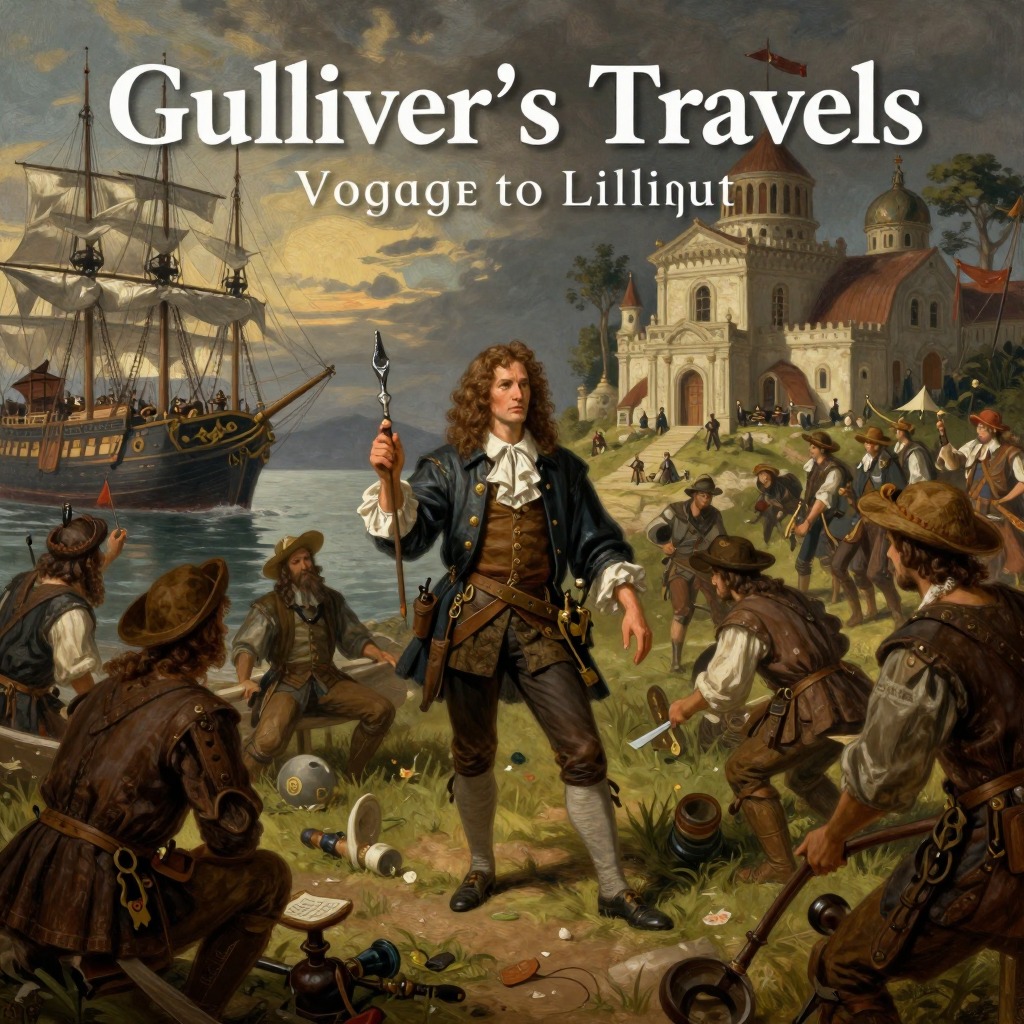
On the fifth of November, which was the beginning of summer in those parts, the weather being very hazy, the seamen spied a rock within half a cable's length of the ship. The wind was so strong that they were driven directly upon it, and the ship immediately split. Six of the crew, including Gulliver, let down the boat into the sea and made a shift to get clear of the ship and the rock. They rowed about three leagues until they were spent with labor, and then trusted themselves to the mercy of the waves. In about half an hour, the boat was overset by a sudden flurry from the north. Gulliver never learned what became of his companions in the boat, those who escaped on the rock, or those left in the vessel, but he concluded they were all lost. For his own part, he swam as fortune directed him, pushed forward by wind and tide. He often let his legs drop and could feel no bottom, but when he was almost gone and able to struggle no longer, he found himself within his depth. The storm by this time was much abated. The declivity was so small that he walked near a mile before he got to the shore, which he conjectured was about eight o'clock in the evening. He advanced forward near half a mile but could not discover any sign of houses or inhabitants. Extremely tired, and with the heat of the weather and about half a pint of brandy he had drunk as he left the ship, he found himself much inclined to sleep. He lay down on the grass, which was very short and soft, and slept sounder than ever he remembered to have done in his life, for about nine hours. When he awaked at daylight, he attempted to rise but was not able to stir, finding his arms and legs strongly fastened to the ground, his long thick hair tied down, and slender ligatures across his body from his armpits to his thighs. He then felt something alive moving on his left leg, and perceived it to be a human creature not six inches high, with a bow and arrow in his hands—the first Lilliputian he encountered.
Consequences and Aftermath
The shipwreck directly led to Gulliver's capture by the Lilliputians, who bound him while he slept and then transported him to their capital, Mildendo, using a specially constructed engine. The event also resulted in the loss of his ship and all his companions, leaving him utterly isolated in a foreign land. The shipwreck's timing and location—the beginning of summer in the southern hemisphere, near Van Diemen's Land—are recorded with the precise geographical and chronological detail characteristic of Gulliver's narrative, lending an air of factual authenticity to the fantastic events that follow. The disaster also caused the loss of Gulliver's hat, which fell off after he came to land and was later recovered by the Lilliputians, dragged for half an English mile, and returned to him with two holes bored in the brim. The shipwreck thus serves as the necessary threshold event that removes Gulliver from the known world and plunges him into the first of his satirical encounters with alternative human societies.