The eagle carries off Gulliver's box
The eagle carries off Gulliver's box is the decisive escape event that ends Lemuel Gulliver's two-year captivity in Brobdingnag, transforming a moment of seaside melancholy into a violent aerial abduction and a near-fatal fall into the ocean, from which he is rescued by an English merchant ship. The event marks the climax of Gulliver's second voyage and the final rupture of his relationship with the giant kingdom, accomplished not by human agency but by the instinct of a bird of prey.
Circumstances and Setting
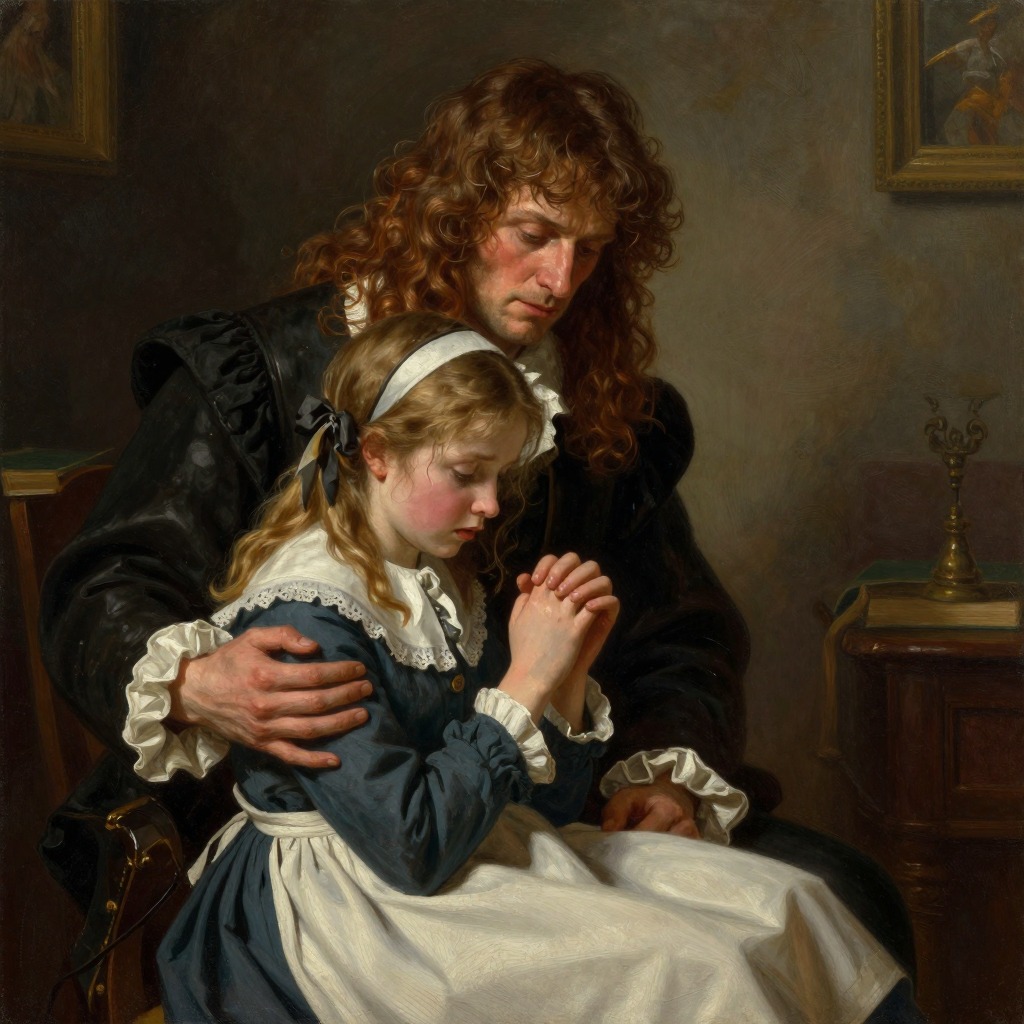
By the beginning of his third year in Brobdingnag, Gulliver had grown desperate to return home, though he could form no plan with any hope of success. The King of Brobdingnag had given strict orders that any ship appearing off the coast should be seized and brought with its crew to the capital, Lorbrulgrud. Gulliver was treated with kindness and was the favorite of the king and queen, but he found the situation ill-befitting human dignity and longed to be among people he could converse with on equal terms. The opportunity for escape arose when the king and queen made a progress to the south coast of the kingdom, near the city of Flanflasnic, within eighteen English miles of the sea. Glumdalclitch, Gulliver's devoted nurse, fell so ill that she was confined to her chamber. Gulliver pretended to be worse than he really was and obtained leave to take the fresh sea air with a page he trusted. Glumdalclitch consented with great unwillingness, bursting into tears as if she had some foreboding of what was to happen, and gave the page a strict charge to be careful of Gulliver.
The Abduction
The page carried Gulliver in his travelling box—a closet twelve feet wide with a hammock fixed by silken ropes from the four corners at the top—about half an hour's walk from the palace toward the rocks on the seashore. Gulliver ordered the boy to set him down, lifted one of his sashes, and cast a wistful, melancholy look toward the sea. Feeling unwell, he told the page he wished to take a nap in his hammock. The boy shut the window close down to keep out the cold, and Gulliver soon fell asleep. While he slept, the page, thinking no danger could happen, went among the rocks to look for birds' eggs. Gulliver was suddenly awakened by a violent pull upon the ring fastened at the top of his box for carriage. He felt the box raised very high in the air and borne forward with prodigious speed. The first jolt nearly shook him out of his hammock, but afterward the motion became easy enough. He called out as loud as he could, but to no purpose. Looking toward his windows, he could see nothing but clouds and sky. He heard a noise just over his head like the clapping of wings and then perceived his woeful condition: an eagle had got the ring of his box in its beak, intending to let it fall on a rock like a tortoise in a shell and then pick out his body and devour it.
The Struggle and Fall
In a little time, the noise and flutter of wings increased very fast, and Gulliver's box was tossed up and down like a sign in a windy day. He heard several bangs or buffets given to the eagle—for he was certain it was an eagle that held the ring—and then all of a sudden felt himself falling perpendicularly down for above a minute with such incredible swiftness that he almost lost his breath. His fall was stopped by a terrible squash that sounded louder to his ears than the cataract of Niagara. After that he was quite in the dark for another minute, and then his box began to rise so high that he could see light from the tops of the windows. He perceived he had fallen into the sea. The box, by the weight of his body, the goods that were in it, and the broad plates of iron fixed for strength at the four corners of the top and bottom, floated about five feet deep in the water. Gulliver supposed that the eagle which flew away with his box was pursued by two or three others and forced to let him drop while it defended itself against the rest, who hoped to share in the prey. The plates of iron fastened at the bottom preserved the balance while it fell and hindered it from being broken on the surface of the water. Every joint of the box was well grooved, and the door moved up and down like a sash, keeping the closet so tight that very little water came in.
Gulliver's Ordeal at Sea
Gulliver got with much difficulty out of his hammock, having first ventured to draw back the slip-board on the roof contrived to let in air, for want of which he found himself almost stifled. He wished himself with his dear Glumdalclitch, from whom one single hour had so far divided him, and lamented the grief she would suffer for his loss, the displeasure of the queen, and the ruin of her fortune. He expected every moment to see his box dashed to pieces or overset by the first violent blast or rising wave. A breach in a single pane of glass would have been immediate death; nothing could have preserved the windows but the strong lattice-wires placed on the outside against accidents in travelling. He saw the water ooze in at several crannies and endeavored to stop them as well as he could. He was unable to lift up the roof of his closet, which otherwise he would certainly have done to sit on top and preserve himself some hours longer. He was four hours under these circumstances, expecting and indeed wishing every moment to be his last.
Rescue
Gulliver heard, or thought he heard, some kind of grating noise on the side of his box where the two strong staples were fixed—the side that had no window, into which the servant who used to carry him on horseback would put a leathern belt and buckle it about his waist. Soon after, he began to fancy that the box was pulled or towed along in the sea, for he now and then felt a sort of tugging that made the waves rise near the tops of his windows, leaving him almost in the dark. This gave him faint hopes of relief. He ventured to unscrew one of his chairs, which were always fastened to the floor, and having made a hard shift to screw it down again directly under the slipping board he had lately opened, he mounted on the chair and, putting his mouth as near as he could to the hole, called for help in a loud voice and in all the languages he understood. He then fastened his handkerchief to a stick he usually carried and, thrusting it up the hole, waved it several times in the air, so that if any boat or ship were near, the seamen might conjecture some unhappy mortal to be shut up in the box. He found no effect from all he could do, but plainly perceived his closet to be moved along. In the space of an hour or better, that side of the box where the staples were struck against something hard. He heard a noise upon the cover of his closet like that of a cable and the grating of it as it passed through the ring. He then found himself hoisted up by degrees at least three feet higher than before. He again thrust up his stick and handkerchief, calling for help till he was almost hoarse. In return he heard a great shout repeated three times, giving him such transports of joy as are not to be conceived but by those who feel them. He heard a trampling over his head and somebody calling through the hole with a loud voice in the English tongue: "If there be anybody below, let them speak." Gulliver answered he was an Englishman, drawn by ill fortune into the greatest calamity that ever any creature underwent, and begged by all that was moving to be delivered out of the dungeon he was in. The voice replied he was safe, for his box was fastened to their ship, and the carpenter should immediately come and saw a hole in the cover large enough to pull him out. Gulliver answered that was needless and would take up too much time; they need only let one of the crew put his finger into the ring and take the box out of the sea into the ship. Some of them upon hearing him talk so wildly thought he was mad; others laughed. The carpenter came and in a few minutes sawed a passage about four feet square, then let down a small ladder upon which Gulliver mounted, and from thence was taken into the ship in a very weak condition. The captain was Mr. Thomas Wilcocks, an honest, worthy Shropshire man, who took Gulliver into his cabin, gave him a cordial, and made him turn in upon his own bed. Thus, after two years in Brobdingnag, Gulliver was restored to people of his own stature and returned to England, arriving in the Downs on June 3, 1706.