Thomas Wilcocks
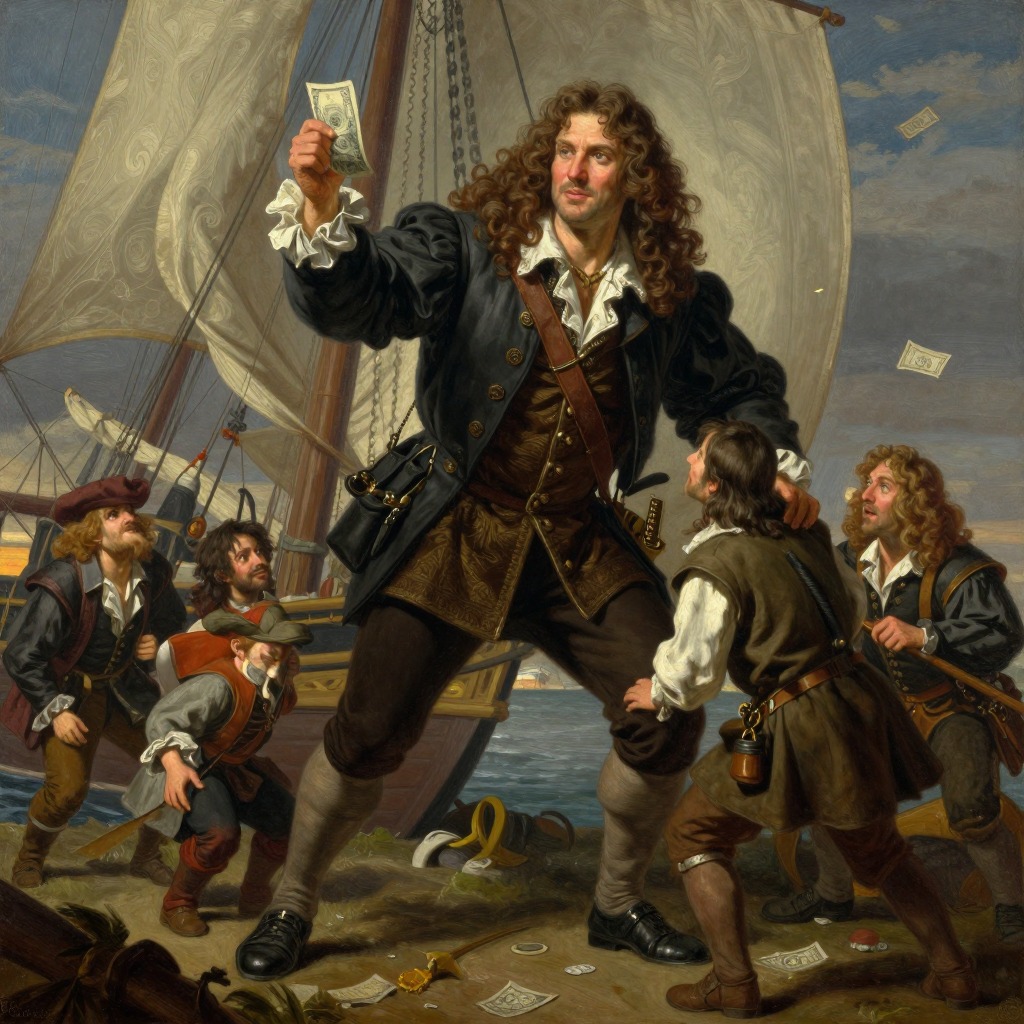
Captain Thomas Wilcocks, an honest and worthy Shropshire man, commands the English merchantman that rescues Lemuel Gulliver from the most desperate predicament of his travels. Sailing from Tonquin toward England, Wilcocks spots a strange object through his glass at about noon and, hoping to buy biscuit for his ship, sends out his long-boat to investigate. His men return in a fright, swearing they have seen a swimming-house; Wilcocks laughs at their folly and rows out himself, ordering a strong cable to be taken along. He rows around the floating chest several times, observes its windows and wire lattices, discovers two staples on one side, and has his men fasten a cable to one of them to tow the object toward the ship. When the chest is alongside, he directs the crew to fasten another cable to the ring fixed in the cover and to raise it with pulleys, but even all the sailors together cannot lift it more than two or three feet. It is Wilcocks who sees Gulliver's stick and handkerchief thrust out of a hole in the roof and concludes that some unhappy man must be shut up inside.
Rescue and First Impressions
When the carpenter saws a passage through the cover and lets down a small ladder, Gulliver mounts it and is taken into the ship in a very weak condition. The sailors are all in amazement and ask a thousand questions, but Gulliver has no inclination to answer. Wilcocks, observing that Gulliver is ready to faint, takes him into his cabin, gives him a cordial to comfort him, and makes him turn in upon his own bed, advising him to take rest. Before sleeping, Gulliver tells the captain about the valuable furniture in his box—a hammock, two chairs, a table, and a cabinet—and asks that the box be brought into the cabin so he can open it and show his goods. Hearing these absurdities, Wilcocks concludes that Gulliver is raving, but he promises to give orders as desired, presumably to pacify him. The seamen, however, strip the quilting from the closet, tear up the screwed-down furniture by force, knock off some boards for the ship's use, and let the hull drop into the sea, where it sinks. Gulliver is glad not to have witnessed the havoc.
Skepticism and Conviction
After Gulliver sleeps several hours, Wilcocks orders supper and entertains him with great kindness, observing that Gulliver no longer looks wildly or talks inconsistently. When they are left alone, Wilcocks asks for a relation of Gulliver's travels and the accident that set him adrift. He grows serious and asks freely whether Gulliver is troubled by the consciousness of some enormous crime for which a prince has punished him by exposing him in that chest, as great criminals in other countries have been forced to sea in a leaky vessel without provisions. He adds that his suspicions are increased by Gulliver's absurd speeches and odd looks. Gulliver begs patience and faithfully tells his story from the last time he left England to the moment Wilcocks first discovered him. Because truth forces its way into rational minds, Wilcocks—a man with some tincture of learning and very good sense—is immediately convinced of Gulliver's candor and veracity. To confirm all, Gulliver opens his cabinet in the captain's presence and shows him the comb made from the king of Brobdingnag's beard stumps, a collection of needles and pins from a foot to half a yard long, four wasps' stings like joiners' tacks, combings of the queen's hair, and a gold ring the queen gave him. Wilcocks refuses a gold ring Gulliver offers him but accepts a footman's tooth, which he examines with great curiosity and receives with abundance of thanks.
Return to England and Aftermath
The captain is very well satisfied with Gulliver's plain relation and says he hopes that when they return to England, Gulliver will oblige the world by putting it on paper and making it public. Gulliver replies that he thinks the world is already overstocked with books of travels, but he thanks Wilcocks for his good opinion and promises to take the matter into his thoughts. The voyage is prosperous; Wilcocks calls in at one or two ports for provisions and fresh water, but Gulliver never goes out of the ship until they come into the Downs on June 3, 1706, about nine months after his escape. Gulliver offers to leave goods in security for payment of his freight, but Wilcocks protests he will not receive one farthing. They take a kind leave of each other, and Gulliver makes him promise to come to his house in Redriff. Gulliver borrows five shillings from the captain to hire a horse and guide for the journey home. Wilcocks thus stands as the final, humane link between Gulliver's fantastic ordeals and his return to domestic life—a man whose initial skepticism gives way to belief, whose kindness restores Gulliver to his own world, and whose encouragement prompts the very narrative that becomes Gulliver's Travels.