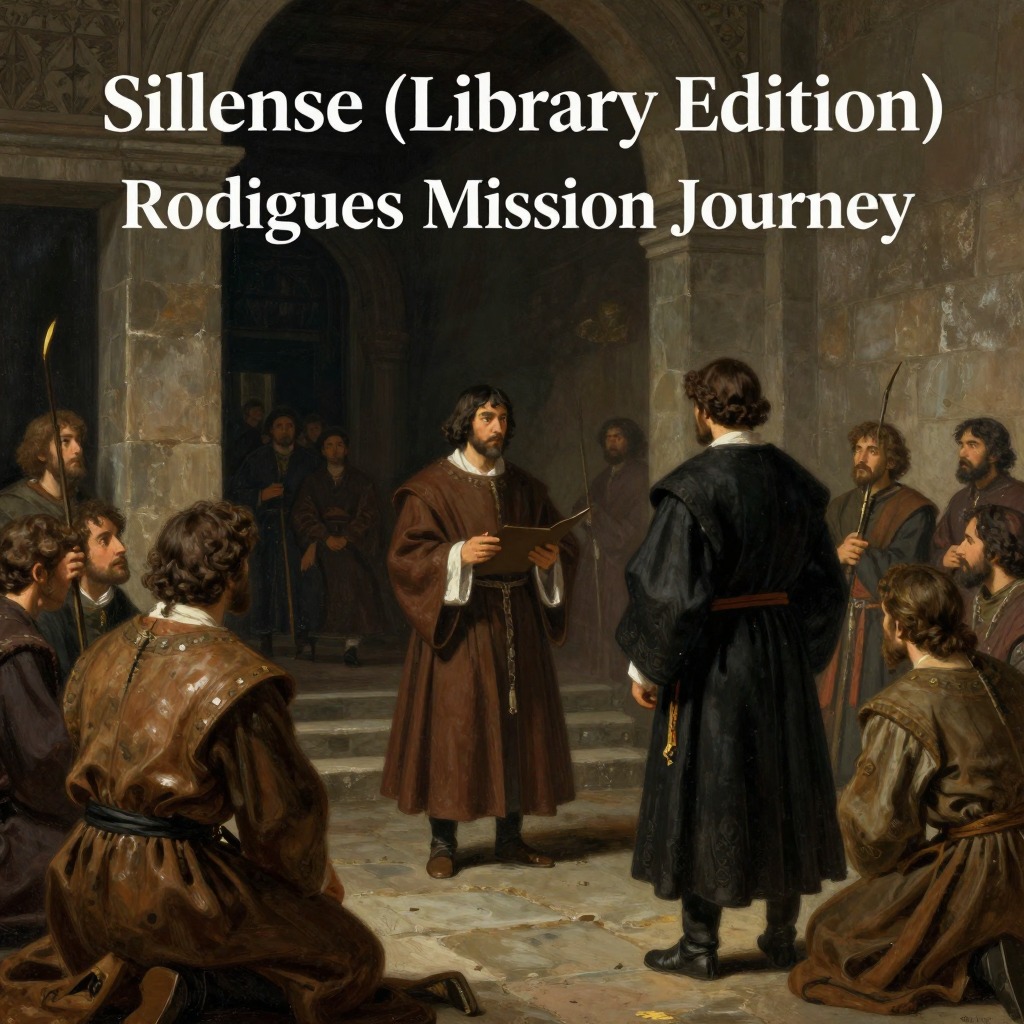
Juan de Santa Marta
Juan de Santa Marta is a Portuguese Jesuit priest who, together with his close friends Sebastian Rodrigues and Francisco Garrpe, undertakes a perilous mission to Japan in 1638. A former student of Christovao Ferreira at the monastery of Campolide, Santa Marta is driven by the same burning need to learn the truth about their revered teacher, who has reportedly apostatised under torture. Yet Santa Marta's own story is one of thwarted purpose: he never sets foot on Japanese soil, felled instead by a devastating illness that strands him in Macao while his companions go on to face the persecution he had prepared himself to share.
Identity and Background
Juan de Santa Marta studied theology alongside Rodrigues and Garrpe at the seminary of Campolide, where all three were taught by Ferreira. The memory of their teacher—a man with "clear blue eyes and soft radiant light"—binds them together and fuels their determination to reach Japan. Santa Marta is described as having a special devotion to Saint Francis Xavier; after arriving in Goa, he prayed daily at the saint's shrine, asking that he might be allowed to go to Japan. This devotion marks him as a figure of intense spiritual longing, one who has internalised the heroic model of the missionary saint.
Illness and Exclusion from the Mission
The long sea journey around Africa and across the Indian Ocean exacts a terrible toll on Santa Marta. By the time the three priests reach Macao, he is utterly exhausted and showing signs of malaria. Rodrigues writes that Santa Marta, once vigorous, has become "wretchedly thin and broken-down," with bloodshot, dim eyes; a wet towel placed on his head grows warm as if immersed in hot water. Father Alessandro Valignano, the rector of the college at Macao, judges that to send Santa Marta on to Japan in such a condition is "simply unthinkable" and refuses permission for the journey unless Santa Marta is left behind for treatment. Garrpe tries to console him, saying, "We'll prepare the way so that you can come afterwards when you get better," but the uncertainty of the future hangs over them all. Santa Marta remains silent, staring at the window, his cheeks and chin covered with thick stubble. Rodrigues reflects on the irony: perhaps Santa Marta will "live a safe and happy life, while we like so many other Christians will be captured by the infidel."
The Unfulfilled Dream
Santa Marta's exclusion from the mission is a profound personal tragedy. The three priests had endured thirst, sickness, and the terrible storm that broke the mast of the Santa Isabella, all for the sake of reaching Japan. Rodrigues notes that "we priests are in some ways a sad group of men. Born into the world to render service to mankind, there is no one more wretchedly alone than the priest who does not measure up to his task." Santa Marta, who had prayed so fervently at Xavier's shrine, is now left behind, his purpose unfulfilled. Rodrigues writes that "God bestows upon man a better fate than human knowledge could possibly think of or devise," and that "no doubt God is secretly preparing the mission that some day will be his," but these are words of consolation for a loss that cannot be undone. Santa Marta never appears again in the narrative; his fate remains unknown, a silent counterpoint to the martyrdoms and apostasies that follow.
Thematic Significance
Santa Marta's story embodies the novel's exploration of thwarted vocation and the silence of God. He is a priest who has dedicated his life to a mission he cannot complete, a man of faith whose body fails him before any persecutor can. His absence from Japan means he never faces the fumie, the pit, or the agonising choice between apostasy and the death of others. In this sense, he is spared the central trial of the novel, but he is also denied the chance to prove his faith through suffering. His fate raises the question of whether it is harder to die for one's faith or to live with the knowledge that one was never given the opportunity. Santa Marta remains a figure of unrealised potential, a reminder that the "swamp of Japan"—as Inoue and Ferreira call it—defeats missionaries not only through torture and betrayal, but also through the simple, indifferent cruelty of disease.