Mokichi
Mokichi is a young Christian peasant from the fishing village of Tomogi, a settlement of about two hundred households not far from Nagasaki where the greater number of villagers had already received baptism. He is among the first Japanese Christians to meet Sebastian Rodrigues and Francisco Garrpe when they secretly land on the coast, and he immediately becomes one of their most trusted guides and protectors. When the priests are hidden in a charcoal hut on the mountain above the village, it is Mokichi who brings them food, who helps dig a secret hiding place beneath the floorboards, and who speaks with quiet urgency about the desperate state of the faithful. He tells the priests that for six years—since the death of the Japanese priest Miguel Matsuda and the Jesuit brother Mateo de Coros in November 1633—the Christians of Tomogi have had neither priest nor brother to administer the sacraments. Yet they have kept their faith alive through a secret organization of their own devising, with a Jiisama who baptizes the children, Tossama who teach prayer and catechism, and Mideshi who serve as helpers. When Rodrigues asks if other villages preserve their faith in the same way, Mokichi shakes his head and explains that in this country, where blood relationship is of primary importance, the people of one village, though closely united among themselves like one family, sometimes look with hostility on the peoples of other villages. He adds that too much contact with other villages might end up in accusation before the magistrate.
Identity and Background
Mokichi is introduced as a young man with an expressionless face, much like a puppet, a mask that the long years of secrecy have forced upon the Christians of Tomogi. He cannot register on his face any sorrow nor even joy. This is a bitter and sad reality that Rodrigues comes to understand: the peasants have learned to hide every emotion because their lives depend on it. Mokichi is a poor farmer who ekes out a living by cultivating potatoes and wheat in little fields on the mountainside facing the sea. The magistrate of Nagasaki exacts from him and his fellow villagers an exceedingly harsh revenue. For a long, long time these farmers have worked like horses and cattle, and like horses and cattle they have died. The reason Christianity has penetrated this territory like water flowing into dry earth, Rodrigues reflects, is that it has given to this group of people a human warmth they never previously knew. For the first time they have met men who treated them like human beings.
Arc Through the Plot
Mokichi's trajectory moves from faithful guide to willing hostage to martyr. When the officials first descend on Tomogi on June 5th, taking the Jiisama as a hostage, Mokichi comes to the priests that night and declares that no matter what happens, he and the others will stand by them. When the officials return on June 8th with a smiling old samurai who demands three hostages to be sent to Nagasaki, the men of Tomogi spend the night debating fiercely who should go. The name of Kichijiro is mentioned first—he is a stranger, not a native of Tomogi, and many harbor the deep feeling that the whole catastrophe has occurred just because of him. Kichijiro, from sheer weakness, finally agrees. Then Ichizo suddenly speaks up and volunteers to go as well. And then it is Mokichi's turn: he will join the other two. Everyone gasps in amazement. On the morning of June 9th, in a light drizzling rain, the three climb up to the wood where the priests are hiding. Mokichi seems a little excited. Ichizo, his eyes narrowed as always, is sullen and silent. Behind them, Kichijiro looks like a whipped dog. Mokichi, head hanging, mumbles the words as though he is talking to himself: "Father, if we are ordered to trample on the fumie… It's not only a matter that concerns us. If we don't trample, everyone in the village will be cross-examined. What are we to do?" Rodrigues, overcome with pity, shouts out, "Trample! Trample!"—words he immediately realizes should never have been on his lips. Garrpe looks at him reproachfully. Kichijiro is still sniveling, crying out, "Why has Deus Sama given us this trial? We have done no wrong." Mokichi and Ichizo remain silent, their eyes fixed on a speck in the empty sky. All together they join in a last prayer, and then the three men descend the mountain. Rodrigues and Garrpe watch the figures as they disappear into the mist. Never again is Rodrigues to meet Mokichi and Ichizo.
Martyrdom
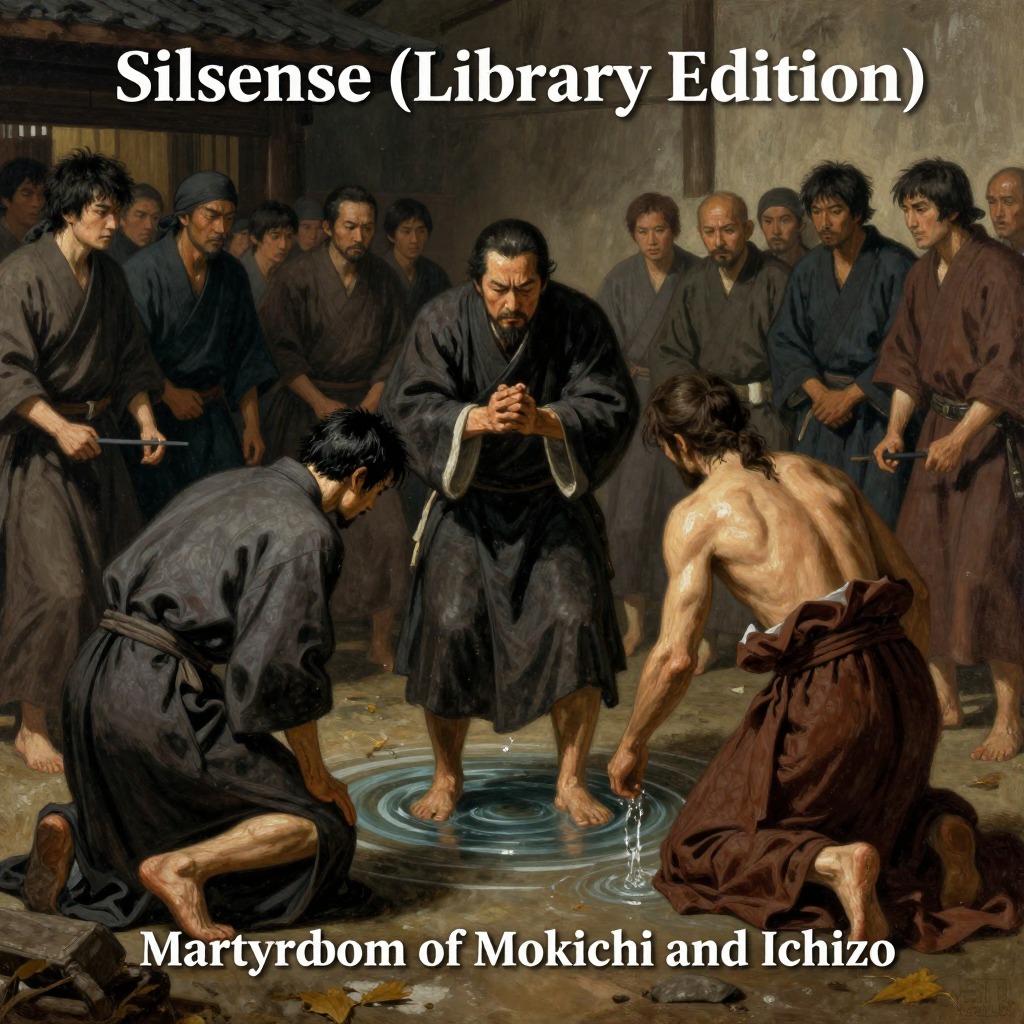
At the magistrate's office at Sakuradai, the three men are questioned. When ordered to trample on the fumie, Kichijiro is the first to place his foot on the image, following Rodrigues's advice. Mokichi and Ichizo do likewise. But the officials notice the expressions on their faces—the heavy, nervous breathing—and are not deceived. The officials then order them to spit on the crucifix and declare that the Blessed Virgin is a whore, a plan thought out by Inoue, who knows that these poor peasants honor the Virgin above all. Ichizo grasps the fumie in both hands and tries to spit on it but is powerless. Kichijiro hangs back, making no movement. At the fierce urging of the officials, a white tear overflows from Mokichi's eye and rolls down his cheek. Ichizo shakes his head as though caught in the throes of pain. Then both of them at last confess openly that they are Christians. Only Kichijiro, overcome by threats, gasps out the required blasphemy. Following this investigation, Mokichi and Ichizo are imprisoned for ten days in the prison of Sakuradai. On June 22nd, the officials ride into Tomogi with a proclamation: on the beach of Tomogi, Mokichi and Ichizo will be subjected to the water punishment. Two trees, made into the form of a cross, are set at the water's edge. Mokichi and Ichizo are fastened to them. When night comes and the tide comes in, their bodies will be immersed in the sea up to the chin. They will not die at once, but after two or even three days of utter physical and mental exhaustion they will cease to breathe. The plan of the authorities is to let the people of Tomogi and the other peasants get a good view of this prolonged suffering so that they will never again approach the Christian faith. The tide comes in. The two forms do not move. The waves, drenching the feet and lower half of their bodies, surge up the dark shore with monotonous roar, and with monotonous roar again recede. Omatsu and her niece bring food to the guards and ask if they might give the two men something to eat. Receiving permission, they approach in a small boat. Omatsu calls out to Mokichi, and he replies, "What is it?" She calls to Ichizo, but the aged Ichizo can make no answer, though the occasional slight movement of his head shows he is not dead. Omatsu tells them to be patient, that Padre and all of them are praying, that they will both go to Paradise. When she tries to put a potato into Mokichi's mouth, he shakes his head. If he must die anyway, he seems to feel, he would like to escape as quickly as possible from this torment. "Give it to Ichizo," he says. "Let him eat. I can endure no more." Night comes. The red light of the guards' blazing fire can be seen faintly even from the mountain hut. The people of Tomogi gather on the shore and gaze at the dark sea. All with tears are praying in their hearts. Then, mingled with the sound of the waves, they hear what seems to be the voice of Mokichi. Whether to tell the people that his life has not yet ebbed away or to strengthen his own resolution, the young man gaspingly sings a Christian hymn: "We're on our way, we're on our way / We're on our way to the temple of Paradise, / To the temple of Paradise… / To the great Temple…" All listen in silence to the voice of Mokichi; the guards also listen; and again and again, amid the sound of the rain and the waves, it breaks upon their ears. On June 24th, the drizzle continues all day. When the tide recedes, there only remain in the distance the solitary stakes to which the two men are fastened. It is impossible to distinguish between the stakes and the men. Mokichi and Ichizo adhere to the stakes in such a way that they become part of them. The only indication that they are still alive is the dark moaning of a voice which sounds like that of Mokichi. The moaning sometimes ceases. Mokichi has not even the strength to encourage himself with a hymn like that of the previous day. Yet after an hour of silence the voice is again brought to the ears of the people by the wind. Hearing this sound, like that of an animal, the peasants tremble and weep. In the afternoon the tide gradually comes in again; the black, cold color of the sea deepens; the stakes seem to sink into the water. The white foaming waves, swirling past the stakes, break on the sand. A white bird, skimming over the surface of the sea, flies far, far away. And with this all is over. They are martyred. But what a martyrdom! Rodrigues had long read about martyrdom in the lives of the saints—how the souls of the martyrs had gone home to Heaven, how they had been filled with glory in Paradise, how the angels had blown trumpets. This was the splendid martyrdom he had often seen in his dreams. But the martyrdom of the Japanese Christians he now describes is no such glorious thing. What a miserable and painful business it is! The rain falls unceasingly on the sea. And the sea which killed them surges on uncannily—in silence. In the evening the officials again arrive on horseback. At their command, the guards gather damp pieces of wood and, removing the bodies of Mokichi and Ichizo from the stakes, begin to burn them. This they do to prevent the Christians from bringing home the remains for veneration. When the bodies are reduced to ashes, they throw them into the sea. The flame they had kindled flares red and black in the breeze; the smoke flows over the sandy beach while the people, without the slightest movement, vacantly watch its undulations. When all is over, heads hanging like cows, they shuffle back to their homes.
Thematic Significance
Mokichi's death becomes the central wound in Rodrigues's consciousness. The priest cannot bear the monotonous sound of the dark sea gnawing at the shore. Behind the depressing silence of this sea, he feels the silence of God—the feeling that while men raise their voices in anguish, God remains with folded arms, silent. The song Mokichi sang, "We're on our way to the temple of Paradise," gnaws constantly at Rodrigues's heart. He has heard from the people of Tomogi that many Christians, when dragged off to the place of execution, sang this hymn—a melody filled with dark sadness. Life in this world is too painful for these Japanese peasants. Only by relying on "the temple of Paradise" have they been able to go on living. Such is the sadness which fills this song. Mokichi's martyrdom, along with Ichizo's, forces Rodrigues to confront the question that will eventually shatter his faith: why does God remain silent in the face of such suffering? The memory of the rain-drenched sea with the two black stakes floating on its surface arises painfully before his mind's eye whenever he tries to defend the meaning of his mission. If these people had not died for their faith, what a blasphemy to man! Yet when Ferreira later argues that the Japanese Christians did not believe in the Christian God but in their own distortion, Rodrigues counters with the memory of Mokichi and Ichizo: with his own eyes he has seen them die, burning with faith. Mokichi represents the irreducible fact of Japanese martyrdom that Rodrigues clings to as the proof that his mission has not been in vain, even as everything else—the silence of God, the swamp of Japan, his own eventual apostasy—threatens to overwhelm him.