Gnomon (Rose Line)
The Gnomon, also known as the Rose Line, is a thin polished strip of brass embedded in the gray granite floor of the Church of Saint-Sulpice in Paris. It is a pagan astronomical device, a sundial of sorts, that bears graduated markings like a ruler. The line slants across the church's floor at an awkward angle, entirely at odds with the symmetry of the sanctuary, slicing across the main altar, cleaving the communion rail in two, and finally reaching the corner of the north transept, where it arrives at the base of a colossal Egyptian obelisk. There, the glistening Rose Line takes a ninety-degree vertical turn and continues directly up the face of the obelisk itself, ascending thirty-three feet to the very tip of the pyramidical apex, where it finally ceases.
Historical and Navigational Significance
The Rose Line is a meridian, or longitude, an imaginary line drawn from the North Pole to the South Pole. For centuries, the symbol of the Rose had been associated with maps and guiding souls in the proper direction. The Compass Rose—drawn on almost every map—indicated North, East, South, and West. Originally known as the Wind Rose, it denoted the directions of the thirty-two winds. When diagrammed inside a circle, these thirty-two points of the compass perfectly resembled a traditional thirty-two petal rose bloom. To this day, the fundamental navigational tool is still known as a Compass Rose, its northernmost direction still marked by an arrowhead or, more commonly, the symbol of the fleur-de-lis. Long before the establishment of Greenwich as the prime meridian in 1888, the zero longitude of the entire world had passed directly through Paris, and through the Church of Saint-Sulpice. The brass marker in Saint-Sulpice is a memorial to the world's first prime meridian, and although Greenwich stripped Paris of the honor, the original Rose Line is still visible today.
Role in the Plot
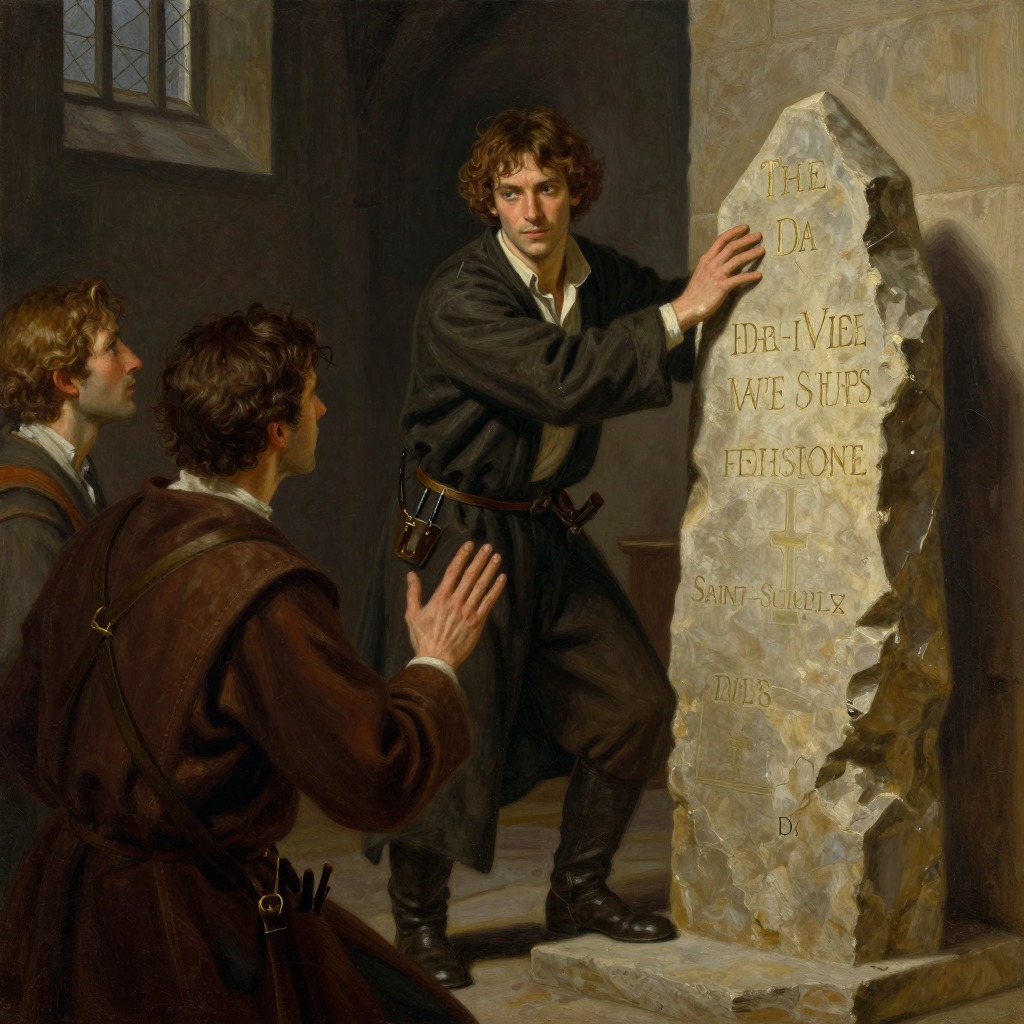
Silas, the albino monk, learns from the Teacher that the Priory keystone is hidden "beneath the Sign of the Rose." The Teacher tells Silas of Saint-Sulpice's famed architectural oddity—a strip of brass that segments the sanctuary on a perfect north-south axis. The sun's rays, shining through the oculus on the south wall, move farther down the line every day, indicating the passage of time, from solstice to solstice. The north-south stripe had been known as the Rose Line. Silas, having been told by his victims that the keystone is hidden at the Rose Line, follows the brass line due north toward the obelisk. He kneels at the base of the obelisk and, after rapping on the floor tiles adjacent to the brass line, finds a hollow area beneath the floor. He breaks the tile and retrieves a stone tablet, which bears the inscription "Job 38:11." This leads him to the Bible on the main altar, where he reads the verse "Hitherto shalt thou come, but no further," realizing he has been tricked.
Thematic Significance
The Rose Line embodies the novel's central themes of hidden knowledge, the sacred feminine, and the subversion of established religious history. The Rose is a symbol of secrecy (sub rosa), womanhood, and guidance—the feminine chalice and guiding star that leads to secret truth. The line's pagan origins, its connection to the goddess Venus, and its role as a meridian linking the earthly and the celestial all reinforce the novel's argument for a lost sacred feminine tradition that the Church has suppressed. The fact that the keystone is hidden "beneath the Sign of the Rose" ties the physical location to the Priory's secret, making the Rose Line a literal and metaphorical path to the Holy Grail.