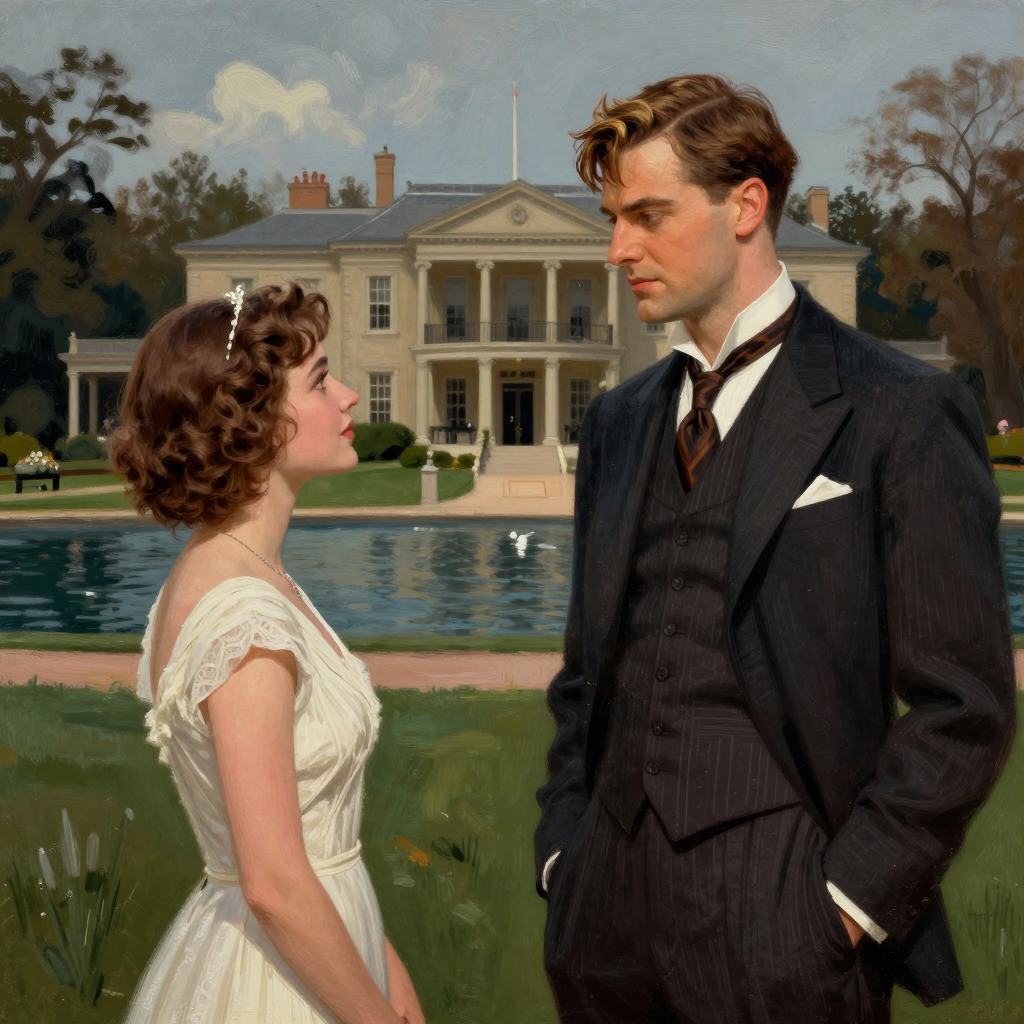
Gatsby and Daisy's Reunion
Gatsby and Daisy's Reunion is the central emotional hinge of the novel, the moment toward which Gatsby's entire elaborate performance—the mansion, the parties, the green light—has been directed. Orchestrated by Nick Carraway at Gatsby's request, the meeting takes place on a rainy afternoon at Nick's modest West Egg bungalow, and it transforms Gatsby from a figure of mysterious splendor into a man visibly vulnerable, trembling before the woman he has spent five years idealizing. The reunion simultaneously fulfills and begins to undermine Gatsby's dream, as Daisy's presence proves both intoxicating and, ultimately, insufficient to sustain the colossal illusion he has built around her.
Preparation and Arrival
The reunion is the product of careful arrangement. Gatsby, through Jordan Baker, has asked Nick to invite Daisy to tea without telling her that Gatsby will be there. The day before, Gatsby's house blazes with light from tower to cellar, and when Nick returns home at two in the morning, Gatsby is waiting on his lawn, suppressing eagerness as he confirms the plan. On the appointed day, rain pours steadily. Gatsby sends a man to cut Nick's grass, then a greenhouse of flowers arrives. Gatsby himself appears in a white flannel suit, silver shirt, and gold-colored tie, pale and dark-eyed from sleeplessness. He is so nervous that he asks Nick whether the grass looks fine, then immediately forgets what he has said. As the rain continues, Gatsby grows increasingly agitated, nearly abandoning the plan, insisting that no one is coming. At two minutes to four, Daisy's car turns into the drive. She wears a three-cornered lavender hat and greets Nick with a bright ecstatic smile, her voice a wild tonic in the rain.
The First Encounter
When Nick brings Daisy inside, the living room is empty—Gatsby has vanished. A light, dignified knock at the front door reveals Gatsby, pale as death, standing in a puddle of water with his hands plunged like weights in his coat pockets. He stalks past Nick into the hall, turns sharply as if on a wire, and disappears into the living room. For half a minute there is silence, then a choking murmur and part of a laugh, followed by Daisy's voice on a clear artificial note: "I certainly am awfully glad to see you again." Nick enters to find Gatsby reclining against the mantelpiece in a strained counterfeit of perfect ease, his head leaning so far back that it rests against a defunct mantelpiece clock. The clock tilts dangerously; Gatsby catches it with trembling fingers. The awkwardness is excruciating. Gatsby mutters, "We've met before," and Daisy, her voice matter-of-fact, says, "We haven't met for many years." Gatsby's automatic reply—"Five years next November"—sets them all back. Nick suggests making tea, but the Finn brings it in, and amid the welcome confusion of cups and cakes, a certain physical decency establishes itself. Gatsby retreats into a shadow, looking from one to the other with tense, unhappy eyes. When Nick makes an excuse to leave, Gatsby follows him into the kitchen, closes the door, and whispers, "Oh, God!" He calls the meeting "a terrible, terrible mistake." Nick tells him he is just embarrassed, that Daisy is embarrassed too, and Gatsby, incredulous, repeats, "She's embarrassed?" Nick insists he go back inside, and Gatsby, with unforgettable reproach, returns.
Transformation and Intimacy
Nick walks out into the rain and waits under a tree for half an hour. When he returns, the atmosphere has changed completely. Gatsby and Daisy sit at either end of the couch, looking at each other as if some question has been asked, and every vestige of embarrassment is gone. Daisy's face is smeared with tears, but Gatsby literally glows—a new well-being radiates from him without a word or gesture of exultation. He smiles like an ecstatic patron of recurrent light and announces that the rain has stopped. Gatsby insists that Nick and Daisy come to his house. As they walk across the lawn, Gatsby points out his mansion, saying, "It took me just three years to earn the money that bought it," though he has previously claimed to have inherited his wealth. Daisy admires the house, the gardens, the odors of jonquils and hawthorn. Inside, they wander through Marie Antoinette music-rooms and Restoration salons, and Gatsby revalues everything according to the response it draws from Daisy's eyes. In his bedroom, the simplest room except for a toilet set of pure dull gold, Gatsby opens two cabinets holding his massed suits and shirts—shirts of sheer linen, thick silk, and fine flannel, in stripes and scrolls and plaids of coral, apple-green, lavender, and faint orange, with monograms of Indian blue. He throws them one by one before them, and the soft rich heap mounts higher. Suddenly Daisy bends her head into the shirts and begins to cry stormily. "They're such beautiful shirts," she sobs. "It makes me sad because I've never seen such—such beautiful shirts before."
The Green Light and the Illusion
Standing at the window, Gatsby tells Daisy that without the mist she could see the green light at the end of her dock across the bay. Daisy puts her arm through his, but Gatsby seems absorbed in what he has just said. It has occurred to him that the colossal significance of that light has now vanished forever. Compared to the great distance that had separated him from Daisy, it had seemed very near to her, almost touching her. Now it is again a green light on a dock. His count of enchanted objects has diminished by one. Later, as Ewing Klipspringer plays the piano, Nick observes that the expression of bewilderment has come back into Gatsby's face, as though a faint doubt has occurred to him about the quality of his present happiness. Almost five years have passed, and there must have been moments even that afternoon when Daisy tumbled short of his dreams—not through her own fault, but because of the colossal vitality of his illusion. Gatsby has thrown himself into it with a creative passion, adding to it all the time, decking it out with every bright feather that drifted his way. No amount of fire or freshness can challenge what a man will store up in his ghostly heart. Yet as Gatsby adjusts himself, takes Daisy's hand, and turns toward her with a rush of emotion, Nick thinks that her voice holds him most—a deathless song that cannot be over-dreamed. Nick leaves them together, looking back once to see them possessed by intense life, and walks out into the rain.
Consequences and Aftermath
The reunion sets in motion the chain of events that leads to tragedy. Gatsby and Daisy resume their affair, meeting frequently at Gatsby's house in the afternoons. Gatsby dismisses his servants to prevent gossip, replacing them with people connected to Meyer Wolfsheim. The affair culminates in the confrontation at the Plaza Hotel, where Gatsby demands that Daisy tell Tom she never loved him. Daisy cannot do so, and the dream begins to shatter. Later that day, driving Gatsby's car, Daisy hits and kills Myrtle Wilson. Gatsby takes the blame, waiting outside the Buchanans' house through the night to protect Daisy. But Daisy retreats into her marriage, and Gatsby is left alone. The reunion, which seemed to fulfill his deepest desire, ultimately reveals that the past cannot be repeated—that Daisy, however real, cannot match the dream he has carried for five years. Gatsby's death, shot by George Wilson in his swimming pool, is the final consequence of the reunion's impossible promise.