Bilbo's Conversation with Smaug
Bilbo Baggins's conversation with the dragon Smaug is the pivotal verbal duel of the quest, a contest of wits in which the hobbit, armed only with riddling speech and calculated flattery, conceals his identity, extracts the dragon's secret vulnerability, and inadvertently sets in motion the chain of events that leads to Smaug's destruction. The exchange transforms Bilbo from a frightened burglar into a cunning interlocutor who dares to match words with the worm, and it reveals the dragon's pride, his suspicion of the Lake-men, and the one bare patch in his otherwise impenetrable armour.
The Setting and the Dragon's Deception
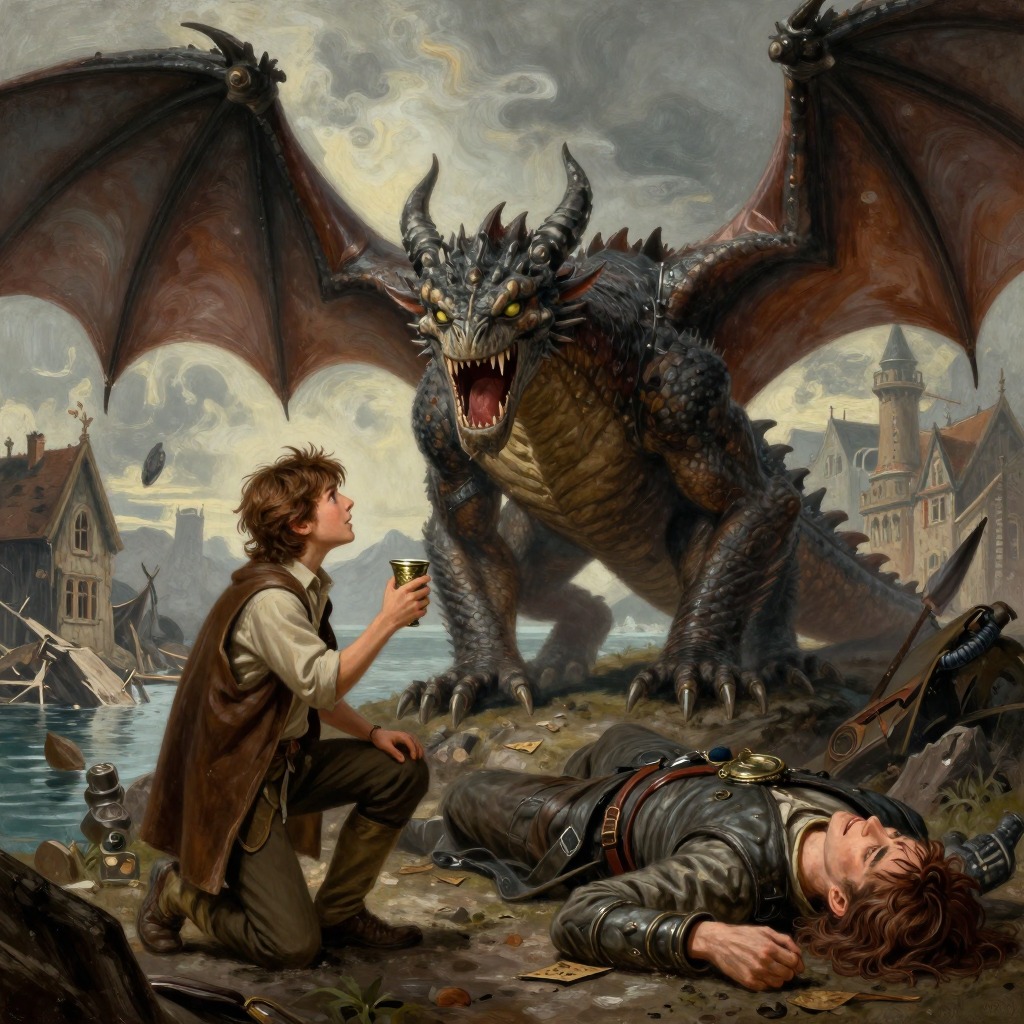
When Bilbo creeps down the tunnel for his second visit, the hall is lit only by the faintest glow. Smaug appears to be fast asleep, "almost dead and dark, with scarcely a snore more than a whiff of unseen steam." But as Bilbo is about to step onto the floor, he catches "a sudden thin and piercing ray of red from under the drooping lid of Smaug's left eye." The dragon is only pretending to sleep, watching the tunnel entrance. Smaug then speaks, his voice revealing that he has sensed the intruder: "Well, thief! I smell you and I feel your air. I hear your breath. Come along! Help yourself again, there is plenty and to spare!" Bilbo, however, is not so easily lured; he has learned enough dragon-lore to know better than to approach a dragon that is clearly awake and suspicious.
The Riddling Exchange and Concealed Identity
Bilbo refuses the invitation, replying, "No thank you, O Smaug the Tremendous! I did not come for presents. I only wished to have a look at you and see if you were truly as great as tales say. I did not believe them." The flattery works; Smaug is "somewhat flattered, even though he did not believe a word of it." Bilbo then delivers a series of riddling titles that conceal his true name and origin: "I come from under the hill, and under the hills and over the hills my paths led. And through the air. I am he that walks unseen." He calls himself "the clue-finder, the web-cutter, the stinging fly," "the friend of bears and the guest of eagles," "Ringwinner and Luckwearer; and I am Barrel-rider." Smaug, though suspicious, is fascinated by the riddling talk, for "no dragon can resist the fascination of riddling talk and of wasting time trying to understand it." The dragon chuckles to himself, deducing that the Lake-men are behind the scheme: "Lake-men, some nasty scheme of those miserable tub-trading Lake-men, or I'm a lizard."
The Dragon's Probing and the Hobbit's Unease
Smaug probes for information, revealing that he knows the smell of dwarves and that he ate six ponies the night before. He warns Bilbo not to trust the dwarves, suggesting they will give him a poor share and leave him to do the dangerous work. Bilbo, beginning to feel the dragon-spell, struggles to remain loyal. He claims that "gold was only an afterthought with us" and that they came "for Revenge." Smaug laughs devastatingly, boasting of his invincibility: "My armour is like tenfold shields, my teeth are swords, my claws spears, the shock of my tail a thunderbolt, my wings a hurricane, and my breath death!" Bilbo, in a frightened squeak, makes a calculated remark: "I have always understood that dragons were softer underneath, especially in the region of the—er—chest; but doubtless one so fortified has thought of that." The dragon, stopping short, snaps that he is "armoured above and below with iron scales and hard gems. No blade can pierce me." Bilbo then flatters him further, exclaiming, "What magnificence to possess a waistcoat of fine diamonds!" Smaug, "absurdly pleased," rolls over to display his jewel-encrusted belly, and Bilbo sees what he had hoped for: "a large patch in the hollow of his left breast as bare as a snail out of its shell."
The Revelation and the Fatal Consequence
Having discovered the dragon's weak spot, Bilbo's only thought is to escape. He bids farewell, but adds a parting shot: "Well, I really must not detain Your Magnificence any longer, or keep you from much needed rest. Ponies take some catching, I believe, after a long start. And so do burglars." This remark is unfortunate, for the dragon spouts "terrific flames" after him, and Bilbo barely escapes with singed hair. More critically, the reference to "Barrel-rider" confirms Smaug's suspicion that the Lake-men are involved. The dragon, enraged and vengeful, decides to attack Lake-town: "Barrel-rider! Your feet came from the waterside and up the water you came without a doubt. I don't know your smell, but if you are not one of those men of the Lake, you had their help. They shall see me and remember who is the real King under the Mountain!" This decision leads directly to Smaug's flight south, his assault on Esgaroth, and his eventual death at the hands of Bard. Bilbo's conversation, though a triumph of wit and nerve, thus has consequences far beyond the mountain hall.