Swords (Orcrist, Glamdring, Sting)
The three swords that come into the possession of Thorin Oakenshield, Gandalf, and Bilbo Baggins are not ordinary weapons. They are ancient blades of the High Elves of the West, forged in the hidden city of Gondolin during the wars against the goblins. Each sword carries a name in the ancient tongue of Gondolin and a history that reaches back to a time before the events of the tale. Their discovery, identification, and use mark key turning points in the adventure, and they become symbols of the heritage and peril that the company faces.
Discovery and Identification
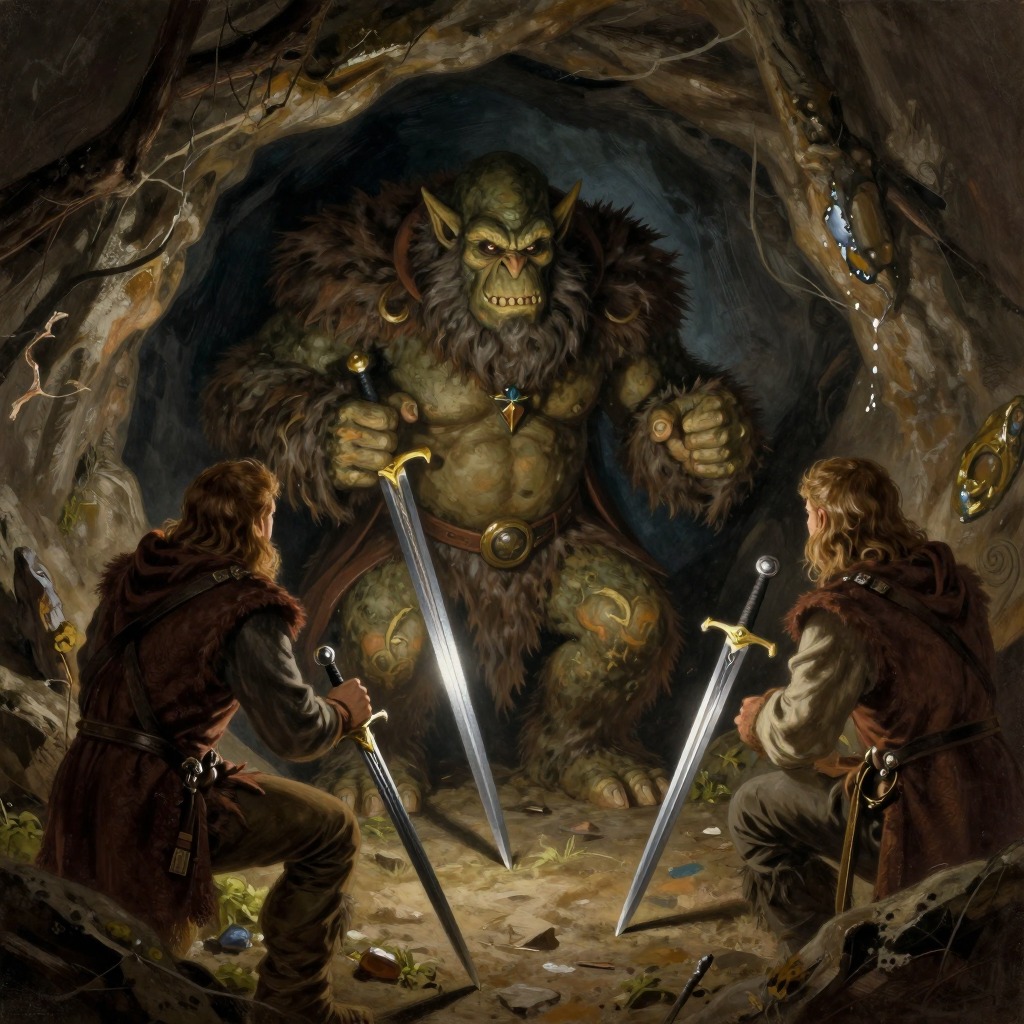
The swords are first found in the trolls' cave, among a litter of plunder that includes pots of gold coins and various garments. Gandalf and Thorin each take one of the two larger swords, which have beautiful scabbards and jewelled hilts. Bilbo takes a knife in a leather sheath that, though a tiny pocket-knife for a troll, is as good as a short sword for a hobbit. Gandalf remarks that the blades were not made by any troll nor by any smith among men in those parts, and that reading the runes on them will reveal more. Later, at the Last Homely House, Elrond examines the swords and identifies them. He declares that they are old swords of the High Elves of the West, his kin, made in Gondolin for the Goblin-wars. He reads the runes: Thorin's sword is named Orcrist, the Goblin-cleaver in the ancient tongue of Gondolin, a famous blade. Gandalf's sword is Glamdring, Foe-hammer, once worn by the king of Gondolin. Elrond speculates that the trolls had plundered other plunderers or come upon remnants of old robberies in some hold in the mountains, perhaps in the deserted caverns of the mines of Moria.
The Swords in Battle
The swords prove their worth almost immediately. When the company is captured by goblins in the Misty Mountains, the Great Goblin recognizes Orcrist at once. He gives a truly awful howl of rage, and his soldiers gnash their teeth and clash their shields, for the sword had killed hundreds of goblins in its time. The goblins call it Biter, and they hate it and hate worse any one that carries it. In the ensuing chaos, Gandalf kills the Great Goblin with Glamdring, which the goblins call Beater. The sword flashes in its own light, and the goblin soldiers flee before it. Later, as the company escapes, Gandalf uses Glamdring to cut through the goblin-chains, and the sword burns with a rage that makes it gleam if goblins are about, bright as blue flame for delight in the killing of the great lord of the cave. The goblins' terror of Biter and Beater is so great that when Thorin and Gandalf turn a corner and draw their swords, the goblins in front drop their torches and are killed, while those behind shriek and leap back, knocking over those running after them.
Bilbo's Sword: Sting
Bilbo's knife, though smaller, is also an elvish blade. When he draws it in the dark tunnels of the goblins, it shines pale and dim, confirming that it is an elvish blade and that goblins are not very near, yet not far enough. The knowledge that he is wearing a blade made in Gondolin for the goblin-wars comforts him. Later, after killing a giant spider in Mirkwood, Bilbo decides to give his sword a name. He says, "I will give you a name, and I shall call you Sting." The killing of the spider, alone in the dark without help, makes a great difference to him; he feels a different person, much fiercer and bolder. Sting becomes a key weapon in the battle against the spiders, and its presence terrifies them. The spiders become mortally afraid of Sting, and it helps Bilbo lead the dwarves to safety.
The Fate of the Swords
After the Battle of Five Armies, Thorin is buried deep beneath the Mountain, and the Elvenking lays Orcrist upon his tomb. It is said in songs that the sword gleams ever in the dark if foes approach, so that the fortress of the dwarves cannot be taken by surprise. Glamdring remains with Gandalf, who continues to use it in his travels. Bilbo keeps Sting, hanging it over his mantelpiece at Bag-End after his return. The swords thus pass from the ancient wars of Gondolin into the hands of new bearers, each fulfilling a role in the quest and in the peace that follows.