Beavers' house
The Beavers' house is a small, bee-hive-shaped structure built atop a beaver dam across a frozen river, serving as the warm, secure home of Mr. and Mrs. Beaver and the pivotal setting where the Pevensie children receive the prophecy that will determine the fate of Narnia. It is here that the children first hear the name Aslan, learn of the Deep Magic and the four thrones at Cair Paravel, and share a meal that cements their alliance with the talking animals of Narnia—while Edmund's secret defection to the White Witch begins in this very room.
Location and Appearance
The Beavers' house is situated in the middle of a dam that Mr. Beaver has built across a fairly large river. The dam creates a deep, frozen pool above it, while below, the water has frozen into foamy, wavy shapes. Icicles hang from the dam's side like "flowers and wreaths and festoons of the purest sugar." The house itself is described as a "funny little house shaped rather like an enormous bee-hive," with smoke rising from a hole in the roof, immediately evoking thoughts of cooking and warmth. The top of the dam is wide enough to walk on, though it is covered with ice, and the house is reached by walking in single file across the dam to its center. Inside, the home is snug but rustic, with bunks built into the wall like those on a ship, hams and onions hanging from the roof, and gum boots, oilskins, hatchets, fishing rods, and nets stored against the walls. The tablecloth is rough but very clean, and the only seating consists of three-legged stools, except for Mrs. Beaver's own special rocking chair beside the fire.
The Meal and the Prophecy
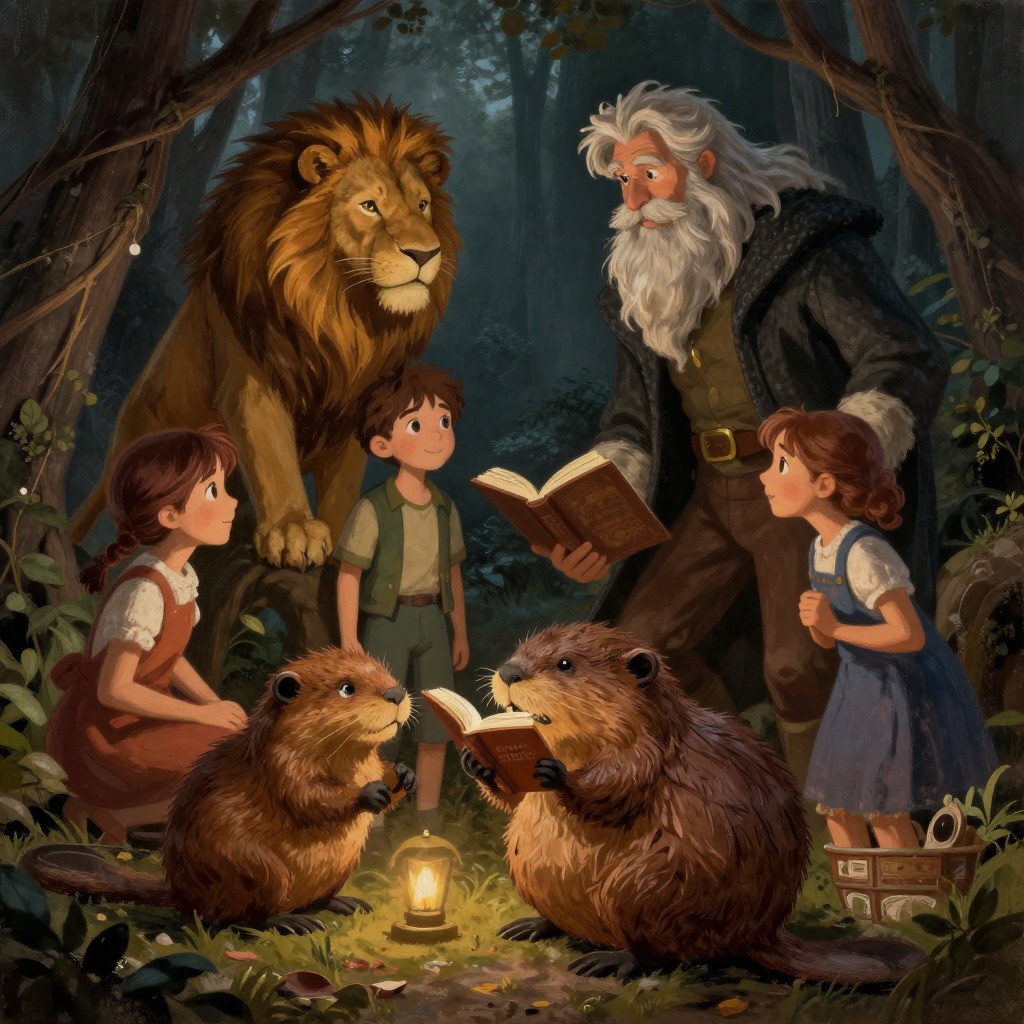
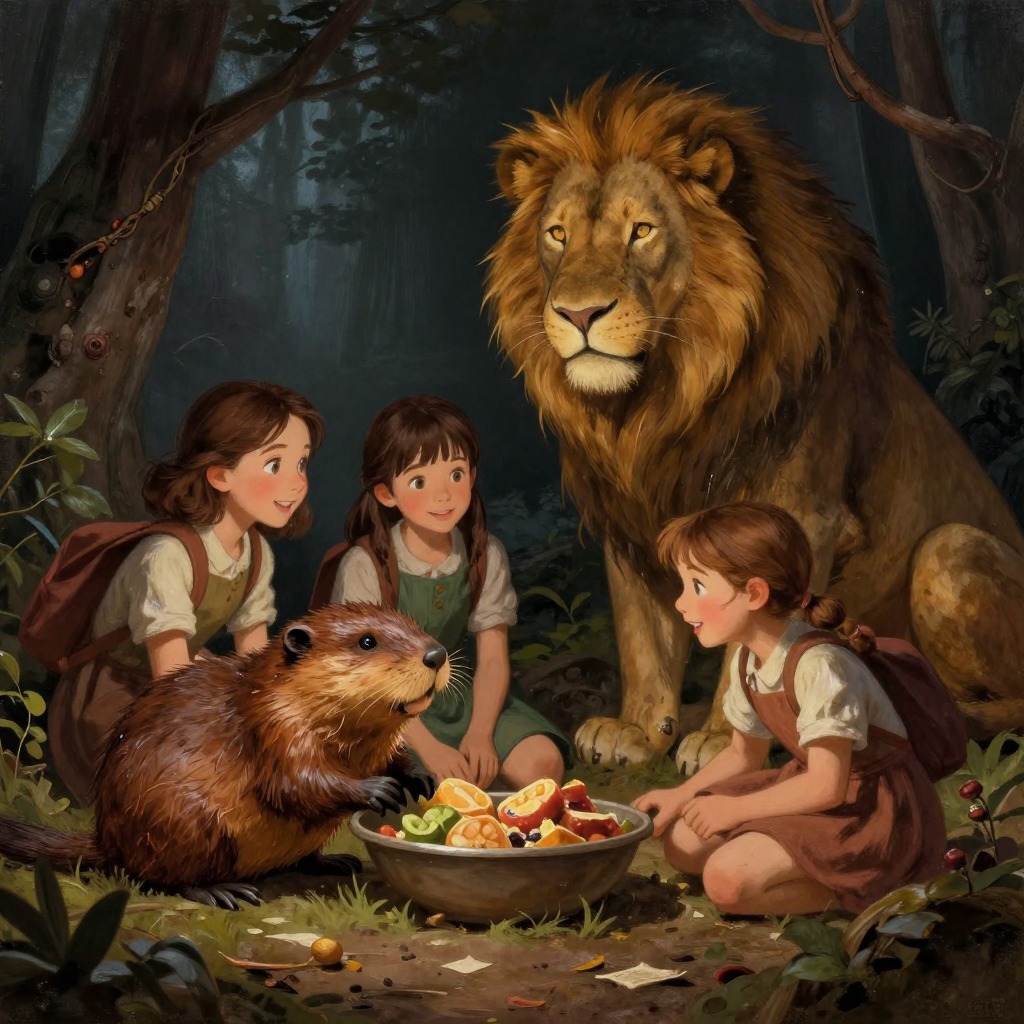
Upon the children's arrival, Mrs. Beaver is already at work, with potatoes boiling and the kettle singing. Mr. Beaver and Peter catch fresh trout from a hole in the ice, and the meal that follows is a feast of fried fish, potatoes with deep yellow butter, and a steaming marmalade roll, all washed down with tea and creamy milk. After the meal, Mr. Beaver lights his pipe and reveals the crucial information. He tells them that Mr. Tumnus has been taken by the White Witch's police to her house, a place from which few return, and that the Witch turns her captives into stone statues. He then introduces the name Aslan, the great Lion, the King of the wood and the son of the Emperor-Beyond-the-Sea, who is "on the move" and will set all wrongs right. Mr. Beaver recites the old rhyme: "Wrong will be right, when Aslan comes in sight, / At the sound of his roar, sorrows will be no more, / When he bares his teeth, winter meets its death / And when he shakes his mane, we shall have spring again." He further explains the prophecy of the four thrones at Cair Paravel, which states that when two Sons of Adam and two Daughters of Eve sit in those thrones, the White Witch's reign and her life will end. This is why the Witch has been watching for humans for years, and why the children's lives are in danger.
Edmund's Betrayal and the Flight
During the conversation, Edmund, who has been brooding over his desire for Turkish Delight and his resentment toward the others, quietly slips out of the house. He has heard everything about Aslan and the Stone Table, and he has already met the White Witch and eaten her enchanted food. Mr. Beaver immediately recognizes the signs of treachery, noting that Edmund has "the look of one who has been with the Witch and eaten her food." The Beavers realize that Edmund has gone to betray them, and that the Witch will soon arrive to capture them all. Mrs. Beaver, practical and unflappable, insists on packing provisions—ham, tea, sugar, matches, and loaves of bread—before they flee. Mr. Beaver locks the door behind them to delay the Witch, and the group sets off into the snowy night, heading for a secret hiding cave. The Beavers' house thus becomes the last place of safety before the children are forced into a desperate flight, and its cozy interior stands in stark contrast to the danger and betrayal that erupt from within it.
Narrative Significance
The Beavers' house functions as a crucial narrative hub, a domestic sanctuary where the children are fully initiated into the stakes of Narnia's conflict. It is the place where the abstract idea of Aslan becomes a concrete, emotional reality for Peter, Susan, and Lucy, and where the prophecy that drives the entire plot is revealed. The house's warmth and abundance—the roaring fire, the fresh fish, the marmalade roll—create a stark contrast with the cold, barren world of the White Witch, and its destruction (implied by the Witch's order to kill whatever is found there) marks the point of no return for the children's adventure. The Beavers' home is not merely a setting but a symbol of the ordinary, good life that the Witch's tyranny has put at risk, and its loss propels the children toward their destiny at the Stone Table and the final battle.