Deep Magic
The Deep Magic is the foundational legal and magical code of Narnia, a set of absolute laws inscribed at the very dawn of time. It is the principle the White Witch invokes to claim ownership over Edmund Pevensie after his betrayal, and it forms the central conflict that Aslan must resolve through a sacrifice that transcends the law itself.
Origin and Nature
The Deep Magic was established by the Emperor-Beyond-the-Sea at the creation of Narnia. Its precepts are written on the Stone Table that stands on the hilltop, in letters as deep as a spear is long on the trunk of the World Ash Tree, and engraved on the sceptre of the Emperor-Beyond-the-Sea. Aslan himself acknowledges its authority, stating, "It is very true; I do not deny it." The Witch describes it as the magic that the Emperor put into Narnia at the very beginning, a law that predates all other powers in the land.
The Witch's Claim
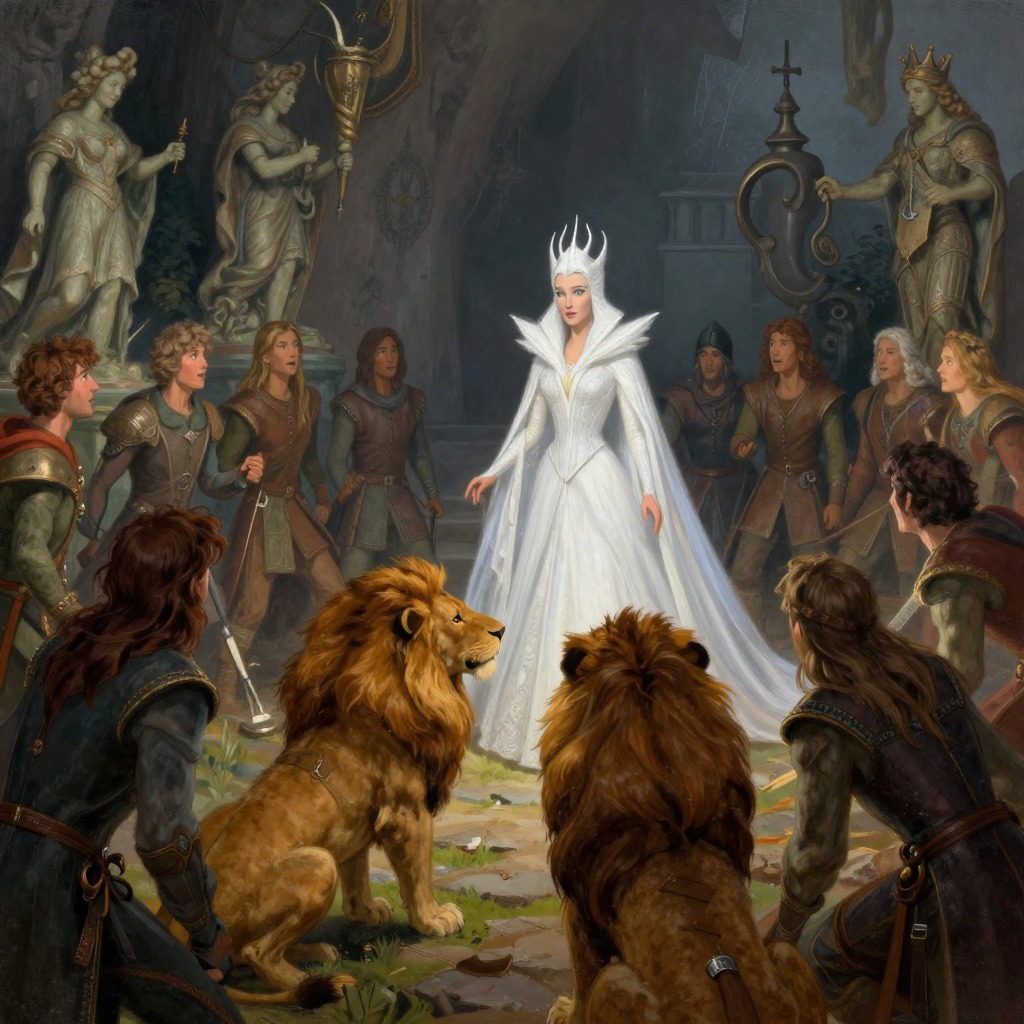
The White Witch bases her entire claim to rule Narnia on her role as the executor of the Deep Magic. She declares that "every traitor belongs to me as my lawful prey and that for every treachery I have a right to a kill." When Aslan confronts her, she insists that Edmund's life is forfeit to her, that his blood is her property. She warns that unless she has blood as the Law says, "all Narnia will be overturned and perish in fire and water." Mr. Beaver recognizes her as "the Emperor's hangman," a role that allows her to imagine herself a queen.
Aslan's Confrontation and the Deeper Magic
Aslan does not deny the Deep Magic's authority. When Susan asks if he can work against it, he rebukes her: "Work against the Emperor's magic?" Instead, he negotiates with the Witch alone, and afterward announces that she has renounced her claim on Edmund's blood. However, the Witch's demand is ultimately satisfied not by Edmund's death but by Aslan's own willing sacrifice in the traitor's stead. This act fulfills the letter of the Deep Magic while simultaneously invoking a deeper, older magic that the Witch did not know. Aslan explains after his resurrection that "though the Witch knew the Deep Magic, there is a magic deeper still which she did not know. Her knowledge goes back only to the dawn of Time. But if she could have looked a little further back, into the stillness and the darkness before Time dawned, she would have read there a different incantation. She would have known that when a willing victim who had committed no treachery was killed in a traitor's stead, the Table would crack and Death itself would start working backwards." This Deeper Magic, from before the dawn of time, supersedes the Deep Magic and breaks its power, causing the Stone Table to crack and Aslan to return to life.
Significance
The Deep Magic serves as the narrative's central legal and magical mechanism, establishing the stakes of Edmund's betrayal and the necessity of a substitutionary sacrifice. It embodies a law of strict justice—treachery demands a death—that cannot be circumvented by force or negotiation. Aslan's victory comes not by breaking the law but by fulfilling it in a way that reveals a more fundamental principle of self-sacrificial love. The cracking of the Stone Table symbolizes the end of the old order and the beginning of a new one, where death itself is reversed. The Deep Magic thus functions as both a plot device and a theological allegory, representing the Old Testament law that must be satisfied before grace can prevail.