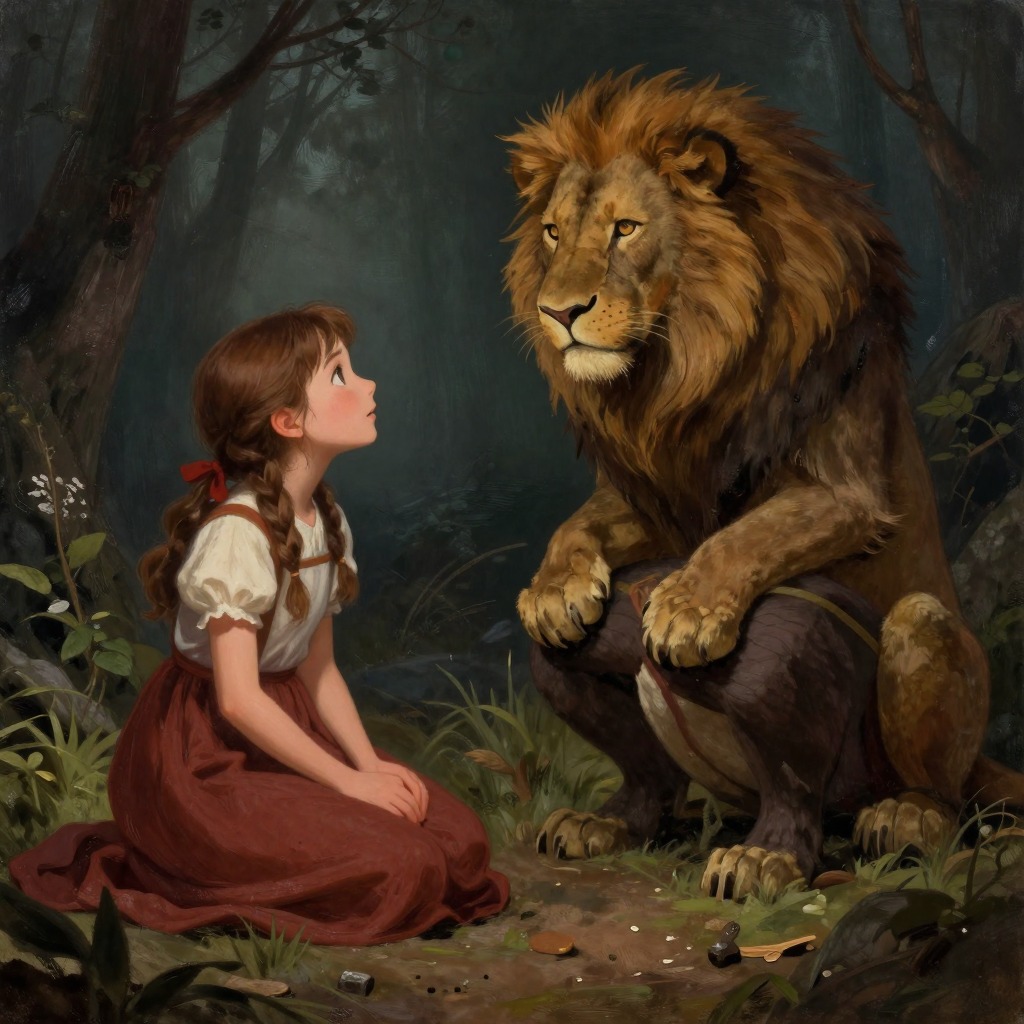
Tumnus's cave
Tumnus's cave is the small, dry, clean home of the Faun Mr. Tumnus, located in a rocky valley in the Narnian wood not far from the Lamp-post. It is the first Narnian dwelling Lucy Pevensie enters, and it serves as the setting for the story's initial encounter between a human child and a Narnian creature—an encounter that begins in warmth and hospitality but ends in confession and danger.
Appearance and Interior
The cave is a little, dry, clean space of reddish stone, with a carpet on the floor, two small chairs ("one for me and one for a friend," as Mr. Tumnus explains), a table, a dresser, and a mantelpiece over a wood fire. Above the mantelpiece hangs a picture of an old Faun with a grey beard—Mr. Tumnus's father. In one corner a door leads to the Faun's bedroom, and on one wall is a shelf full of books with titles such as The Life and Letters of Silenus, Nymphs and Their Ways, Men, Monks and Gamekeepers; a Study in Popular Legend, and Is Man a Myth? The cave is lit by a lamp that Mr. Tumnus lights with a flaming piece of wood taken from the fire. Lucy thinks she has never been in a nicer place.
The Tea and the Confession
It is in this cave that Mr. Tumnus serves Lucy a wonderful tea: a lightly boiled brown egg for each of them, sardines on toast, buttered toast, toast with honey, and a sugar-topped cake. After eating, the Faun plays a strange little flute made of straw, producing a tune that makes Lucy want to cry, laugh, dance, and go to sleep all at once. When Lucy insists she must go home, Mr. Tumnus breaks down in tears and confesses that he is in the pay of the White Witch, that he has been ordered to kidnap any Son of Adam or Daughter of Eve he meets in the wood, and that he has been lulling Lucy to sleep in order to hand her over. He describes the punishments the Witch would inflict on him if he fails: his tail cut off, his horns sawn off, his beard plucked out, his cloven hoofs turned into solid horse-like hoofs, or even being turned into stone. Yet, having come to know Lucy, he cannot go through with the betrayal. He leads her back to the Lamp-post, and she returns through the Wardrobe.
Destruction and Aftermath
When the four children later return to the cave together, they find it in ruins. The door has been wrenched off its hinges and broken to bits. Inside, the cave is dark and cold, with a damp smell of disuse. Snow has drifted in and is heaped on the floor, mixed with charred sticks and ashes from the fire—someone has apparently flung the fire about the room and stamped it out. The crockery lies smashed on the floor, and the picture of the Faun's father has been slashed into shreds with a knife. Nailed through the carpet to the floor is a notice of arrest signed by Fenris Ulf, Captain of the Secret Police, charging Mr. Tumnus with High Treason against the White Witch, comforting her enemies, harbouring spies, and fraternising with Humans. The destruction of the cave marks the point at which the children understand the real danger of Narnia and commit themselves to rescuing the Faun.
Narrative Significance
Tumnus's cave functions as a threshold space—the first interior of Narnia that a human child experiences, and the place where the moral complexity of the land is first revealed. Its cozy, bookish warmth contrasts sharply with the cold, snowy wood outside, and its subsequent violent destruction signals the reach of the White Witch's power. The cave is also the site of the story's first act of mercy: Tumnus's decision to release Lucy rather than betray her, a choice that sets the entire rescue plot in motion.