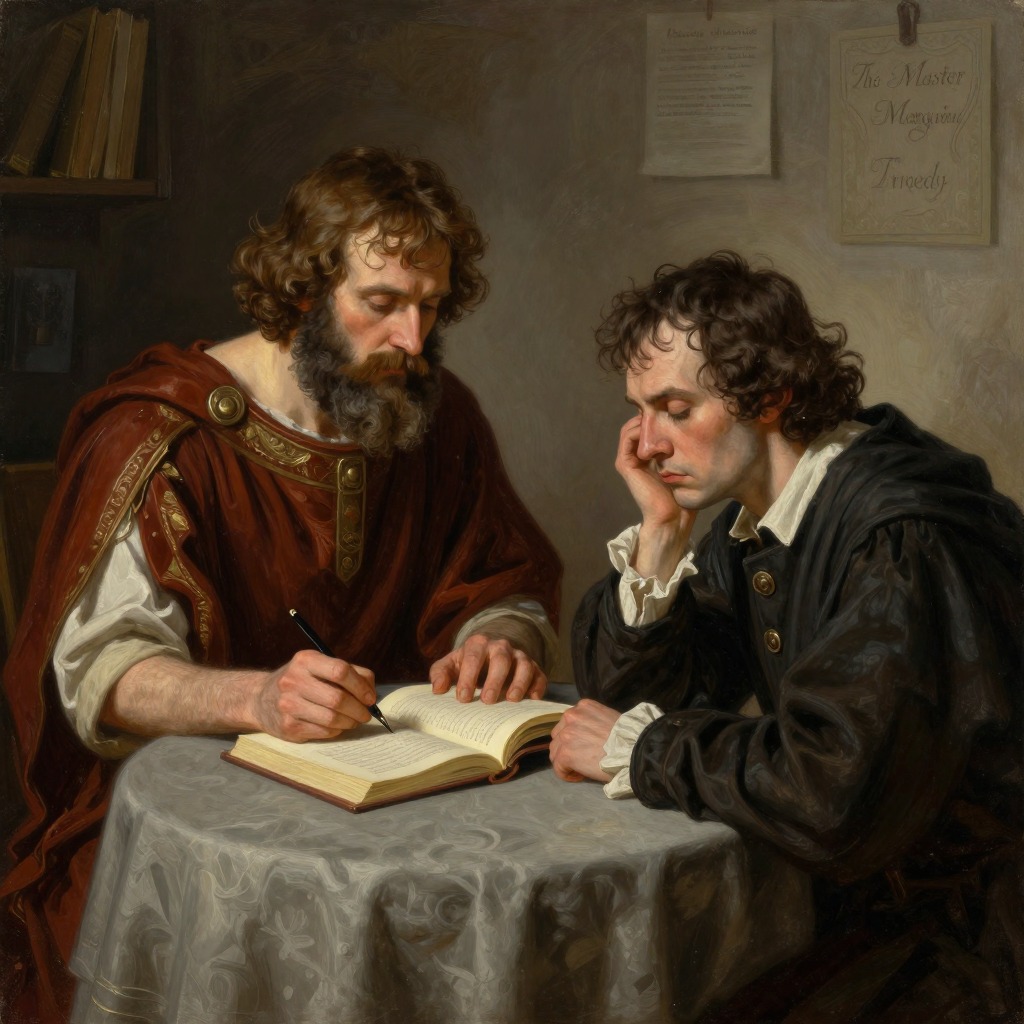
The Master's Basement
The Master's Basement is the private refuge where the master writes his novel about Pontius Pilate and lives with his secret wife Margarita, a space that embodies both creative freedom and eventual despair. Located in a lane near the Arbat, this two-room basement apartment becomes the sanctuary for the master's literary work and his love affair, but also the site of his psychological collapse and the burning of his manuscript. It stands in stark contrast to the public, bureaucratic spaces of Moscow, representing the possibility of authentic life and art outside the official sphere.
Identity and Setting
The Master's Basement consists of two rooms in the basement of a little house in a garden, rented by the master after he won one hundred thousand roubles on a state bond. The larger room, about one hundred and fifty square feet, is filled with books from the painted floor to the sooty ceiling, along with a stove and a sofa. The second, quite minuscule room contains another sofa, a little table with a night lamp, and a small writing table near the window. A narrow front hall with a sink completes the apartment, a detail the master recalls with special pride. The windows are just level with the paved walk leading from the gate, and opposite, only four steps away, grow lilacs, a linden, and a maple. In winter, the master sees black feet through the dim glass and hears snow crunching; in spring, the lilac bushes dress themselves in green. The extraordinary smell of lilacs fills the space, and a fire eternally blazes in the stove.
Life and Plot Trajectory
The basement becomes the setting for the master's golden age. After winning the hundred thousand roubles, he gives up his room on Myasnitskaya, leaves his work at the museum, and begins writing his novel about Pontius Pilate. He lives solitarily, with almost no acquaintances in Moscow, until Margarita enters his life. She comes to him every afternoon, and he begins waiting for her in the morning, listening for the banging of the decrepit gate. When her hour comes and the hands show noon, his heart pounds until her shoes appear at the window, their black suede bows held tightly by steel buckles. Sometimes she pauses at the second window and taps the glass with her toe. No one knows of their liaison; in the old house, people see that some woman visits him, but they do not know her name. The lovers spend their days together: she puts on an apron, lights the kerosene stove in the front hall, prepares lunch, and sets it out on the oval table. When May storms come and water rushes past the near-sighted windows, threatening to flood their last refuge, they light the stove and bake potatoes, their laughter rising from the basement. After the storms end and sultry summer comes, the long-awaited roses appear in a vase. The master works feverishly on his novel, and Margarita absorbs it completely, endlessly rereading what he has written, sitting by the lower shelves or standing by the upper ones, wiping the hundreds of dusty spines with a cloth. She foretells fame, urges him on, and begins to call him a master. She waits impatiently for the last words about the fifth procurator of Judea, repeating aloud certain phrases she likes, and says that her life is in this novel.
Key Actions and Objectives
The basement is the site of the novel's completion and its destruction. The master finishes the novel in August, gives it to an unknown typist, and she types it in five copies. Then he goes out into life holding it in his hands, and his life ends. The novel is rejected by editors, and critical articles appear, attacking him for attempting to foist an apology for Jesus Christ into print. The master begins to suffer from mental illness: anguish comes over him, certain forebodings appear, and he becomes afraid of the dark. He imagines a very cold and pliant octopus stealing with its tentacles immediately and directly towards his heart, and he has to sleep with the light on. In mid-October, at dusk, Margarita leaves, and the master falls asleep without turning on the light. He wakes at two o'clock in the morning, feeling that the autumn darkness will push through the glass and pour into the room, and he will drown in it as in ink. He struggles with himself like a madman, gets to the stove, and starts a fire. Then he takes the heavy manuscript of the novel and the draft notebooks from the desk drawer and begins burning them. The paper burns reluctantly; he tears up the notebooks, sticks them vertically between the logs, and ruffles the pages with the poker. Familiar words flash before him, the yellow climbs steadily up the pages, but the words still show through until the paper turns black. Just then, someone scratches quietly at the window. It is Margarita. She clings to him, trembling, all wet, her cheeks wet and her hair uncurled. With a soft cry, she pulls out of the stove with her bare hands the last of what was there, a sheaf that had caught fire from below. She stamps out the fire with her feet, then collapses on the sofa and weeps irrepressibly. She collects and smooths out the burnt-edged pages, wraps them in paper, and ties them with a ribbon, full of determination. She says she will cure him, that he will restore it. But the master tells her he is ill and frightened. She leaves, promising to return in the morning, but a quarter of an hour after she leaves, there comes a knock at his window. The master is taken away, and in mid-January, at night, in the same coat but with the buttons torn off, he is huddled with cold in his little yard. Behind him are snowdrifts that hide the lilac bushes, and before him and below are his little windows, dimly lit, covered with shades. He bends down to the first window and listens—a gramophone is playing in his rooms. He has nowhere to go, and fear possesses every cell of his body. He sets out for the clinic on foot across the entire city, and a truck driver takes pity on him and brings him to Stravinsky's clinic.
Relationships and Conflict
The basement is the space where the master's relationship with Margarita flourishes and where it is shattered. Their love leaps out in front of them like a murderer in an alley, striking them both at once. She becomes his secret wife, and their lives become completely inseparable. The basement is also the site of the master's conflict with the literary establishment. The editor who reads the novel looks at him as if he had a swollen cheek, and the critics Latunsky, Ariman, and Mstislav Lavrovich write articles attacking him. The master's fear and mental illness are concentrated in the basement, where he imagines the octopus and where he burns his novel.
Change and Ending
The basement undergoes a transformation from a golden refuge to a place of despair. The master's initial joy and creative energy give way to fear and illness. The burning of the novel marks the end of his life as a writer and the beginning of his confinement in the clinic. The basement is left behind, but its memory—the lilacs, the stove, the books, the yellow flowers—remains as a symbol of what was lost.
Narrative Role and Significance
The Master's Basement functions as a counter-space to the official, bureaucratic world of Moscow. It is a private, intimate realm where authentic art and love can exist, but it is also vulnerable to the pressures of the outside world. The basement's low windows, its proximity to the ground, and its location in a lane near the Arbat all emphasize its hidden, secret nature. It is a space of refuge that becomes a prison, a place of creation that becomes a site of destruction. The basement's significance lies in its representation of the possibility of a life outside the system, and the impossibility of sustaining that life in the face of state power and literary orthodoxy.