Olympia (automaton)
Olympia (automaton) is the lifeless mechanical doll created by Professor Spalanzani and the barometer salesman Coppola, who is revealed to be the sinister Coppelius. She is presented as Spalanzani's daughter and becomes the object of Nathaniel's obsessive love, ultimately leading to his madness and death. The automaton embodies the story's central themes of deceptive appearances, the uncanny, and the destructive power of projection.
Identity and Creation
Olympia is not a living woman but a highly sophisticated automaton, the product of a collaborative and later conflictual partnership between Professor Spalanzani and the sinister Coppelius (who operates under the alias Giuseppe Coppola). Spalanzani claims to have invested twenty years of work in her creation, including the clockwork mechanism that governs her speech, step, and movements. Coppelius, for his part, claims to have made her eyes. The automaton is presented to the world as Spalanzani's daughter, kept hidden for a long time before being introduced to society at a grand party. Her appearance is that of a tall, very slender, and well-proportioned woman with a finely chiselled face and graceful figure, though observers note a strange stoop of her back and a bone-thin waist, attributed to a girdle tied too tight. Her hand is ice-cold, and her lips are initially cold as well, though they seem to come alive with warmth when she presses Nathaniel to her.
Introduction to Society and Nathaniel's Obsession
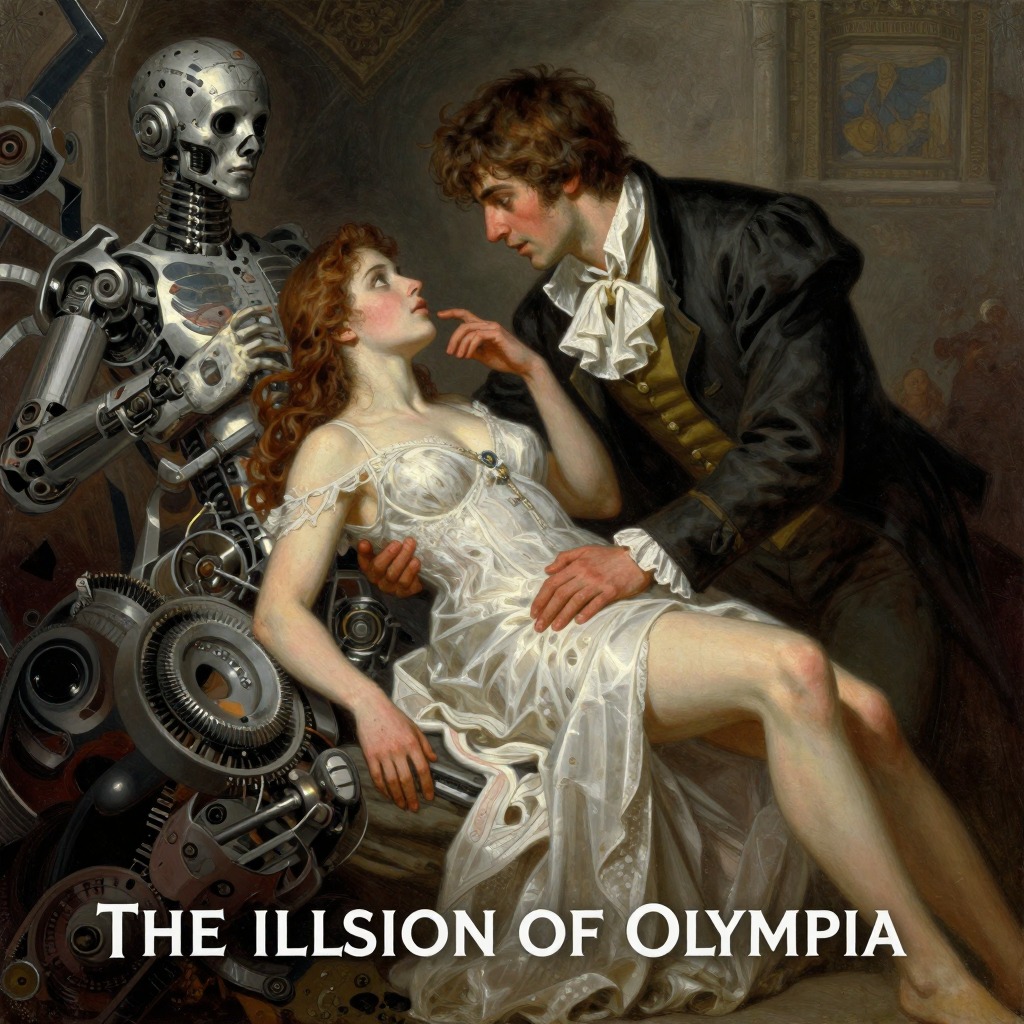
At Spalanzani's party, Olympia appears richly and tastefully attired and performs on the grand piano with great skill, singing a bravura aria with a clear, almost bell-glass-like, pitch-perfect voice. Nathaniel, already captivated by a glimpse of her through a glass door, uses Coppola's looking-glass to gaze at her from across the room. Through the lens, he perceives her as gazing ardently in his direction, and her every note seems to him enveloped in a loving look. He becomes completely captivated, crying out her name during the performance. During the ball, he dances with her repeatedly, finding her step to have a precise rhythmic steadiness that makes him falter. He speaks fervently of his love, to which Olympia only sighs, "Oh – Oh – Oh!" and later, "Oh! Oh!" Nathaniel interprets these monosyllabic responses as profound expressions of a deep spirit, while others in the company notice her strange stiffness and soullessness, with some laughing quietly among themselves. His friend Siegmund warns him that Olympia seems like a "wooden doll" with a "strangely stiff and soulless" appearance, her gaze devoid of life, her movements like clockwork, and her singing and playing like a machine. Nathaniel dismisses these observations as the blindness of cold, prosaic types.
The Revelation
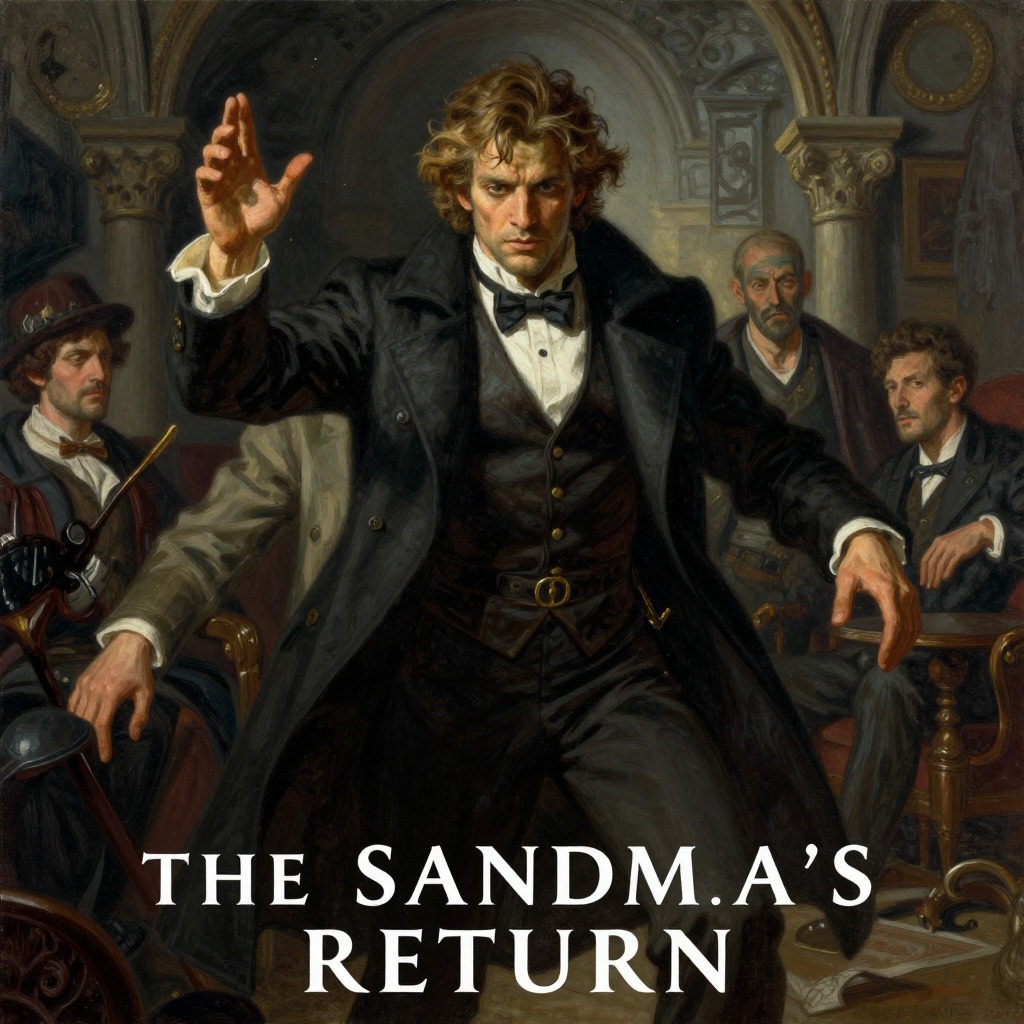
The truth of Olympia's nature is violently revealed when Nathaniel, intending to propose marriage, arrives at Spalanzani's house and hears a terrible din. He bursts into the study to find Spalanzani and Coppola furiously fighting over the automaton, each claiming credit for her creation. Coppola yanks the figure free and, swinging her, strikes Nathaniel with her, causing him to tumble backwards. Coppola then flings the figure over his shoulder and races down the steps, her ugly dangling feet banging with a wooden thud and thump. Nathaniel sees clearly that Olympia's deathly pallid wax face has no eyes, only black hollows in their stead. She is a lifeless doll. Spalanzani, bleeding from glass shards, cries out that Coppelius has robbed him of his finest automaton, and points to a pair of bloody eyes on the floor, which he flings at Nathaniel, striking him on the breast. This sight triggers Nathaniel's complete descent into madness.
Consequences and Aftermath
The revelation of Olympia as an automaton causes a public uproar. Spalanzani is forced to leave the university, as his act is considered a fraudulent swindle to pass off a wooden doll as a living person in proper society. The story of the automaton takes root, and a dreadful distrust of human figures seeps into the souls of the townspeople. Lovers begin to demand that their beloveds demonstrate their humanity by singing off-key, dancing out of step, or occasionally saying something that shows actual thought and feeling. The automaton, Olympia, thus becomes a symbol of the uncanny and the dangers of mistaking a projection for a real person, directly causing Nathaniel's madness and eventual suicide. Her empty eye sockets and the bloody eyes on the floor serve as the story's most potent and horrifying image of the collapse of Nathaniel's reality.