For you, Myra
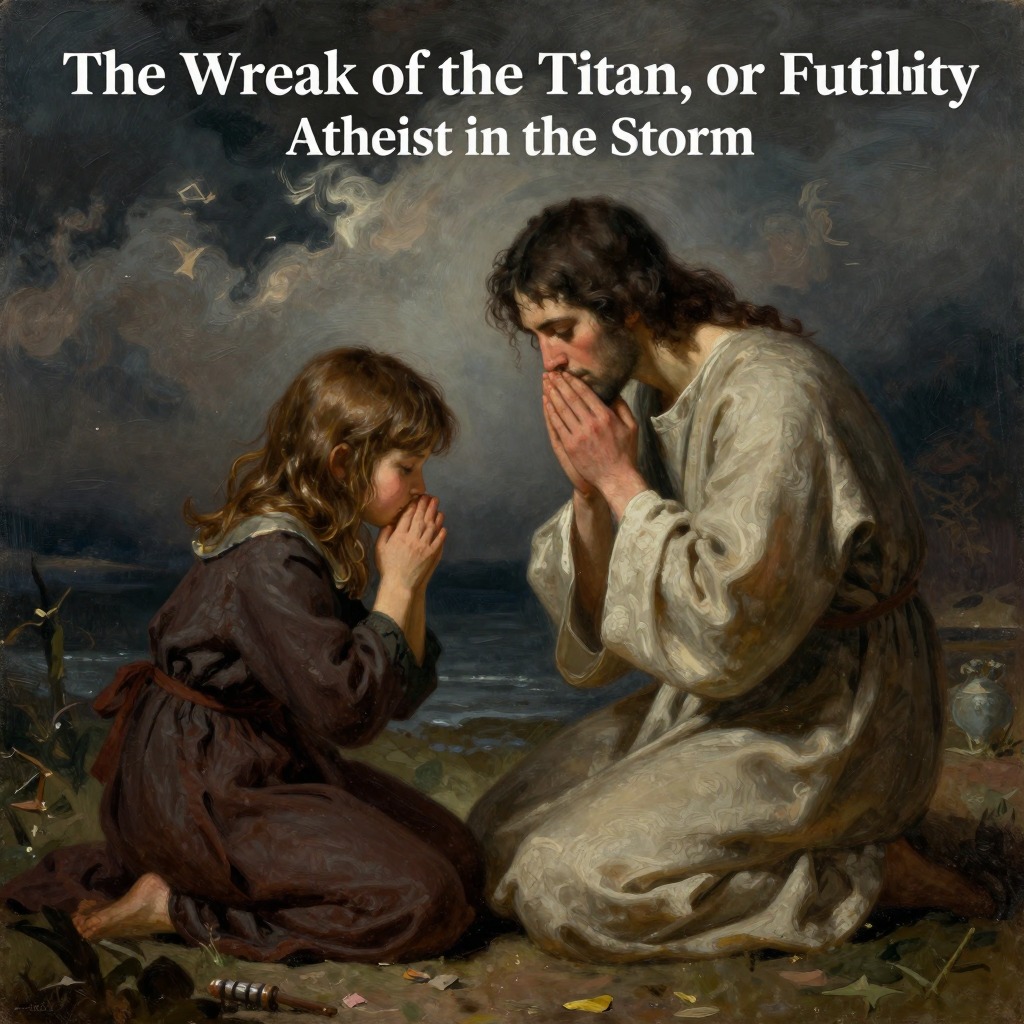
For you, Myra is the whispered prayer of John Rowland, the atheist protagonist of Morgan Robertson's The Wreck of the Titan, spoken as he kneels on an iceberg and appeals to the God he denies, begging for the life of the child in his care and the safety of her mother. This phrase marks the pivotal moment of Rowland's spiritual and moral transformation, bridging his defiant unbelief and his selfless act of rescue, and it becomes the emotional and thematic core of his redemption arc.
The Atheist's Defiance
Rowland's atheism is established early as a defining trait, one that had alienated him from Myra Gaunt, the woman he loved. In a conversation recalled by Myra, she describes how he "actually denied the existence of God" to her, a professing Christian, and how he ridiculed all she held sacred, declaring that he "would be honest with himself and others, and express his honest unbelief." His unbelief is not casual but philosophical, rooted in a worldview of "cause and effect" and "the survival of the fittest," which he invokes to explain the universe and himself. On the bridge of the Titan, drugged with hasheesh, he raves against the idea of a "merciful God," denying any obligation of love or gratitude to a deity that, in his view, has placed Myra Gaunt in his way only to torment him. He affirms "the integrity of cause and effect" as sufficient to explain existence, and he scorns the notion of a heaven where unsatisfied wants are attended to, insisting that he does not love Myra's soul but wants her, the woman herself.
The Prayer on the Ice
After the Titan sinks and Rowland finds himself stranded on an iceberg with Myra's child, his atheism is tested to its breaking point. Alone with the sleeping child, a dead polar bear, and the vast, indifferent sea, he contemplates the "Christians' Heaven" and the "good God" who, he bitterly notes, has placed the child in this desolation. He argues that the qualities of mercy, goodness, and justice play no part in the governing scheme, and he questions whether prayers are ever truly answered, dismissing them as mere physiological experiments. Yet, in a moment of profound helplessness, he walks softly to the boat, looks at the little one, and whispers: "For you, Myra." Then, sinking to his knees, the atheist lifts his eyes to the heavens and prays to the God that he denies, begging for the life of the waif in his care, for the safety of the mother so needful to the little one, and for courage and strength to do his part and bring them together. Notably, beyond this appeal for help in the service of others, not one word of his prayer includes himself as a beneficiary—a point the narrator attributes to pride.
The Answered Prayer
As Rowland rises to his feet, the flying-jib of a bark appears around the corner of ice, and the whole moonlit fabric comes into view, not half a mile away. He springs to the fire, makes a blaze, and hails the bark in a frenzy of excitement. The rescue is immediate, yet Rowland himself is uncertain whether the prayer was answered. He mutters to himself: "That bark was there—half a mile back in this wind—before I thought of praying. Is that prayer answered? Is she safe?" The ambiguity is deliberate: the bark's presence predates the prayer, yet the timing of its appearance, immediately after his supplication, leaves the question open. This uncertainty underscores the novel's ambivalent treatment of faith, neither confirming nor denying divine intervention.
The Transformation and Its Echoes
The prayer marks a turning point in Rowland's life. After his rescue and the amputation of his arm, he undergoes a moral and physical rehabilitation. He refuses to testify against the Titan's owners, choosing instead to protect the child's inheritance, and he accepts passage to New York to return Myra to her mother. His sobriety, maintained for two months, is a testament to his changed priorities. When Captain Barry asks if he will begin drinking again, Rowland replies, "Never again. I've a future now, as well as a past." The phrase "For you, Myra" thus encapsulates his shift from self-destructive despair to selfless purpose. Even in his final act of the novel, when he receives a letter from Mrs. Selfridge asking him to come and see Myra, the echo of his prayer resonates: he goes to see the child, completing the circle of devotion that began with his whispered words on the ice.
The Thematic Significance
The phrase "For you, Myra" is the novel's most concentrated expression of its central themes: the conflict between atheism and faith, the redemptive power of selfless love, and the possibility of moral rebirth. Rowland's prayer is not a conversion in the conventional sense—he does not renounce his intellectual doubts—but it is a surrender of pride and a commitment to another's welfare. The narrator's comment that "so much for pride" follows the prayer, suggesting that Rowland's act is a humbling of the self, a recognition of limits. The phrase also ties together the two Myras: the woman he loved and lost, and her child, whom he saves. In praying for the child, he is, in a sense, praying for the mother, and his devotion to the child becomes a proxy for his unfulfilled love. The ambiguity of the answered prayer—whether the bark's appearance was coincidence or providence—leaves the reader to decide, but the emotional truth of Rowland's transformation is unambiguous. He emerges from the iceberg not as the broken, drunken sailor of the Titan, but as a man who has found a purpose beyond himself, and "For you, Myra" is the utterance that marks that change.