Mr. Thompson
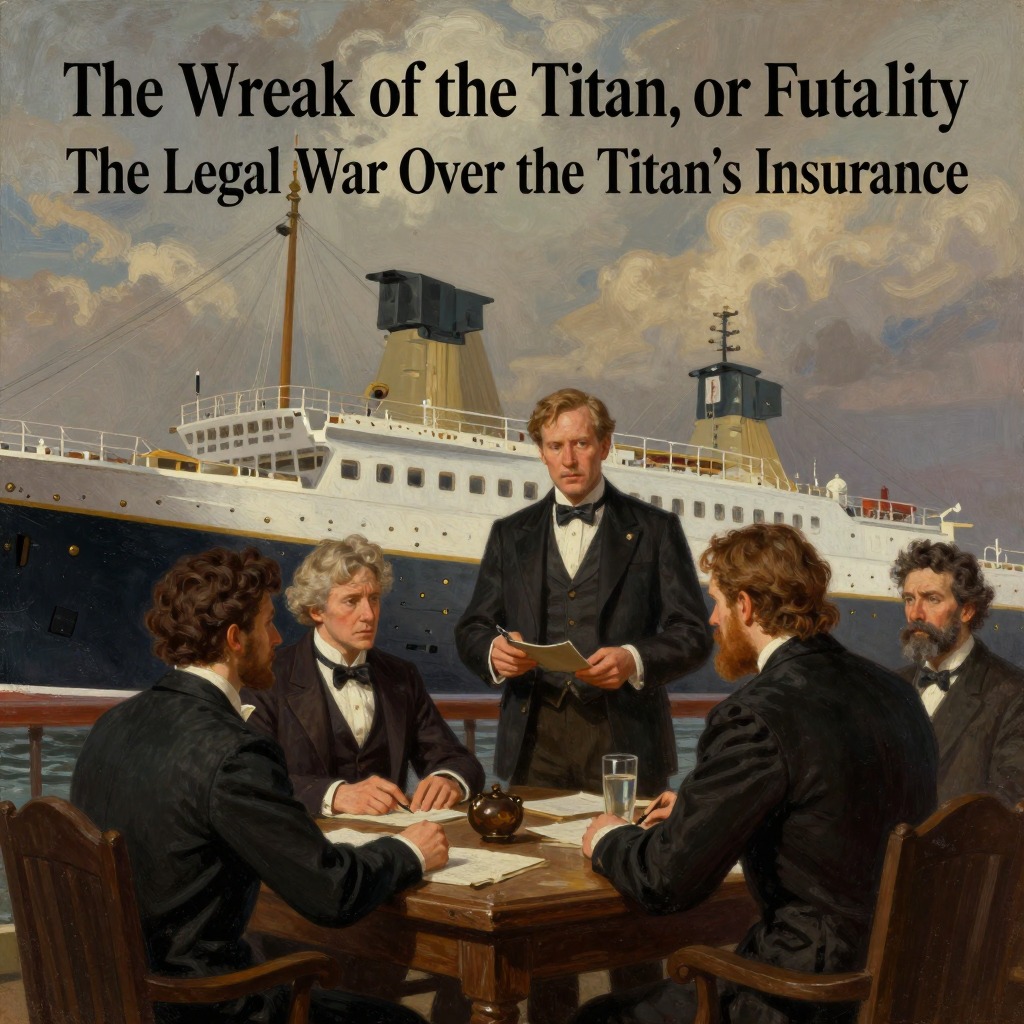
Mr. Thompson is the attorney for the steamship company that owns the Titan, a figure who appears only in the aftermath of the great ship's destruction, yet whose legal maneuvers determine the financial fate of the disaster's survivors and villains alike. He is introduced in the private office of Mr. Meyer on Threadneedle Street, where the underwriter has gathered the captain and first officer of the lost Titan to contest the insurance claim. Thompson arrives with the affidavit of Captain Bryce, a document that swears the voyage was uneventful up to the moment of the wreck, with nothing occurring to make the Titan less seaworthy or manageable. This sworn statement, Thompson will later argue, is the cornerstone of the company's defense against the underwriters' refusal to pay.
Role in the Insurance Dispute
Thompson's professional function is to protect the steamship company's interests against the claims of the underwriters, and he does so with cold legal precision. When Mr. Meyer, in his excitement, accuses Captain Bryce of concealing the collision with the Royal Age, Thompson immediately interjects that whether the story is true or false, it has no bearing on the validity of the policy, since the alleged collision occurred after the policy attached and before the wreck of the Titan. He further dismisses Meyer's charge of concealment, arguing that even if the captain concealed something, it was done after the wreck and after the underwriter's liability was confirmed, making it not even barratry. His conclusion is blunt: "You must pay this insurance." When Meyer shifts tactics, claiming that having a drunken man on lookout at the time of the iceberg collision would void the policy, Thompson counters that Meyer has no witnesses to that admission, forcing the first officer, Mr. Austen, to recant his earlier statement and swear that Rowland was a sober and competent lookout.
The Turning Point: Rowland's Counter-Argument
The attorney's confidence is shattered when Rowland, the very man the company sought to discredit, turns the legal tables on him. Rowland, having learned that Captain Bryce and Mr. Austen are part owners of the Titan, argues that an unlawful act perpetrated by a captain who is part owner, which might cause shipwreck and during which shipwreck actually occurs, is sufficient to void the policy. Thompson is forced to admit, "That is law," acknowledging the validity of Rowland's reasoning. This admission, coupled with Captain Bryce's self-convicting outburst about Indian hemp, leads Thompson to pocket his notes and remark to the discomfited captain, "You are the poorest fool I know," before leaving the office. His departure signals the collapse of the company's defense and the beginning of Meyer's triumph.
Facilitating Rowland's Departure
Despite his role in the failed defense, Thompson acts decisively to resolve the situation in a way that serves both the company and Rowland. After Mr. Selfridge's sudden death and Rowland's refusal to testify against the underwriters, Thompson pays Rowland's wages out of his own pocket, a month's pay amounting to about seventeen dollars in American money, which Captain Barry collects on Rowland's behalf. More significantly, Thompson offers Rowland two first-class cabin tickets from Liverpool to New York, in consideration of the fact that Rowland lost all his clothes and later his arm through the carelessness of the company's officers. Rowland, who had earlier refused the captain's bribe of one hundred pounds, initially recoils at this offer, but Captain Barry persuades him to accept it, arguing that he must get the child to her mother. Thompson also agrees to settle Rowland's doctor's bill and expenses with Mr. Meyer, ensuring that Rowland's passage is secured without further financial burden.
Significance
Thompson embodies the cold, calculating machinery of corporate law that surrounds the Titan's disaster. He is neither a hero nor a villain, but a professional whose primary concern is the letter of the law and the protection of his clients' interests. His legal arguments, while initially successful in defending the policy, ultimately prove insufficient against Rowland's superior understanding of admiralty law. Yet his final actions, paying Rowland's wages and providing the tickets, reveal a pragmatic willingness to resolve the matter quietly, even at personal expense. Thompson's role highlights the novella's critique of an economic system where human lives and suffering are subordinated to the interests of insurance companies and stockholders, and where even a man's redemption is facilitated not by justice, but by the expedient settlement of a financial dispute.