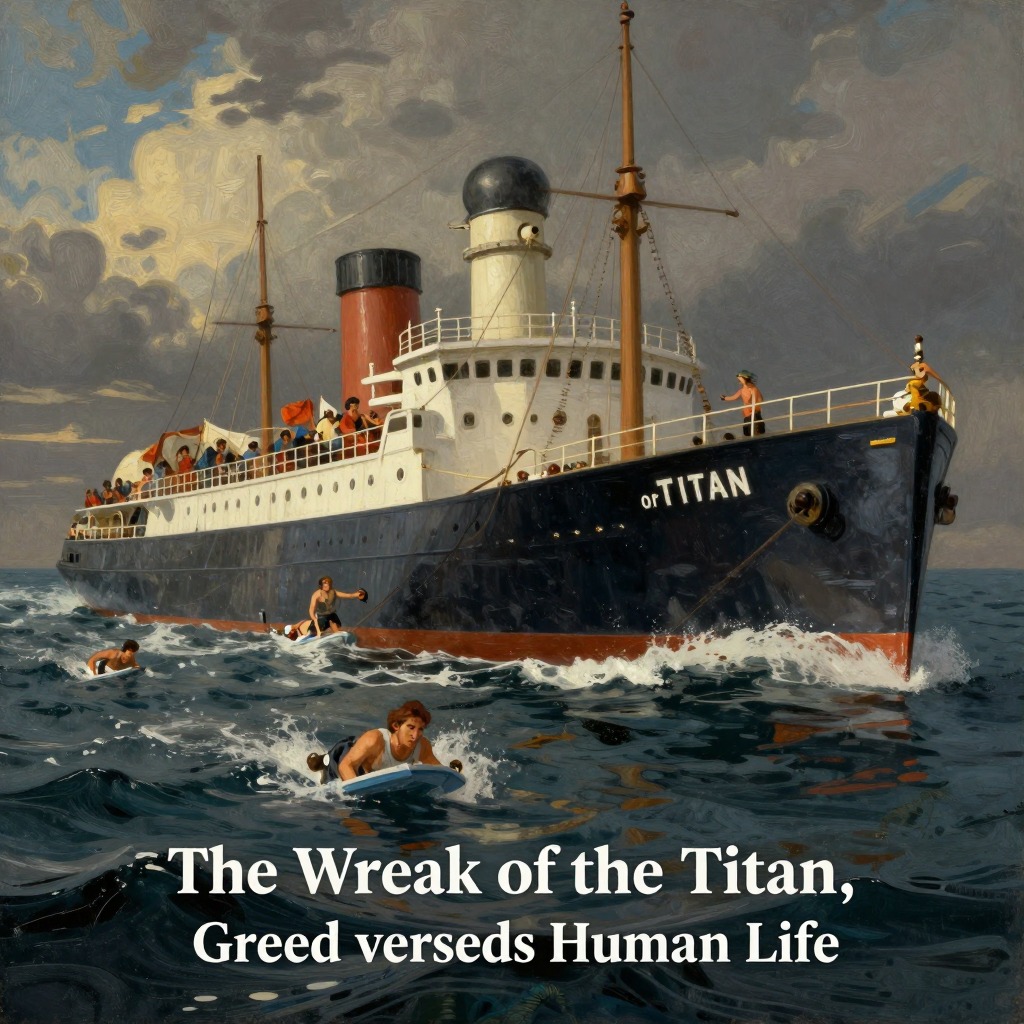
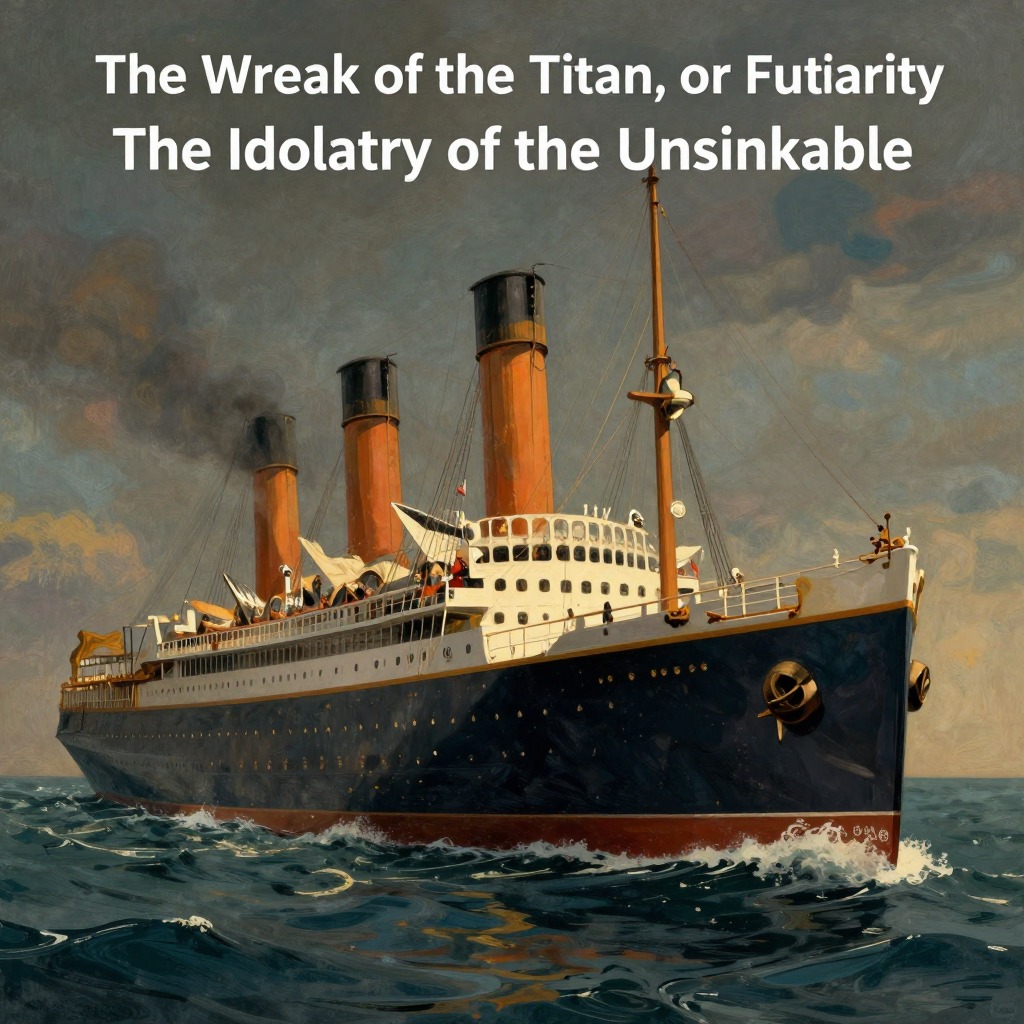
The invincible Titan
The invincible Titan is the proud designation of the fictional steamship Titan, the central vessel of Morgan Robertson's 1898 novella The Wreck of the Titan, or Futility. The phrase, which appears in the narrative's opening description and echoes through the story, captures the ship's celebrated unsinkability and the hubris of its design and operation. It is an epithet that the narrative systematically dismantles, as the Titan—declared practically unsinkable and indestructible—meets its catastrophic end after striking an iceberg, taking nearly all of its three thousand passengers and crew to the bottom of the Atlantic. The expression thus becomes a symbol of technological overconfidence, corporate negligence, and the moral blindness that the novella indicts.
The Ship's Boastful Introduction
The Titan is introduced as "the largest craft afloat and the greatest of the works of men," a floating city whose construction and maintenance involve every science, profession, and trade known to civilization. Its officers are the pick of the Royal Navy, its steward's department equals that of a first-class hotel, and it carries two brass bands, two orchestras, a theatrical company, a corps of physicians, and a corps of chaplains. The ship's engineering is presented as the pinnacle of maritime technology: ninety-two doors of nineteen water-tight compartments can be closed in half a minute by turning a lever, and they close automatically in the presence of water. With nine compartments flooded, the ship would still float, and so, the narrator states, "no known accident of the sea could possibly fill this many, the steamship Titan was considered practically unsinkable." Built of steel throughout and for passenger traffic only, she carries no combustible cargo, and her designers gave her the sharp dead-rise of a steam yacht, improving her behavior in a seaway. She is eight hundred feet long, of seventy thousand tons displacement, seventy-five thousand horse-power, and on her trial trip steamed at twenty-five knots an hour. The phrase "the invincible Titan" is the natural culmination of this litany of superlatives, a claim of absolute superiority over the sea itself.
The Rule of Full Speed and the Company's Rationale
The company's confidence in the Titan's invincibility is codified in a rule of navigation that applies to her alone: she would steam at full speed in fog, storm, and sunshine, on the Northern Lane Route, winter and summer. The company announces this rule with four reasons. First, if another craft should strike her, the force of the impact would be distributed over a larger area if the Titan had full headway, and the brunt of the damage would be borne by the other. Second, if the Titan was the aggressor, she would certainly destroy the other craft, even at half-speed, and perhaps damage her own bows; while at full speed, she would cut the other in two with no more damage to herself than a paintbrush could remedy. Third, at full speed she could be more easily steered out of danger. Fourth, in case of an end-on collision with an iceberg—"the only thing afloat that she could not conquer"—her bows would be crushed in but a few feet further at full than at half speed, and at most three compartments would be flooded, which would not matter with six more to spare. This rationale, which treats the destruction of smaller vessels as an acceptable cost, reveals the moral calculus behind the ship's invincibility: the company prioritizes speed and profit over the lives of others, and even the Titan's own passengers are secondary to the maintenance of its record.
The Collision with the Royal Age and the First Crack in the Myth
The first blow to the Titan's invincibility comes on the first night out from New York, when, steaming at full speed in a thick fog, she collides with and cuts in half the ship Royal Age. The first officer, who has just taken the deck, sees the deep-laden ship crossing the Titan's bow not half her length away. He turns the lever that closes compartments, pushes the button marked "Captain's Room," and crouches down, awaiting the crash. There is hardly a crash—only a slight jar, and a shower of small spars, sails, blocks, and wire rope sliding down the foretopmast-stay. The two halves of the ship shoot by in the darkness, and from one of them a sailorly voice cries out: "May the curse of God light on you and your cheese-knife, you brass-bound murderers." The Titan swings back to her course, and the first officer does not even turn the engine-room telegraph. The collision is concealed, and the captain attempts to bribe the lookout, John Rowland, with one hundred pounds to keep silent. Rowland refuses, declaring that he will speak of this "wholesale murder" at the first opportunity. The incident exposes the hollowness of the Titan's invincibility: the ship that was supposed to conquer all other craft has just destroyed one, and the company's response is not to question its rule but to suppress the truth.
The Iceberg Collision and the Destruction of the Invincible
The Titan's invincibility is finally shattered when she strikes an iceberg. The narrative describes the impact with clinical precision: seventy-five thousand tons dead-weight rushing through the fog at fifty feet a second. Had the impact been received by a perpendicular wall, the elastic resistance of bending plates and frames would have overcome the momentum, and the ship would have backed off, slightly down by the head, and finished the voyage at reduced speed. But a low beach, possibly formed by the recent overturning of the berg, receives the Titan, and with her keel cutting the ice like the steel runner of an iceboat, she rises out of the sea, higher and higher, until the propellers in the stern are half exposed. Then, meeting an easy, spiral rise in the ice under her port bow, she heels, overbalances, and crashes down on her side, to starboard. The holding-down bolts of twelve boilers and three triple-expansion engines snap, and the giant masses of steel and iron puncture the sides of the ship, filling the engine and boiler-rooms with scalding steam, which brings a quick, though tortured, death to each of the hundred men on duty. The Titan moves slowly backward and launches herself into the sea, where she floats low on her side—"a dying monster, groaning with her death-wound." The narrator notes that the ship was "the invincible Titan, with nearly all of her people, unable to climb vertical floors and ceilings, was beneath the surface of the sea." The phrase "the invincible Titan" is thus used with bitter irony, marking the moment when the ship's celebrated unsinkability is proven false.
The Aftermath and the Exposure of the Company's Deceit
The destruction of the invincible Titan sets in motion a legal and moral reckoning. The underwriter Mr. Meyer, who has insured the Titan heavily, attempts to avoid paying the insurance by proving that the collision with the Royal Age was concealed in the captain's sworn statement. Captain Bryce, the Titan's captain, and Mr. Austen, the first officer, are exposed as part owners who committed barratry by drugging Rowland and placing him on lookout in a stupor, hoping to discredit his testimony. Rowland, who has been rescued from the iceberg with the child Myra, confronts the two officers at Lloyds, and his testimony, along with Captain Bryce's inadvertent admission that the drug was an infusion of Indian hemp, voids the insurance policy. Yet Rowland ultimately refuses to testify, choosing to protect the child's inheritance rather than punish the company. He argues that the cause of the wreck was full speed in a fog, and that the underwriters knew the speed and took the risk. The invincible Titan, once a symbol of human mastery over the sea, becomes a cautionary tale about the cost of that mastery—a cost paid in lives, in truth, and in the moral integrity of those who profited from the ship's supposed invincibility.