Caroline
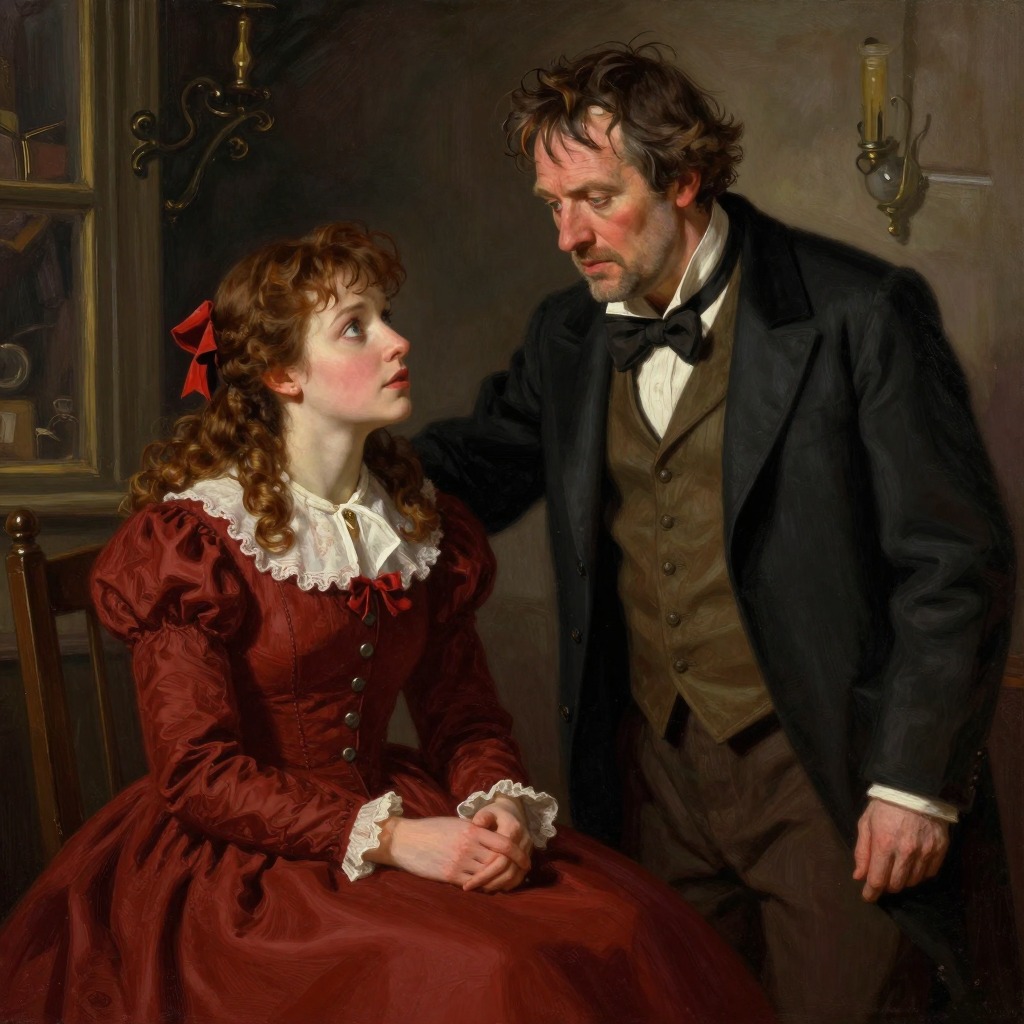
Caroline appears only in the vision of the Ghost of Christmas Yet to Come, yet her brief scene carries enormous weight. She is the wife of a young man who owes money to Scrooge, and her response to the news of Scrooge's death reveals the deep, personal misery that Scrooge's avarice has inflicted on others. Her character functions as a living embodiment of the consequences Scrooge has never allowed himself to see: a family whose happiness depends on his demise.
Identity and Situation
Caroline is introduced as a mild and patient creature, a woman whose face speaks truth. She is the wife of a man named Caroline (the text uses the same name for both husband and wife, a detail that underscores their unity in this ordeal). They are debtors to Scrooge, and the weight of that debt has clearly pressed heavily upon them. When the Ghost shows Scrooge the scene, Caroline is anxiously awaiting her husband's return, walking up and down the room, starting at every sound, looking out the window, glancing at the clock, and unable to concentrate on her needlework. Her children's voices in their play are almost unbearable to her. This portrait establishes her as a woman on the edge, her domestic peace shattered by the threat of Scrooge's mercilessness.
The Revelation of Scrooge's Death
When Caroline's husband finally arrives, his face is careworn and depressed, though he is young. He carries a remarkable expression: a kind of serious delight of which he feels ashamed and struggles to repress. When Caroline asks faintly for news, he tells her it is bad—they are not ruined, but there is hope yet. The hope, he explains, comes from the fact that Scrooge is dead. "He is past relenting," the husband says. "He is dead." Caroline's reaction is immediate and visceral: she is thankful in her soul to hear it, and she says so with clasped hands. She prays forgiveness the next moment and is sorry, but the first emotion of her heart is relief. This moment is the only emotion the Ghost can show Scrooge that is caused by his death, and it is one of pleasure. The scene makes explicit what Scrooge's life has meant to those in his power: not respect, not fear, but a desperate hope for his extinction.
Consequences and Thematic Significance
The relief Caroline and her husband feel is not merely personal; it has practical consequences. The husband explains that Scrooge's death means their debt will be transferred to an unknown successor, and they will have time to prepare the money. "We may sleep to-night with light hearts, Caroline!" he says. The children's faces, hushed and clustered round, become brighter, and the house becomes happier for this man's death. Caroline's scene is a devastating counterpoint to the Cratchit family's grief over Tiny Tim. Where the Cratchits mourn a beloved child, Caroline's household celebrates the death of a hated creditor. The juxtaposition forces Scrooge—and the reader—to confront the full moral arithmetic of his life: his wealth has purchased not love but the joy of others at his passing. Caroline's relief is a judgment more damning than any ghostly accusation, and it is this vision that helps drive Scrooge to his desperate plea to change his fate, to "sponge away the writing on this stone."