Dick Wilkins
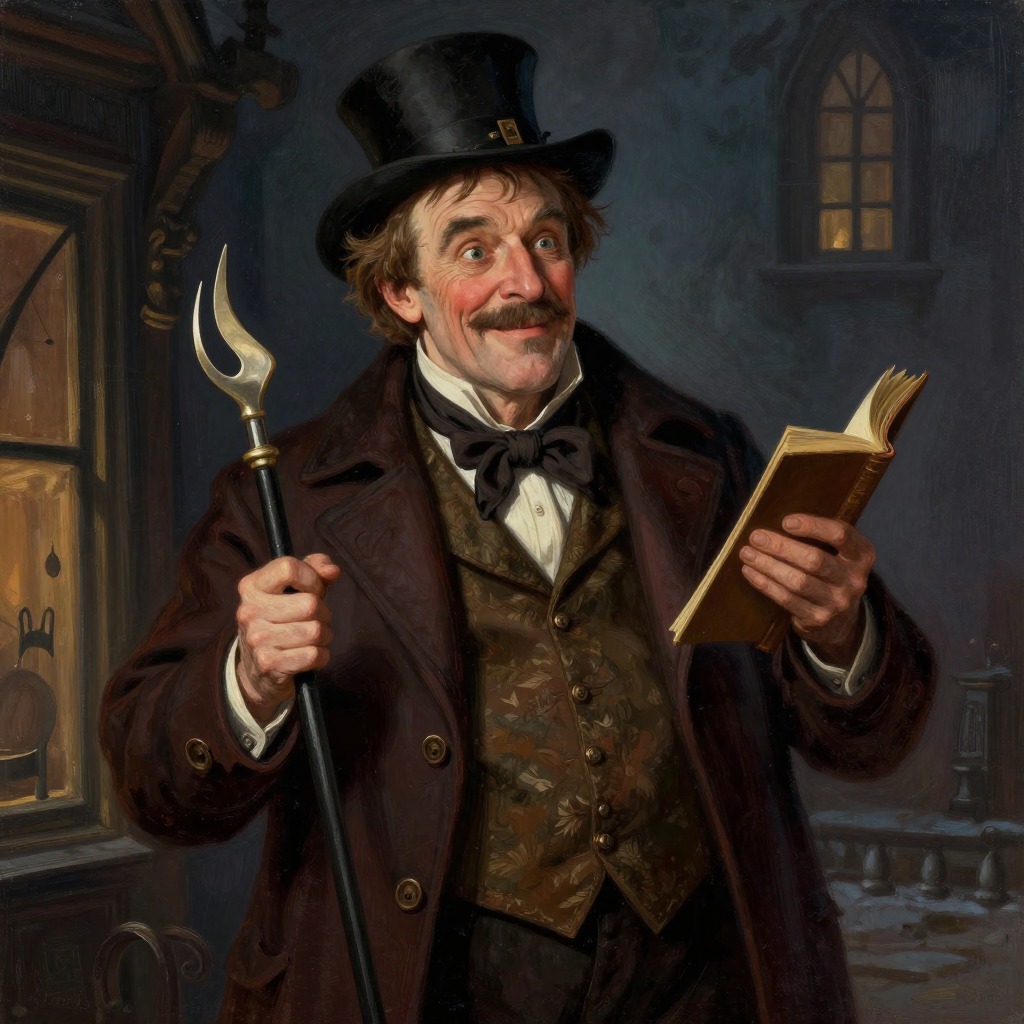
Dick Wilkins is a figure from Ebenezer Scrooge's past, a fellow apprentice at the warehouse of the jovial merchant Fezziwig. He appears only once in the narrative, during the vision shown by the Ghost of Christmas Past, but his presence carries a weight of lost connection and youthful fellowship that reverberates through Scrooge's transformation.
Identity and Introduction
Dick Wilkins is introduced as the young man who, alongside Scrooge's former self, works under Fezziwig. When the Ghost of Christmas Past transports Scrooge to the Fezziwig warehouse on a long-ago Christmas Eve, Scrooge sees his younger self enter briskly, accompanied by his fellow apprentice. Scrooge immediately recognizes him, exclaiming, "Dick Wilkins, to be sure!" and adding, "He was very much attached to me, was Dick. Poor Dick! Dear, dear!" This spontaneous warmth, expressed decades later, reveals that Wilkins was not merely a colleague but a genuine friend, and Scrooge's affectionate lament for "Poor Dick" hints at a friendship that, like so much else in Scrooge's life, was allowed to wither.
Role in the Fezziwig Christmas Scene
Wilkins is an active participant in the exuberant Christmas Eve celebration that Fezziwig throws for his employees. When Fezziwig calls out, "Yo ho, there! Ebenezer! Dick!" both apprentices respond with alacrity, charging into the street to put up the shutters with a speed and energy that astonishes even the narrator. They work as a team, panting like racehorses, and then throw themselves into the dancing, the games, and the feast that follows. Wilkins is part of the "twenty couple at once" that fills the transformed warehouse, and he is one of the two apprentices who, after the party, pour out their hearts in praise of their employer. Scrooge, watching from the shadows of time, corroborates everything, remembers everything, and undergoes "the strangest agitation" as he relives the scene. Wilkins is thus a key component of the memory that triggers Scrooge's first conscious pang of regret for the human connections he has sacrificed.
Contrast with Scrooge's Later Life
The Ghost of Christmas Past uses the Fezziwig scene to teach Scrooge a lesson about the power of a master to make his servants' lives happy or miserable. When the Spirit remarks that Fezziwig spent only a few pounds on the party, Scrooge, heated by the memory and speaking "unconsciously like his former, not his latter self," defends Fezziwig's generosity, arguing that the happiness he gave was "quite as great as if it cost a fortune." Immediately after this outburst, Scrooge feels the Spirit's glance and stops, then admits, "I should like to be able to say a word or two to my clerk just now. That's all." The memory of Dick Wilkins and the fellowship they shared directly prompts Scrooge's first stirring of conscience toward Bob Cratchit, his own underpaid and overworked clerk. Wilkins, though absent from the present, thus serves as a living contrast to the isolation Scrooge has imposed on himself and on those who work for him.
Thematic Significance
Dick Wilkins represents the lost possibility of a life lived in warm, reciprocal human connection. He is a figure from a time when Scrooge was capable of friendship, loyalty, and joy—a time before the "master passion, Gain" had engrossed him. Scrooge's exclamation of "Poor Dick!" is not merely a sentimental aside; it is an acknowledgment of a relationship that, like his engagement to Belle and his bond with his sister Fan, was allowed to lapse as he hardened into the solitary miser. Wilkins has no further role in the story, and Scrooge never seeks him out after his transformation, but the brief vision of their shared apprenticeship is essential to the narrative's moral architecture. It provides the evidence that Scrooge was not always the cold, grasping figure of the opening chapters, and that the capacity for warmth and fellowship, though buried, still exists within him, waiting to be reawakened.