Alice
Alice is the curious and courageous young protagonist of Lewis Carroll's Alice's Adventures in Wonderland, whose journey down a rabbit-hole into a surreal dream-world forces her to confront radical changes in size, identity, and the very nature of reality. Her adventures—from the Pool of Tears to the trial of the Knave of Hearts—trace a trajectory from a passive, rule-following Victorian child to a confident figure who openly defies the arbitrary authority of the Queen of Hearts, ultimately asserting her own agency and waking from the dream transformed.
Identity and Background
Alice is introduced as a young girl who is "beginning to get very tired of sitting by her sister on the bank, and of having nothing to do." She is a child of the Victorian schoolroom, having "learnt several things of this sort in her lessons" and being able to recite poems like "How doth the little busy bee." Her internal life is rich with self-dialogue: she "generally gave herself very good advice, (though she very seldom followed it), and sometimes she scolded herself so severely as to bring tears into her eyes." She is also deeply attached to her cat, Dinah, whom she mentions repeatedly, and she possesses a practical, cautious streak—she checks the "DRINK ME" bottle for a poison label before tasting it, having read "several nice little histories about children who had got burnt, and eaten up by wild beasts and other unpleasant things, all because they would not remember the simple rules their friends had taught them." This blend of book-learned prudence, imaginative play, and a longing for a more interesting world defines her character at the outset.
Arc Through the Plot
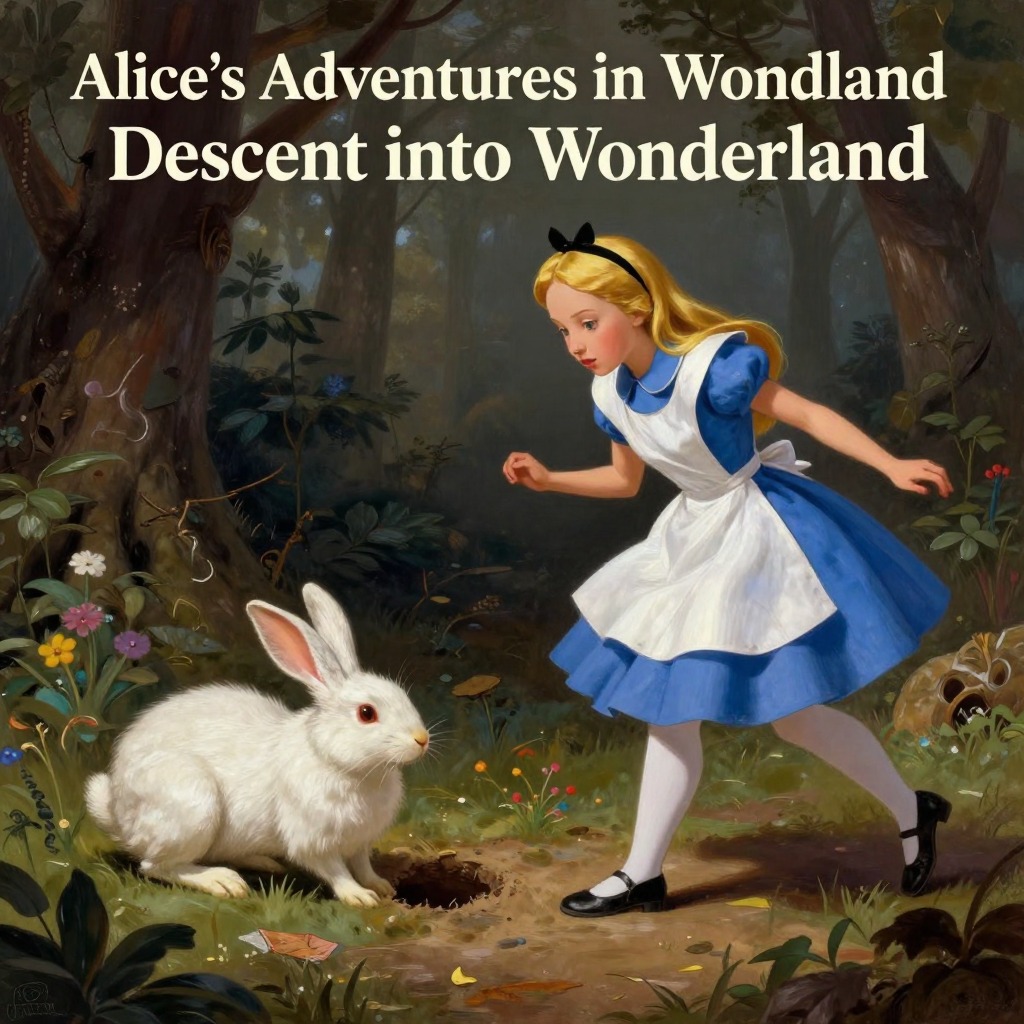
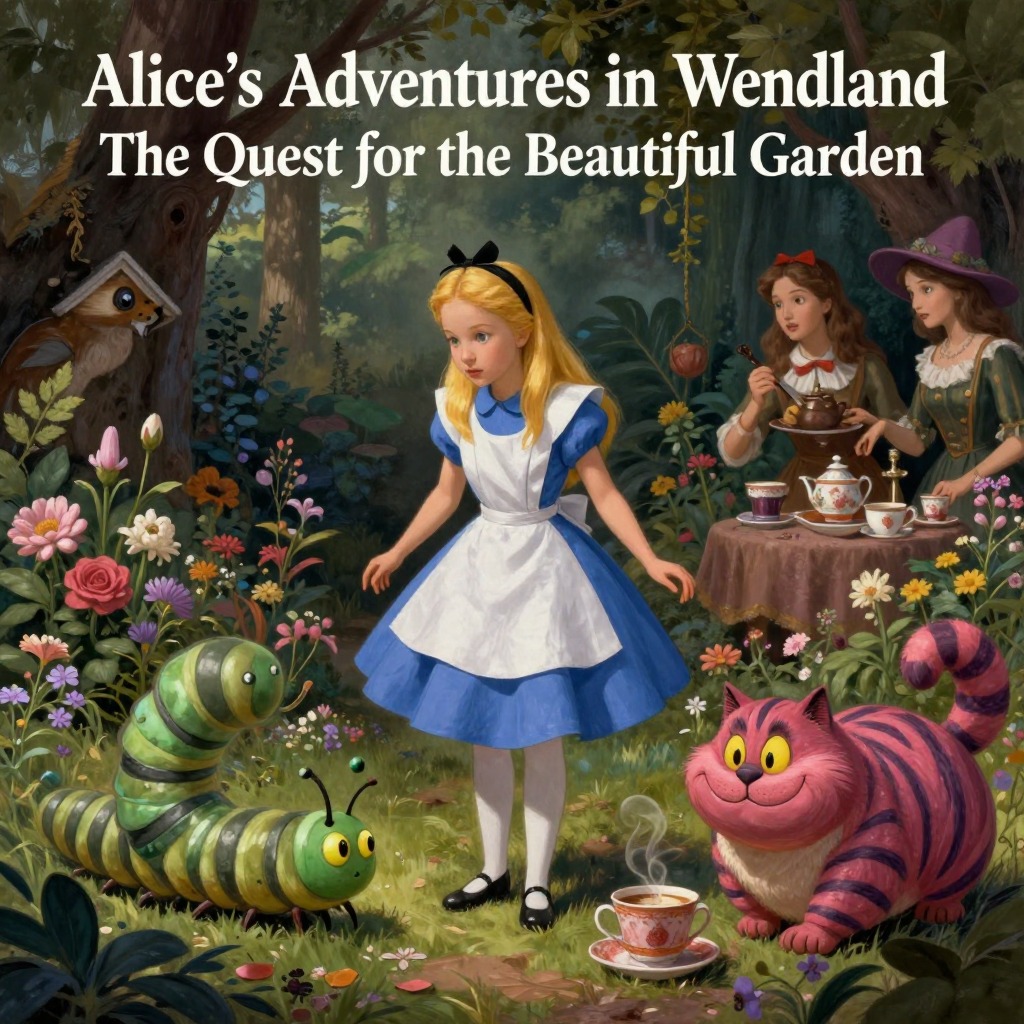
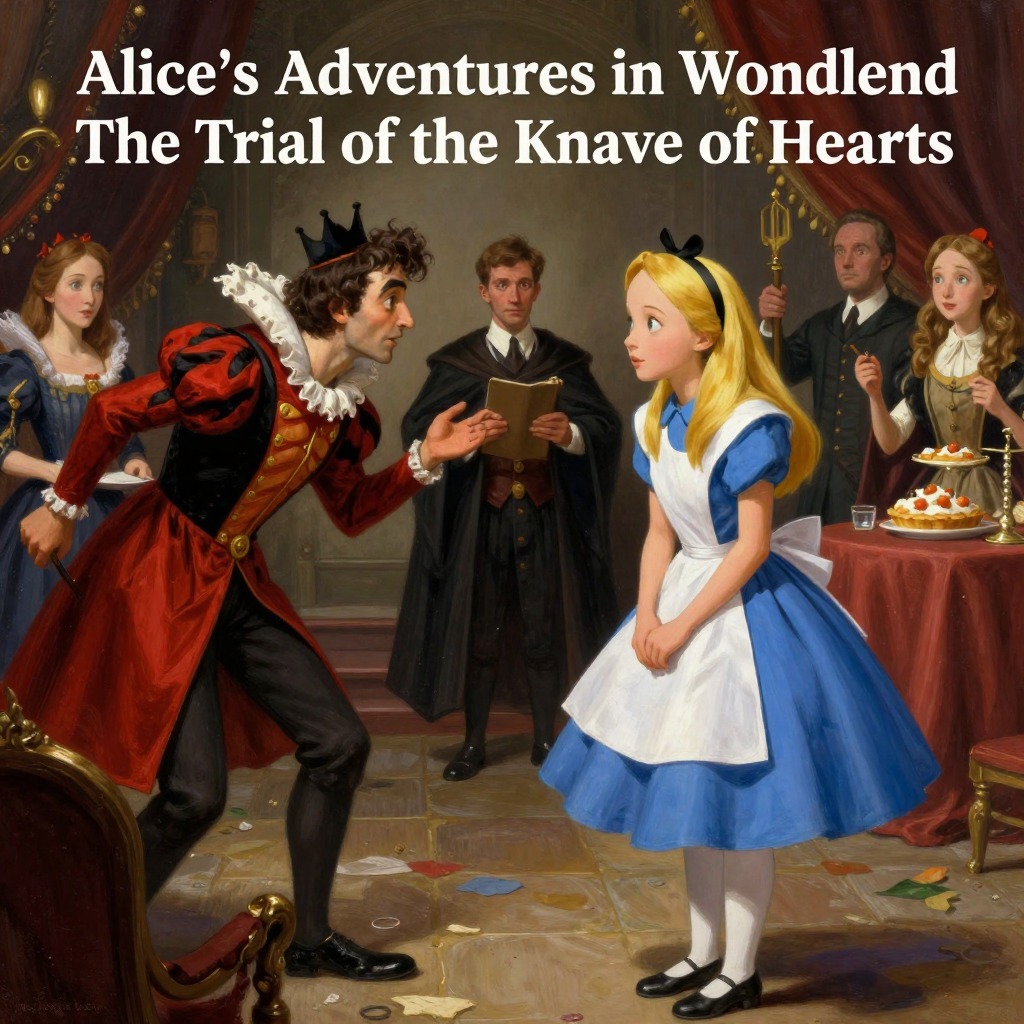
Alice's journey is marked by a series of physical and psychological transformations. Her fall down the rabbit-hole is a plunge into a world where the ordinary rules of cause and effect no longer apply. She drinks a potion labeled "DRINK ME" and shrinks to ten inches high, then eats a cake marked "EAT ME" and grows to more than nine feet tall, weeping a pool of tears so large that she later has to swim in it. These size changes are not merely physical; they trigger a profound crisis of identity. After growing, she asks herself, "Who in the world am I? Ah, that's the great puzzle!" and tries to recite the multiplication table, only to find that "four times five is twelve, and four times six is thirteen." Her attempts to impose order on Wonderland—through logic, memorized poems, and social etiquette—consistently fail, as when she recites "You are old, Father William" to the Caterpillar and is told it is "wrong from beginning to end." Yet she persists, learning to use the Caterpillar's magic mushroom to control her size, nibbling first one side then the other to grow taller or shorter. By the time she reaches the trial of the Knave of Hearts, she has grown so large that she "wasn't a bit afraid of interrupting" the King, and she openly declares that the evidence—a set of nonsense verses—has "not an atom of meaning in it." Her final act of defiance is to shout at the Queen of Hearts, "Who cares for you? You're nothing but a pack of cards!" at which point the entire dream collapses and she wakes on the riverbank, her head in her sister's lap.
Relationships and Conflict
Alice's interactions with Wonderland's inhabitants are almost uniformly adversarial or bewildering. The White Rabbit mistakes her for his housemaid, Mary Ann, and orders her about; the Caterpillar contradicts her at every turn; the Duchess hurls a baby at her that turns into a pig; the Hatter and the March Hare subject her to a mad tea-party where riddles have no answers and time is stuck at six o'clock; and the Queen of Hearts repeatedly screams "Off with her head!" for the slightest offense. Yet Alice never entirely submits. She argues with the Lory about age, corrects the Duchess's morals, and tells the King that his rule about people over a mile high leaving the court is "not a regular rule: you invented it just now." Her relationship with the Cheshire Cat is one of the few that offers genuine guidance, even as the Cat warns her that "we're all mad here. I'm mad. You're mad." The Cat's vanishing grin—the last part of him to disappear—becomes a symbol of the dream's logic, where a grin can exist without a cat. Throughout, Alice's primary conflict is between her desire to understand and navigate this world and the world's refusal to make sense on her terms.
Change and Ending
Alice's most significant change is the growth of her confidence and her willingness to challenge authority. Early in the story, she is timid and polite, even when frightened: she addresses the Mouse with a formal "O Mouse" from her Latin grammar, and she apologizes profusely for offending it. By the trial, however, she has grown to her full size—both physically and metaphorically—and she interrupts the King, contradicts the Queen, and refuses to be silenced. When the Queen orders her beheading, Alice simply replies, "Who cares for you?" and the entire pack of cards rises into the air and flies down upon her. She wakes to find herself on the riverbank, her sister brushing dead leaves from her face. The dream is over, but its effects linger: Alice tells her sister "all these strange Adventures" and runs off to tea, thinking "what a wonderful dream it had been." Her sister, left behind, dreams of Alice as a grown woman who will one day tell the same story to other children, "making their eyes bright and eager with many a strange tale." The ending thus frames the entire adventure as a formative experience that will shape Alice's future self, even as she returns to the ordinary world.
Thematic Significance
Alice embodies the Victorian child's encounter with a world that defies rational explanation. Her journey is a series of cognitive shocks—size changes that violate physics, conversations that violate logic, and a legal system that violates justice—that force her to question the stability of identity, language, and authority. Her repeated attempts to recite poems and recall facts, only to have them come out wrong, dramatize the fragility of knowledge itself. At the same time, her growing assertiveness represents a rejection of arbitrary power: she refuses to be cowed by the Queen's threats, and she insists on meaning where none exists. In this sense, Alice is not merely a passive observer of Wonderland's absurdities but an active, if often bewildered, participant who ultimately reclaims her own sense of self. Her final words—"You're nothing but a pack of cards!"—are both a dismissal of the dream's tyranny and an assertion of her own reality. The story thus uses Alice's perspective to explore the limits of childhood understanding and the power of imagination to reshape the world, even if only in a dream.