Caterpillar
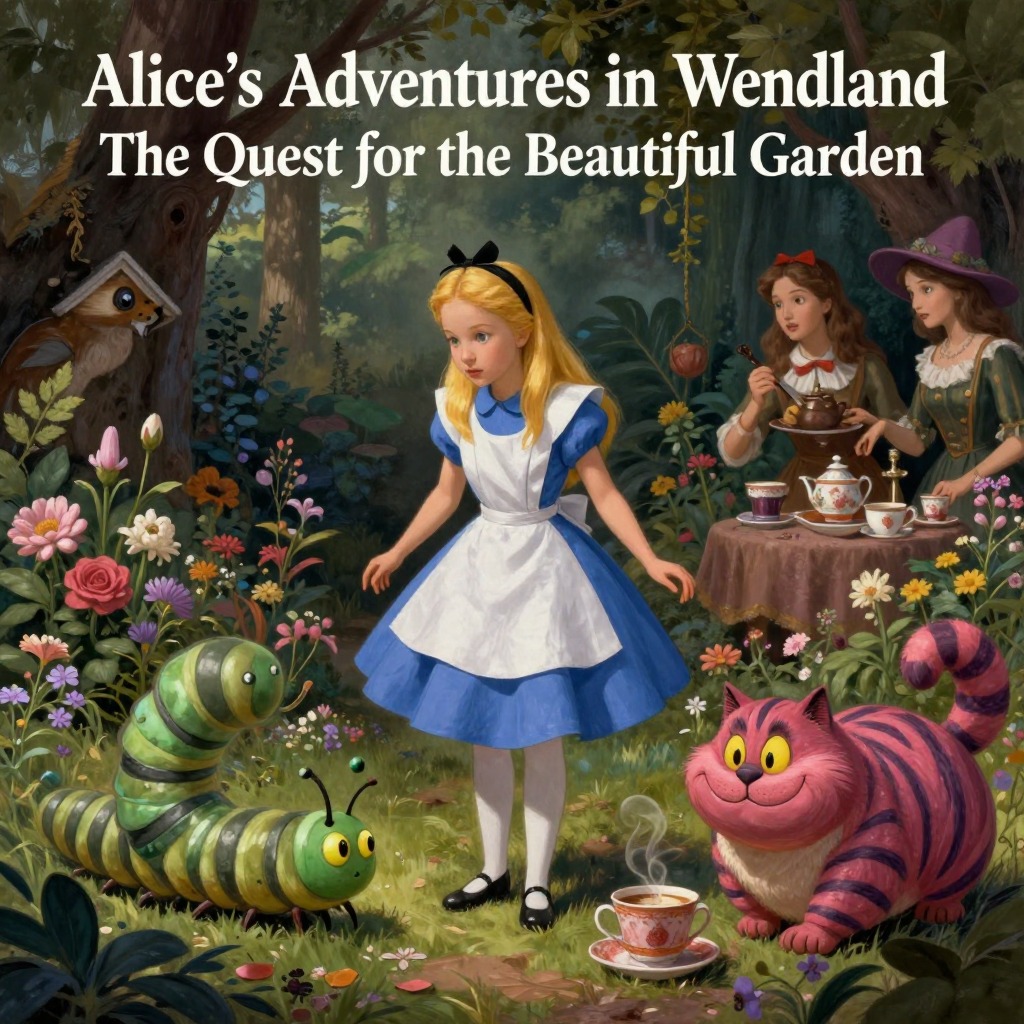
The Caterpillar is one of the most memorable and philosophically charged figures Alice encounters in Wonderland, a creature whose languid authority and cryptic instructions mark a turning point in her journey. Sitting atop a large mushroom and smoking a long hookah, the Caterpillar embodies the dream world's peculiar blend of menace and indifference. He is the first character to directly confront Alice with the question of her own identity, and he ultimately provides her with the key to controlling her bewildering size changes, setting her on a path toward the garden she so desperately seeks.
Identity and Introduction
Alice first sees the Caterpillar when she peers over the edge of a large mushroom, about the same height as herself, and finds a large blue caterpillar sitting on the top with its arms folded, quietly smoking a long hookah and taking not the smallest notice of her. The encounter begins with a long, silent stare before the Caterpillar speaks in a languid, sleepy voice. His opening question—"Who are you?"—is not an invitation to conversation but a challenge that immediately exposes Alice's own confusion. She replies that she hardly knows who she is at present, having been changed several times since that morning. The Caterpillar's stern demand that she explain herself, and his refusal to accept her answer, establishes him as an authority figure who operates on a logic entirely his own.
Arc Through the Plot
The Caterpillar's role is to test and provoke Alice, forcing her to articulate her predicament. When she tries to explain that being so many different sizes in a day is confusing, he flatly contradicts her, saying "It isn't." He then commands her to recite "You are old, Father William," and when her version comes out altered, he declares it wrong from beginning to end. This relentless contradiction pushes Alice to the brink of losing her temper, a state she has never experienced so intensely. Yet the Caterpillar's purpose is not merely to frustrate. After a long silence, he asks what size she wants to be, and when she expresses a wish to be a little larger than her current three inches, he angrily defends that height—being himself exactly three inches tall. Finally, before crawling away, he delivers the crucial information: "One side will make you grow taller, and the other side will make you grow shorter." This cryptic remark, referring to the mushroom, gives Alice the tool she needs to navigate Wonderland.
Relationships and Conflict
The dynamic between Alice and the Caterpillar is one of mutual incomprehension and power struggle. The Caterpillar's short, dismissive remarks—"You!" and "Why?"—irritate Alice, who has never been so contradicted in her life. He treats her attempts at polite explanation with contempt, yet he also commands her to come back when she tries to leave, claiming he has something important to say. This push-pull creates a tense relationship in which Alice must learn to assert herself against an authority that refuses to acknowledge her perspective. The Caterpillar's final gift of knowledge is not given kindly but as a parting remark, almost an afterthought, leaving Alice to puzzle out its meaning on her own.
Change and Ending
The Caterpillar's departure marks a significant shift in Alice's agency. Armed with the knowledge of the mushroom's properties, she is no longer a passive victim of random size changes. She breaks off pieces from each side and begins to experiment, first shrinking so rapidly that her chin strikes her foot, then growing an immense neck that a Pigeon mistakes for a serpent. Through careful nibbling, she eventually brings herself back to her usual height, and later reduces herself to nine inches to approach the March Hare's house. The Caterpillar thus serves as a gatekeeper who, by giving Alice the means to control her own body, enables her to move forward in her adventure.
Thematic Significance
The Caterpillar embodies the theme of identity crisis that runs through Alice's entire journey. His relentless questioning—"Who are you?"—echoes Alice's own internal puzzle, which she first articulated in the hall after her tears: "Who in the world am I?" The Caterpillar's refusal to accept her answers mirrors the dream world's resistance to the stable categories of the waking world. His own transformation from caterpillar to butterfly is a natural parallel to Alice's own physical changes, yet he insists that his own experience of change is not confusing. This contradiction highlights the arbitrary and subjective nature of identity in Wonderland. The Caterpillar is also a figure of pure authority without reason, a precursor to the Queen of Hearts, but his authority is exercised through language and logic games rather than threats of execution. He represents the kind of power that operates by making the other person feel inadequate, and Alice's ability to eventually move past him is a small but crucial victory in her struggle to make sense of a senseless world.