Cheshire Cat
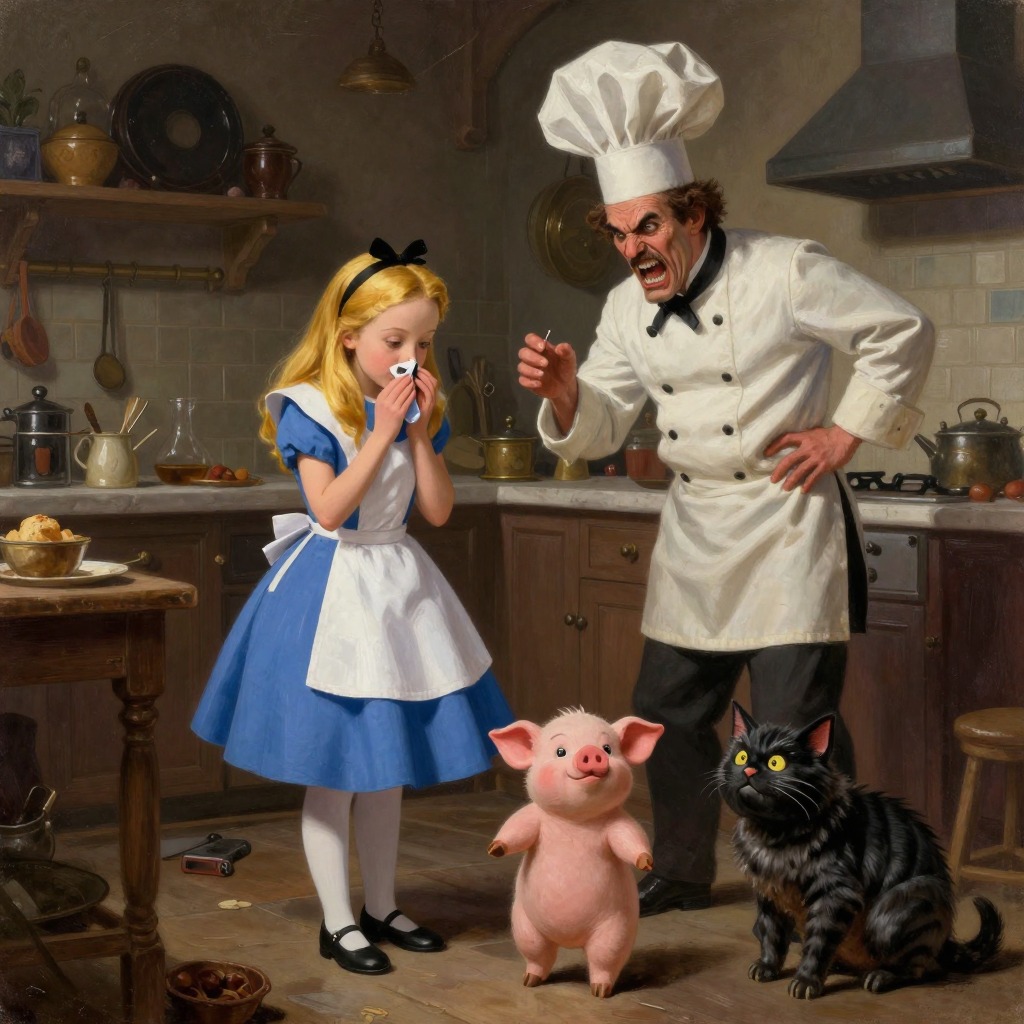
The Cheshire Cat is one of the most memorable and philosophically charged figures in Wonderland, a creature defined by its perpetual grin, its ability to vanish piece by piece, and its unsettlingly logical yet maddening conversation. First encountered in the Duchess's kitchen, where it sits on the hearth grinning from ear to ear while the cook throws dishes and the baby howls, the Cat is introduced as a phenomenon that defies ordinary expectation. When Alice asks why it grins, the Duchess curtly explains, "It's a Cheshire cat," as if the grin were a breed characteristic, and adds that most cats can and do grin—a claim Alice, who has never seen a grinning cat before, finds dubious. The Cat thus enters the story as a living paradox: a creature whose very existence challenges the boundary between the natural and the impossible.
Identity and Introduction
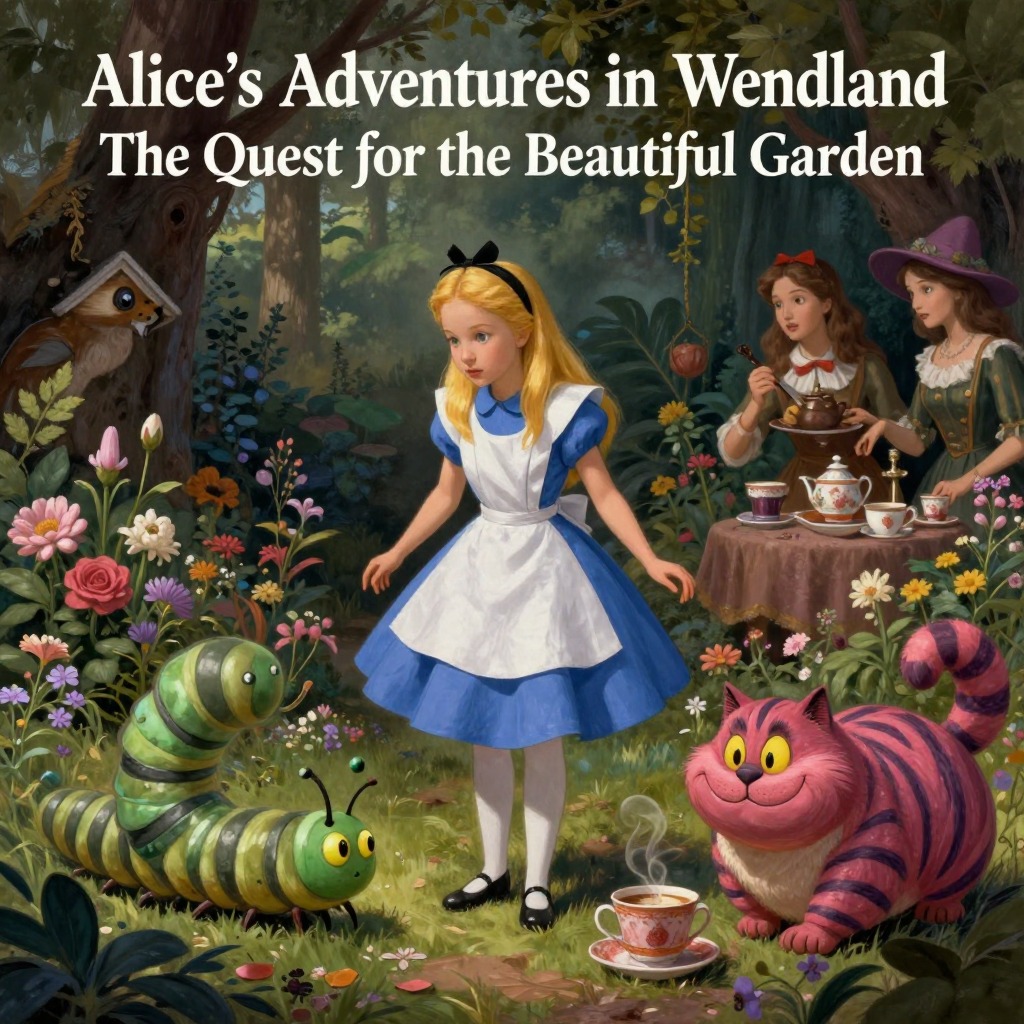
The Cheshire Cat first appears in the chaotic kitchen of the Duchess, sitting on the hearth and grinning while the cook stirs a cauldron of soup so heavily peppered that everyone except the cook and the cat sneezes constantly. Alice, struck by the incongruity of a smiling cat in such a violent setting, asks about it, and the Duchess's dismissive answer—"It's a Cheshire cat, and that's why"—offers no real explanation. The Cat's grin is its most salient feature, and it is this grin that Alice later sees floating in the air before the rest of the Cat appears, a detail that underscores its mastery over the boundaries of visibility and presence. When Alice next meets the Cat, it is sitting on a bough of a tree a few yards off, grinning at her. She notes that it looks good-natured but also has very long claws and a great many teeth, so she feels it ought to be treated with respect. She addresses it as "Cheshire Puss," a name the Cat accepts by grinning a little wider.
Conversations and Philosophy
The Cat's dialogue with Alice is among the most intellectually dense in the book. When Alice asks which way she ought to go, the Cat replies, "That depends a good deal on where you want to get to." When Alice says she doesn't much care where, the Cat responds, "Then it doesn't matter which way you go," and adds that she is sure to get somewhere if she only walks long enough. This exchange encapsulates the Cat's logical nihilism: in a world without fixed destinations, all paths are equivalent. When Alice asks what sort of people live nearby, the Cat tells her that in one direction lives a Hatter and in another a March Hare, and that both are mad. Alice protests that she doesn't want to go among mad people, but the Cat famously counters, "Oh, you can't help that—we're all mad here. I'm mad. You're mad." When Alice asks how it knows she is mad, the Cat replies, "You must be, or you wouldn't have come here." It then offers a proof of its own madness: a dog growls when angry and wags its tail when pleased, but the Cat growls when pleased and wags its tail when angry, therefore it is mad. Alice objects that she calls it purring, not growling, but the Cat dismisses the distinction. This exchange establishes the Cat as a philosopher of relativity, for whom madness is not a defect but a condition of existence in Wonderland.
Appearances and Disappearances
The Cat's most striking physical trait is its ability to appear and vanish at will, often leaving its grin behind as the last trace. When Alice first meets it outside the Duchess's house, the Cat vanishes after saying it will see Alice at the croquet game, then reappears just as suddenly. Alice, growing used to queer things, is not much surprised. The Cat asks what became of the baby, and when Alice says it turned into a pig, the Cat replies, "I thought it would," and vanishes again. Later, when Alice walks toward the March Hare's house, the Cat reappears on a branch and asks, "Did you say pig, or fig?" Alice asks it not to keep appearing and vanishing so suddenly, as it makes one quite giddy. The Cat obliges by vanishing slowly, beginning with the end of its tail and ending with the grin, which remains some time after the rest of it has gone. Alice reflects that she has often seen a cat without a grin, but never a grin without a cat—a moment that crystallizes the Cat's role as a figure who dismantles the ordinary relationship between part and whole, presence and absence.
Role in the Croquet Game
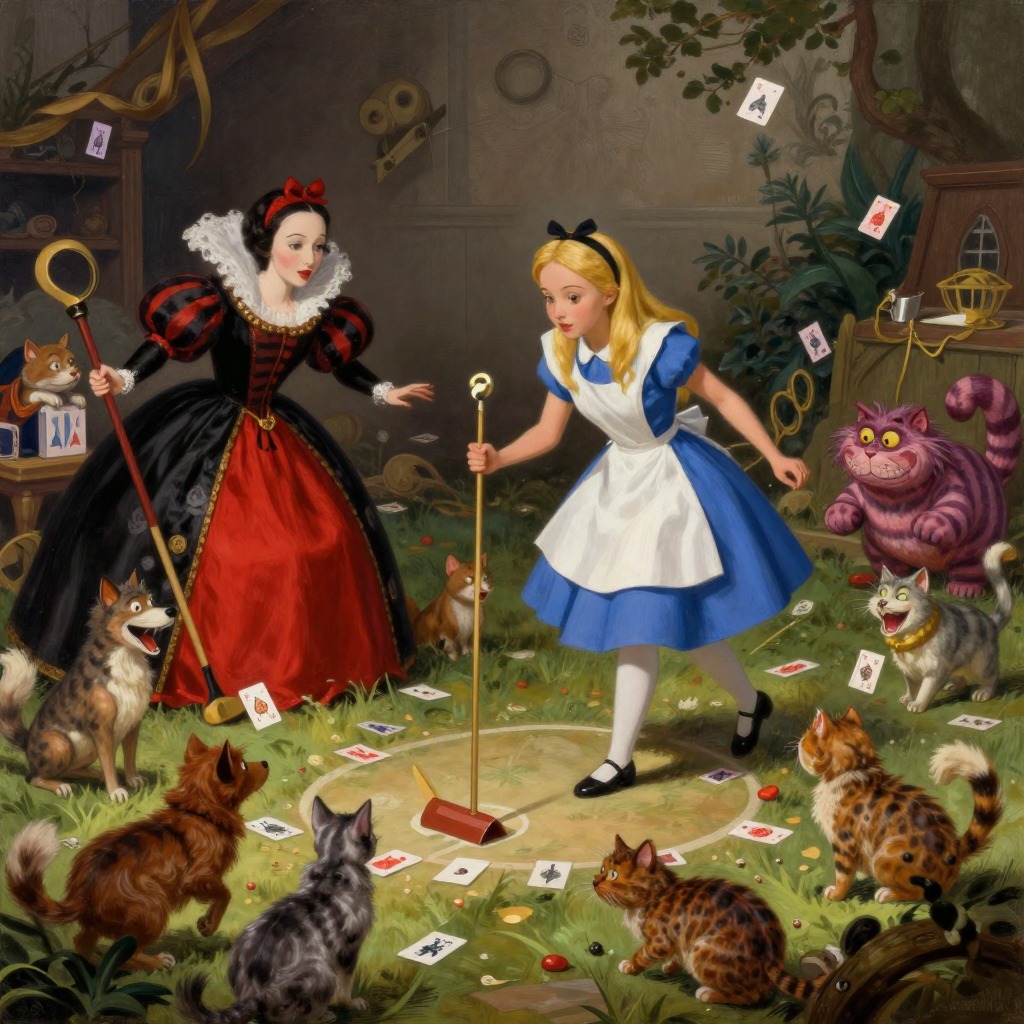
During the chaotic croquet game on the Queen's Croquet-Ground, the Cat appears again, this time as a disembodied grin that gradually resolves into a head. Alice, feeling uneasy about the Queen's frequent orders of execution, is glad to have someone to talk to. She complains to the Cat about the unfairness of the game—the players quarrel, there are no rules, the arches walk away, and the hedgehog runs off. When the Cat asks how she likes the Queen, Alice begins to say "she's so extremely—" but notices the Queen is listening and finishes with "—likely to win, that it's hardly worth while finishing the game." The King then notices the Cat's head and objects to its appearance, demanding that it be removed. The Queen, without even looking, orders its head cut off. The executioner argues that you cannot cut off a head without a body, the King argues that anything with a head can be beheaded, and the Queen threatens to execute everyone if something is not done. Alice suggests asking the Duchess, to whom the Cat belongs. The Queen sends the executioner to fetch the Duchess, but the Cat's head fades away entirely by the time they return, leaving the King and executioner running wildly up and down looking for it. This episode demonstrates the Cat's immunity to the Queen's power: it cannot be executed because it cannot be pinned down to a single, stable form.
Thematic Significance
The Cheshire Cat embodies the principle that in Wonderland, identity is fluid, logic is circular, and authority is absurd. Its grin, which persists after the body has vanished, is the ultimate symbol of a meaning that outlasts its material container—a smile without a face, a sign without a referent. The Cat's calm, detached manner contrasts sharply with the frantic energy of the Queen and the nervousness of the White Rabbit, making it the only character who seems genuinely at ease in Wonderland's chaos. Its pronouncements—"we're all mad here," "it doesn't matter which way you go"—are not merely whimsical but constitute a coherent philosophy of radical acceptance. The Cat is neither a friend nor an enemy to Alice; it is a mirror that reflects the absurdity of her situation and, by extension, the absurdity of any fixed system of meaning. In a world where everyone is constantly ordering, threatening, and contradicting, the Cheshire Cat simply grins and fades away, leaving Alice—and the reader—to wonder whether the grin was ever really there at all.