King of Hearts
The King of Hearts is the husband of the Queen of Hearts and the nominal ruler of Wonderland, yet he is a figure of almost complete powerlessness, a timid and bumbling monarch whose every attempt to assert authority is undercut by his wife's violent whims and his own intellectual inadequacy. He appears most prominently during the trial of the Knave of Hearts, where he serves as the judge, and his conduct there—a mixture of legalistic pedantry, cowardice, and helplessness—defines his character. He is the embodiment of a ruler who possesses the trappings of power—a crown, a throne, a courtroom—but none of its substance, and his narrative arc culminates in his complete failure to control either the proceedings or his own queen.
Identity and Role
The King of Hearts is introduced as part of the grand procession onto the Queen's Croquet-Ground, where he follows the Knave of Hearts, who carries the King's crown on a crimson velvet cushion. He is physically present but makes no initial impression, a pattern that holds throughout the story. His primary function is as the judge in the trial of the Knave of Hearts, a role he assumes by virtue of his position. He wears his crown over his wig, a detail that makes him look uncomfortable and is certainly not becoming, visually signaling his unsuitability for the dignity of his office. He is, in every sense, a figurehead.
Conduct During the Trial
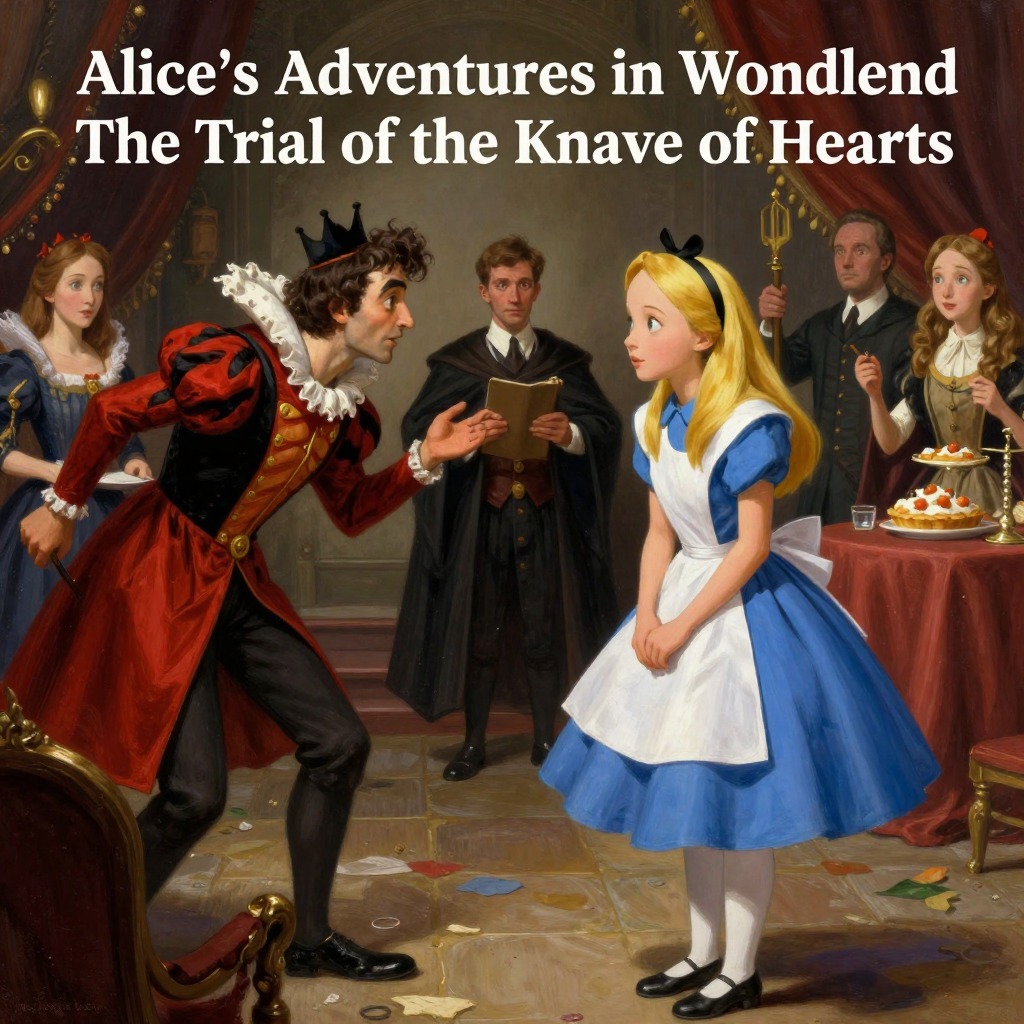
In the courtroom, the King of Hearts attempts to project authority through a series of legalistic gestures that are consistently absurd or counterproductive. He calls for silence, puts on his spectacles, and looks anxiously around. He instructs the jury to "Consider your verdict" prematurely, only to be corrected by the White Rabbit. He cross-examines witnesses with questions that reveal his own confusion, such as asking the Hatter when he began his tea and then demanding the jury write down the dates given by the Hatter, the March Hare, and the Dormouse, which the jury then adds up and reduces to shillings and pence. When the Hatter says his teacup is not his own, the King immediately declares it "Stolen!" and turns to the jury, who make a memorandum of the fact. He threatens the Hatter with execution for nervousness, a threat that does nothing to encourage the witness. When the cook refuses to give evidence, the King looks anxiously at the White Rabbit and, after being told he must cross-examine her, does so with a melancholy air, folding his arms and frowning until his eyes are nearly out of sight. His most famous judicial act is the invocation of "Rule Forty-two. All persons more than a mile high to leave the court," a rule he has clearly just invented, as Alice points out. When she challenges him, he turns pale and shuts his notebook hastily. He is utterly incapable of managing the chaos of his own court.
Relationship with the Queen of Hearts
The King of Hearts is completely dominated by his wife, the Queen of Hearts. He is the only character who dares to offer her even the mildest resistance, but he does so in a timid, almost apologetic manner. When the Queen screams "Off with her head!" at Alice, the King lays his hand upon her arm and says, "Consider, my dear: she is only a child!" This is his most courageous moment, but it is immediately undercut as the Queen turns angrily away from him. He is also the one who, after the Queen has ordered numerous executions, quietly announces to the company, "You are all pardoned," a gesture that reveals his fundamental decency but also his powerlessness to prevent the sentences in the first place. He is a passive figure who can only undo his wife's damage after the fact, and even then, only when she is not listening. His final attempt to reason with her—pointing out that the words of the accusatory verses do not fit her because she never had fits—is met with her throwing an inkstand at the Lizard.
Defiance and Collapse of Authority
The King of Hearts' authority, such as it is, collapses entirely when Alice confronts him. She directly contradicts his invented rule, argues with his interpretation of the evidence, and finally, when the Queen shouts "Off with her head!" and nobody moves, Alice declares, "Who cares for you? You're nothing but a pack of cards!" At this, the whole pack rises into the air and flies down upon her, and the dream ends. The King of Hearts is not even singled out for defiance; he is simply part of the collective "pack of cards" that Alice dismisses. His reign, such as it was, ends not with a bang but with a child's laugh, and he is revealed to be nothing more than a playing card in a dream.
Thematic Significance
The King of Hearts represents the impotence of arbitrary authority when it is not backed by genuine power or reason. He is a figure of legalism without justice, of rule without wisdom, and of kingship without courage. His constant, futile attempts to impose order on a chaotic trial mirror the larger absurdity of Wonderland, where rules are invented on the spot and the only consistent law is the Queen's whim. He is a comic figure, but his comedy is tinged with a critique of authority that is hollow at its core. In the end, he is not a tyrant but a pathetic functionary, a king who cannot even keep his own crown on straight.