Knave of Hearts
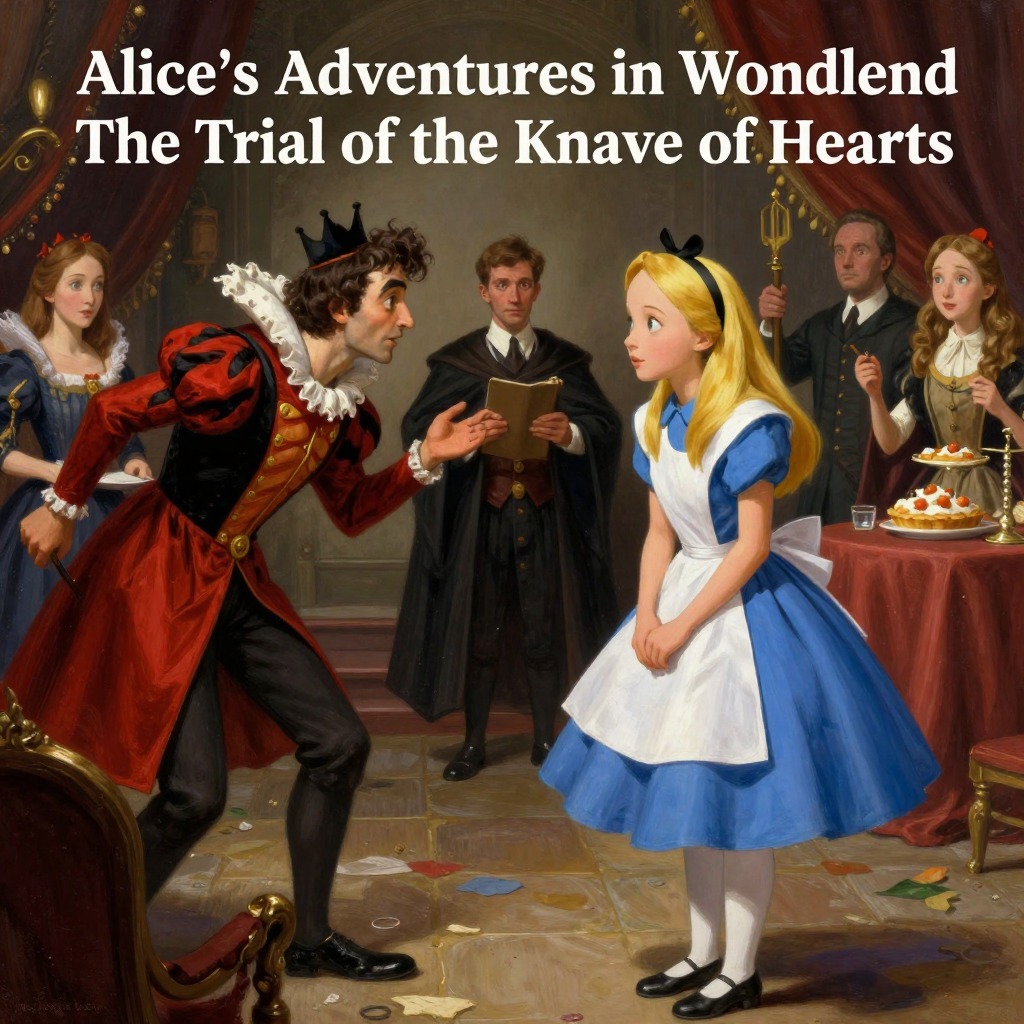
The Knave of Hearts is the central defendant in the trial that occupies the final two chapters of Alice's Adventures in Wonderland, a figure whose silent presence and cardboard construction make him less a character than a prop in the Queen of Hearts' arbitrary justice. He appears in the grand procession to the croquet-ground, carrying the King's crown on a crimson velvet cushion, and is later brought before the court in chains, with a soldier on each side to guard him. Throughout the proceedings, he speaks only once, to protest that he did not write the accusatory verses and that no name is signed at the end, a defense the King immediately twists into evidence of guilt. The Knave's passivity and near-muteness position him as the ultimate victim of Wonderland's legal farce, a figure whose fate is decided not by evidence but by the Queen's whims and the King's absurd interpretations.
Identity and Role
The Knave of Hearts is introduced as a member of the royal procession, walking after the guests and before the King and Queen of Hearts, carrying the King's crown on a crimson velvet cushion. He is one of the playing-card figures that populate the Queen's court, and his role is defined entirely by his position in the hierarchy: he is the Knave, a servant and attendant. When the Queen demands to know who Alice is, she turns to the Knave, who only bows and smiles in reply, earning him the Queen's impatient epithet "Idiot!" This early exchange establishes him as a figure who cannot or will not speak for himself, a characteristic that becomes central to his role in the trial.
The Trial and Accusation
The trial of the Knave of Hearts is the narrative center of the final chapters. He stands before the King and Queen of Hearts, in chains, with a soldier on each side, while the White Rabbit reads the accusation: "The Queen of Hearts, she made some tarts, / All on a summer day: / The Knave of Hearts, he stole those tarts, / And took them quite away!" The Knave offers no defense beyond a single statement: "I didn't write it, and they can't prove I did: there's no name signed at the end." This protest is immediately dismissed by the King, who argues that the absence of a signature only makes the matter worse, as an honest man would have signed his name. The Queen declares, "That proves his guilt," and the court proceeds as if the case is already decided.
The Evidence and Its Meaninglessness
The central piece of evidence against the Knave is a set of verses that the White Rabbit produces, claiming they were written by the prisoner to somebody. The verses are a confusing jumble of pronouns and actions—"They told me you had been to her, / And mentioned me to him"—that Alice declares have "not an atom of meaning in it." The King, however, attempts to interpret them as a confession, pointing to phrases like "I gave her one, they gave him two" as proof that the Knave stole the tarts. Alice's logical objections—that the verses also say "they all returned from him to you"—are ignored. The trial thus becomes a demonstration of how meaning can be imposed on nonsense to serve the interests of power, with the Knave as the silent object of this process.
The Sentence and Alice's Intervention
As the trial reaches its climax, the Queen demands "Sentence first—verdict afterwards," a reversal of legal procedure that Alice loudly condemns as "Stuff and nonsense!" When the Queen orders "Off with her head!" and nobody moves, Alice declares, "Who cares for you? You're nothing but a pack of cards!" At this, the entire pack rises into the air and flies down upon her, and Alice wakes from her dream. The Knave's fate is never resolved within the dream; he remains a figure whose guilt or innocence is irrelevant to the Queen's desire for execution. His role is to be the passive recipient of the Wonderland legal system's absurdity, a cardboard figure whose only function is to be accused, tried, and nearly condemned.
Thematic Significance
The Knave of Hearts embodies the theme of arbitrary justice that runs through Alice's Adventures in Wonderland. He is a character without agency, a silent defendant whose guilt is assumed from the start and whose only defense is dismissed through circular reasoning. His trial parodies the legal system, reducing it to a series of meaningless rituals—the jury writing down "stupid things!" on their slates, the King inventing rules on the spot, the Queen demanding execution before verdict. The Knave's cardboard construction ("being made entirely of cardboard") literalizes his lack of substance: he is a flat figure in a flat world, a target for the Queen's fury rather than a person with a story. Alice's final act of defiance—declaring the court "nothing but a pack of cards"—dissolves the entire legal apparatus, including the Knave, back into the dream from which they came.