Josef Hamacher
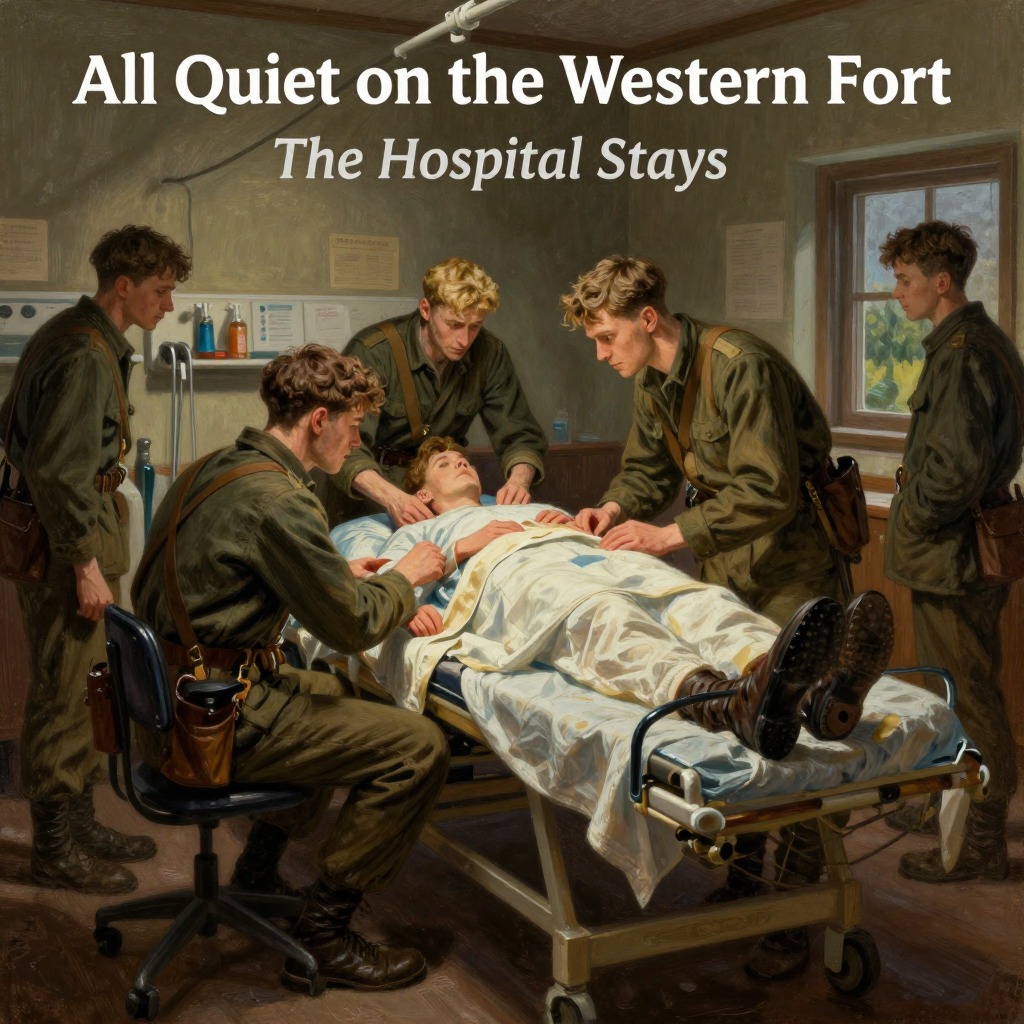
Josef Hamacher is a reinforcement-reservist who, after receiving a head wound, was given a medical certificate declaring him periodically not responsible for his actions. This document, which he calls his "shooting licence," grants him near-total immunity from the consequences of his behavior, and he uses it with cheerful audacity to protect himself and his fellow wounded soldiers from the petty tyrannies of hospital routine.
Identity and Background
Hamacher is a man of bristling beard and blunt speech, who has been in the hospital long enough to know every corner of its grim machinery. He is the oldest and most experienced patient in the ward, and he takes it upon himself to educate the newcomers. He knows, for instance, that the small room at the corner of the building is called the "Dying Room"—a place where those about to die are moved for the convenience of the staff and to spare the other patients the sight of death. He explains this with matter-of-fact authority, and when a patient is taken there, Hamacher is the one who pronounces the verdict: "Once a man is in there, he never comes through." His knowledge extends to the hospital's medical politics as well. When the chief surgeon proposes to operate on two young soldiers for flat feet, Hamacher warns them that the operation is a "special scientific stunt" of the old man's, one that will leave them with club feet instead of flat ones, crippled for life. He tells them to refuse, and he is the one who explains that the war is a "glorious time" for surgeons who want experimental subjects.
Role in the Hospital
Hamacher's shooting licence makes him fearless. When the patients are woken at seven each morning by the sisters' prayers, with the door left open so that the men can share in the devotion, Hamacher is the one who takes action. After a bottle is thrown into the corridor to silence the praying, the hospital inspector arrives and demands to know who did it. Before Paul Bäumer can confess, Hamacher claims the act as his own. When the others protest, he grins and explains: "That doesn't matter. I have a shooting licence." He knows that no one dares to punish him, and he uses this power to shield the entire ward. He promises that if the door is opened again the next morning, they will pitch another bottle. His presence transforms the dynamic of the room: with Hamacher in their midst, the men feel they can risk anything.
Relationships and Influence
Hamacher is not a solitary rebel; he is a communal protector. He is the one who, when a patient begins to hemorrhage in the night and the sister does not answer the bell, suggests smashing a bottle to get her attention. He is the one who, when the chief surgeon tries to pressure the young soldiers into the flat-foot operation, gives them the practical advice to say no. He is the one who, when a patient is taken to the Dying Room and later returns alive—a thing Hamacher has never seen before—admits his error with good grace. He is respected not because he is a hero, but because he has found a loophole in the system and uses it for the common good. His presence gives the other men a sense of security in a place where they are otherwise helpless.
Thematic Significance
Hamacher embodies a darkly comic resistance to the institutional machinery that grinds up soldiers' bodies and wills. His shooting licence is a bureaucratic absurdity that, by accident, grants him a freedom the other men lack: the freedom to act without fear of punishment. He is a living illustration of the arbitrary power of paperwork in a system that claims to be rational. His cheerful, profane, and utterly practical approach to survival—he lies about throwing the bottle, he warns the young soldiers, he knows the hospital's secrets—makes him a figure of sanity in a world gone mad. He is not a tragic figure; he is a survivor, and his survival depends on his willingness to exploit the system's own absurdities. In a novel filled with death and despair, Hamacher is a reminder that even in the most hopeless circumstances, a man can still find a way to laugh, to protect his friends, and to spit in the face of authority.