Mittelstaedt
Mittelstaedt is a former classmate of Paul Bäumer, one of the twenty young men from the same school class who, under the patriotic exhortations of their schoolmaster Kantorek, volunteered for military service at the outbreak of the First World War. Like Paul, Albert Kropp, Müller, and the others, Mittelstaedt was shaped by the same pre-war education that taught duty to country above all, and he too was sent into the trenches. But his path diverges when he is wounded and sent to a hospital, then assigned to a training camp in the rear, where he encounters Kantorek again — this time as a newly conscripted territorial soldier under Mittelstaedt's command. This reversal of roles becomes the stage for a deliberate, almost theatrical humiliation that Mittelstaedt orchestrates with a cold precision born of resentment and a clear-eyed understanding of the system he now controls.
Identity and Background
Mittelstaedt is introduced as one of the classmates who, like Paul, was subjected to Kantorek's relentless pressure to enlist. Kantorek, a stern little man in a grey tailcoat with a face like a shrew mouse, gave long lectures until the whole class went to the District Commandant and volunteered. Among them was Joseph Behm, who hesitated but was persuaded, and who became one of the first to fall — shot down in No Man's Land after being left for dead. The narrative makes clear that Kantorek's influence, though indirect, had lethal consequences. Mittelstaedt, like the others, trusted the authority of his teachers, believing they possessed greater insight and a more humane wisdom. But the first deaths shattered that belief, and under the first bombardment, the world as the teachers had taught it broke in pieces. Mittelstaedt's later actions are rooted in this disillusionment.
Reversal of Power and Revenge
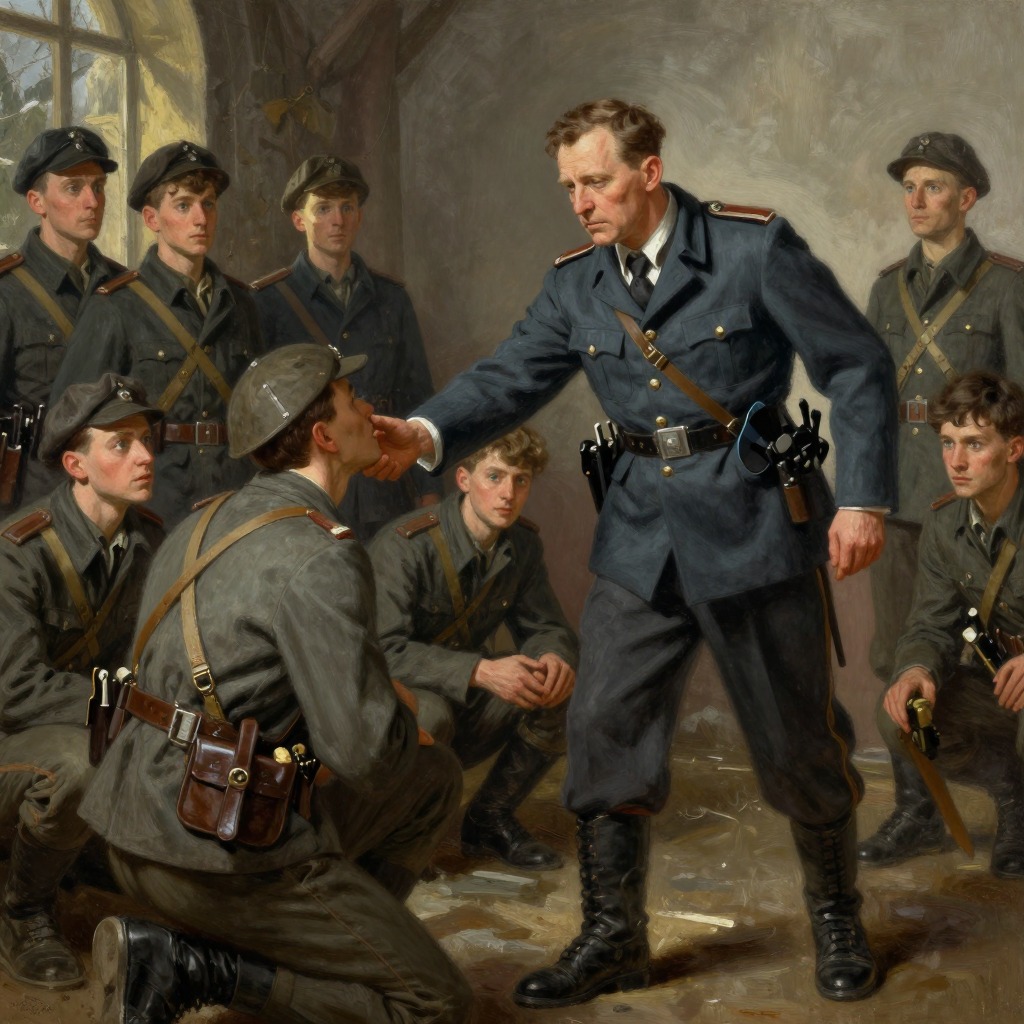
When Mittelstaedt returns from the hospital and finds Kantorek now a territorial under his command, he seizes the opportunity with a calculated cruelty that mirrors the schoolmaster's own methods. He forces Kantorek to stand to attention, addresses him as "Territorial Kantorek," and reminds him of Joseph Behm's death: "Two years ago you preached us into enlisting; and among us there was one, Joseph Behm, who didn't want to enlist. He was killed three months before he would have been called up in the ordinary way. If it had not been for you he would have lived just that much longer." He then dismisses him with a curt "Dismiss. You will hear from me later." Mittelstaedt has himself put in charge of Kantorek's company, and his first act is to fit Kantorek out with a deliberately absurd uniform: a faded blue tunic that must have belonged to a giant, black breeches too short, boots much too big, and a tiny, dirty cap. The effect is pitiful, and Mittelstaedt parades him before the company, stopping in front of him to say, "Territorial Kantorek, do you call those buttons polished? You seem as though you can never learn. Inadequate, Kantorek, quite inadequate" — echoing the very phrase Kantorek used to chastise him at school.
The Humiliation of Kantorek
Mittelstaedt's revenge is systematic and public. He makes Kantorek squad leader during skirmishing practice, a role that forces him to dash back and forth forty paces at every about-turn, a classic Himmelstoss recipe. He then orders the entire company to creep on hands and knees, and Kantorek, breathing hard, shoves his absurd figure over the sand while Mittelstaedt quotes Kantorek's own patriotic phrases back at him: "Territorial Kantorek, we have the good fortune to live in a great age, we must brace ourselves and triumph over hardship." During physical exercises, Mittelstaedt seizes Kantorek by the seat of his trousers as he pulls himself up on the horizontal bar, exactly as Kantorek used to do to him. He also details Kantorek and the school porter Boettcher — now a model soldier — to bread fatigue, sending them through the whole town pushing a handcart, a spectacle that has already become a local amusement. When Paul asks if Kantorek has reported him, Mittelstaedt replies that the Company Commander laughed at the story, and that he is "sweet with his daughter." He dismisses the possibility of Kantorek messing up his examination with contempt: "I don't care."
Narrative Role and Thematic Significance
Mittelstaedt's episode serves as a darkly comic but deeply serious illustration of the war's power to invert the hierarchies of the pre-war world. The schoolmaster who once embodied unquestionable authority is reduced to a sweating, ridiculous figure in an ill-fitting uniform, while his former pupil, now a hardened soldier, wields that authority with a vengeance. The scene exposes the hypocrisy of the patriotic rhetoric that sent a generation to die, and it shows how the war has stripped away the old illusions, leaving only the raw realities of power and survival. Mittelstaedt's revenge is not merely personal; it is a symbolic act of retribution against the entire system of education and authority that deceived them. Yet the episode also carries a bitter irony: Mittelstaedt, in his cruelty, has become a version of the very oppressor he despises, using the army's arbitrary power to torment a man who is now as helpless as they once were. The scene is one of the few moments of overt, satisfying revenge in the novel, but it is undercut by the knowledge that such small victories change nothing about the war itself. Mittelstaedt, like Paul, will eventually return to the front, and his moment of triumph is a fleeting one in the face of the ongoing slaughter.