Mollie
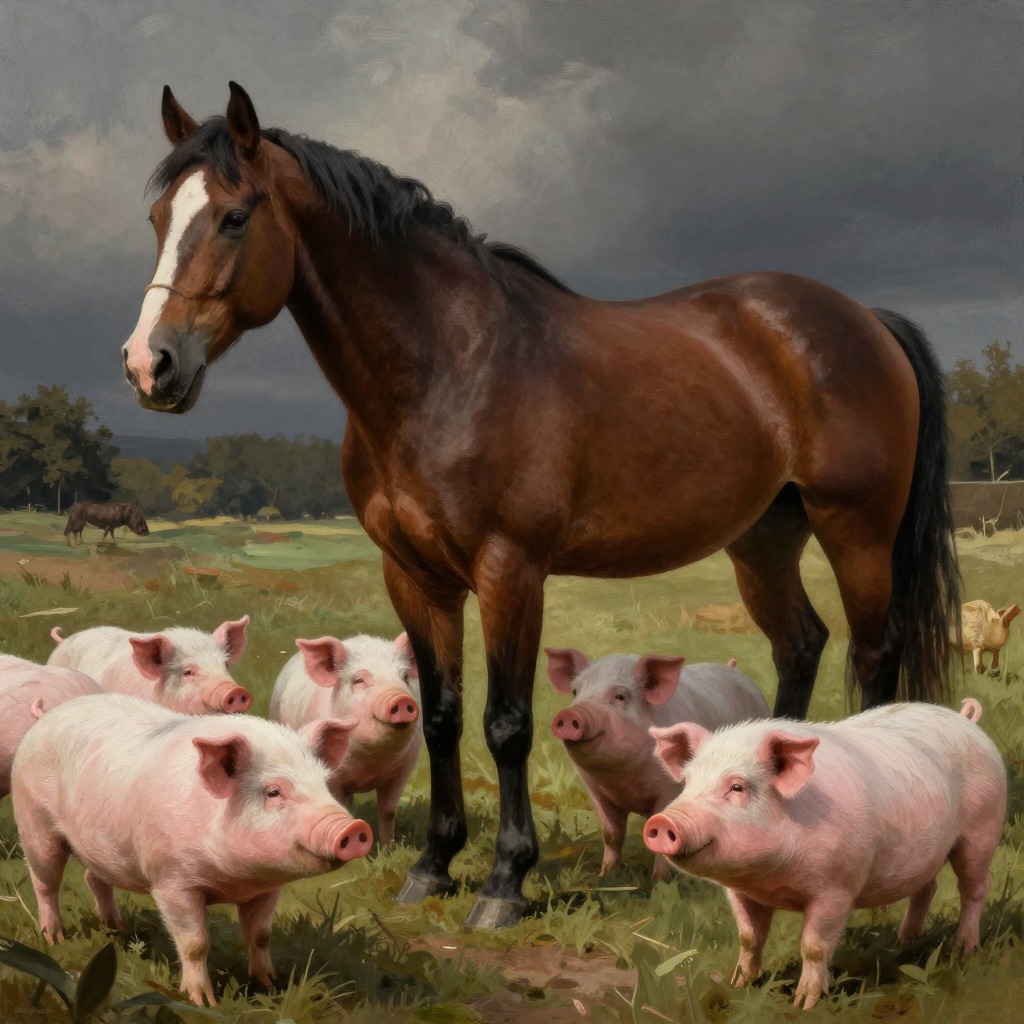
Mollie, the foolish, pretty white mare who drew Mr. Jones's trap, is one of the most vivid examples in Animal Farm of an animal who never truly internalizes the principles of Animalism. From her first appearance, she is defined by her attachment to the small luxuries and ornaments of her former life, and her trajectory—from reluctant revolutionary to voluntary exile—serves as an early warning about the fragility of collective commitment when individual desires are not transformed.
Identity and Introduction
Mollie is introduced on the night of Old Major's speech as the last to arrive at the big barn, "mincing daintily in, chewing at a lump of sugar." She takes a place near the front and begins "flirting her white mane, hoping to draw attention to the red ribbons it was plaited with." This entrance establishes her as vain, pleasure-seeking, and fundamentally unserious about the political awakening that is about to unfold. She is the only animal who, during Major's entire oration, is preoccupied with her own appearance rather than the message of liberation. Her name itself—a diminutive, almost childish form—underscores her immaturity and self-absorption.
Life and Plot Trajectory
Mollie's engagement with the Rebellion is superficial from the start. During the secret meetings where the pigs expound the principles of Animalism, she asks the most trivial questions. Her very first question to Snowball is: "Will there still be sugar after the Rebellion?" When Snowball firmly answers no, she immediately follows up with: "And shall I still be allowed to wear ribbons in my mane?" Snowball explains that ribbons are "the badge of slavery" and that liberty is worth more, but Mollie "agreed, but she did not sound very convinced." This exchange reveals that her primary concern is not freedom from human tyranny but the preservation of her personal comforts. After the Rebellion succeeds and the animals take over the farm, Mollie's behavior does not improve. While the other animals work with unprecedented dedication to bring in the hay harvest, Mollie is "not good at getting up in the mornings, and had a way of leaving work early on the ground that there was a stone in her hoof." She is one of the few animals who shirks her duties, and her excuses are transparently self-serving. Her vanity persists even in the new order: when the animals explore the farmhouse, Mollie is discovered missing, having stayed behind in the best bedroom, where she "had taken a piece of blue ribbon from Mrs. Jones's dressing-table, and was holding it against her shoulder and admiring herself in the glass in a very foolish manner." The others reproach her sharply, but the incident shows that her attachment to human adornments has not diminished.
Key Actions and Objectives
Mollie's most significant actions are acts of disloyalty and eventual desertion. Clover, the motherly mare, confronts Mollie after seeing her talking to a man from Foxwood Farm on the other side of the hedge. The man was stroking Mollie's nose. Mollie denies it, but "she could not look Clover in the face, and the next moment she took to her heels and galloped away into the field." Clover then searches Mollie's stall and finds, hidden under the straw, "a little pile of lump sugar and several bunches of ribbon of different colours." This cache of forbidden items—sugar and ribbons, the very things she had asked about—proves that Mollie has been secretly maintaining her old habits and has been in contact with humans. Three days later, Mollie disappears. The pigeons later report seeing her on the other side of Willingdon. She is between the shafts of a smart dogcart painted red and black, standing outside a public-house. A fat red-faced man in check breeches and gaiters, who looks like a publican, is stroking her nose and feeding her with sugar. Her coat is newly clipped, and she wears a scarlet ribbon round her forelock. She appears to be enjoying herself. None of the animals ever mention Mollie again.
Relationships and Conflict
Mollie's primary relationship is with Clover, who acts as a concerned elder. Clover is the one who confronts Mollie about her contact with the human from Foxwood, and it is Clover who discovers the hidden sugar and ribbons. The dynamic is one of maternal disappointment: Clover represents the collective values of the farm, while Mollie represents the individual who cannot subordinate her personal desires to the common good. Mollie has no meaningful relationship with the pigs or the other workers; she is isolated by her own frivolity. Her conflict is not with any single animal but with the entire ethos of Animal Farm. She is unable to accept that the Rebellion demands sacrifice and that the old pleasures—sugar, ribbons, human admiration—are now forbidden. Her departure is not a dramatic confrontation but a quiet, shameful exit, and she is never spoken of again, as though the farm simply erases her from its memory.
Change and Ending
Mollie undergoes no internal transformation. She does not grow, learn, or develop a commitment to the cause. Instead, she regresses to her pre-Rebellion state, choosing the comfort and vanity of human servitude over the uncertain freedom of animal self-governance. Her ending is a return to the old order: she becomes a well-fed, well-groomed carriage horse for a publican, wearing a scarlet ribbon and receiving sugar. The pigeons' report makes clear that she is happy in this role. Her disappearance is a quiet defeat for the ideals of the farm, but it is also a relief: the animals never mention her again, as if her defection is too embarrassing or painful to acknowledge. She is the only animal who voluntarily leaves Animal Farm to return to human ownership, and her fate underscores the novel's argument that not all creatures are capable of sustaining the discipline required for genuine liberation.
Narrative Role and Evaluation
Mollie functions as a foil to the more committed animals, particularly Boxer and Clover. Where Boxer's motto is "I will work harder," Mollie's unspoken motto is "I will have my sugar and ribbons." She represents the individual who cannot see beyond her own immediate gratifications and who therefore becomes a liability to any collective project. Her early departure from the narrative—she is gone by Chapter V—means that she does not witness the later tyrannies of Napoleon's regime, but her absence also means that she never has to face them. In a sense, she escapes both the hard work of building the new society and the horrors of its corruption. Her story is a cautionary tale about the limits of revolutionary commitment: some will always prefer the familiar comforts of subjugation to the uncertain rigors of freedom. Mollie is a flat character in E. M. Forster's sense—built around a single idea of vanity and self-interest—but she is effective precisely because she is so recognizable. She is the one who asks, in the midst of a revolution, "What about my ribbons?"